
Working paper · Prepared for EuroSEAS 2026
Not All Political Dynasties Are Equal: How Organizational Structure Shapes Dynastic Persistence
Nico Ravanilla
In brief
Political dynasties are usually explained by inheritance across generations. Close-election regression discontinuities across the universe of Philippine elections since 1992 show persistence also depends on how a family arranges itself across offices: most configurations add nothing, but families holding both the mayoralty and the district's House seat retain power 36 percentage points more often, and they redirect national public works toward the village-level projects that sustain local political machines.
Abstract
Existing research explains the persistence of political dynasties through intertemporal succession: families transmit incumbency advantages, connections, and political capital across generations. I argue that persistence also depends on organizational structure. Although political families routinely occupy multiple elected offices simultaneously in different configurations, research has largely treated dynasties as organizationally homogeneous. Using the universe of Philippine elections from 1992 to 2025, I exploit close elections in regression discontinuity designs to isolate the electoral effects of different configurations among established political families. Most provide little additional advantage. Simultaneously holding the mayoralty and governorship, for example, does not increase persistence. However, families controlling both the mayoralty and the district's House seat become substantially more entrenched. Evidence on the mechanism shows that this configuration redirects national public works toward village-level projects that sustain local political machines. Dynastic persistence therefore depends not only on intertemporal succession but also on how political families organize power across elected offices.
Research annotationQuestion, variables, design, findings, and mechanism at a glance▾
- Research question
- Does a dynasty's persistence depend on how the family organizes itself across offices, over and above the advantages transmitted through intertemporal succession, and which configurations matter?
- Independent variable (X)
- The organizational configuration of an established political family: which offices it holds simultaneously alongside the mayoralty, including municipal council, provincial board, vice-mayor, vice-governor, governor, and the district's House seat. Causal estimates take one organizational link at a time, since the largest family organizations are too rare for credible discontinuity designs, so each estimate is the marginal contribution of a single link.
- Dependent variable (Y)
- Whether the family retains the mayoralty at the next election and the margin by which it wins, with term-limited handovers to a relative coded as continued organizational incumbency rather than exit. The mechanism analysis adds nationally financed public works per voter by project type from Department of Public Works and Highways contracts, 2005 to 2018, and forty-five municipal revenue and expenditure outcomes.
- Identification strategy
- Two complementary close-election regression discontinuity designs on the universe of Philippine elections from 1992 to 2025, roughly 628,000 candidacies across twelve synchronized cycles in about 1,600 municipalities. The first uses close mayoral races, with the tied candidate's vote margin at t as the running variable, so families that narrowly win and narrowly lose the mayoralty are otherwise comparable. The second conditions on families already governing the mayoralty and fielding a relative for the allied office, and exploits close elections for that office, isolating the marginal contribution of completing the configuration while holding the family fixed. Both use local linear regression with MSE-optimal bandwidths and robust bias-corrected inference following Calonico, Cattaneo, and Titiunik (2014), with density and balance diagnostics in the appendix. The public works analysis uses 8,031 municipality-cycle observations with municipality and election-cycle fixed effects, log votes cast, and standard errors clustered by province, with Holm adjustments across all eleven project types.
- Main findings
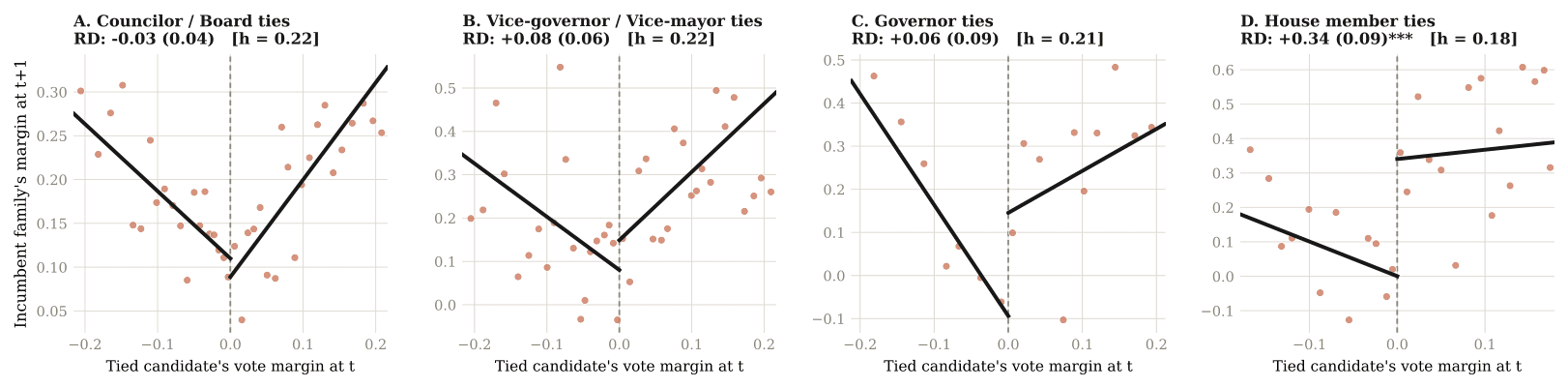
- Persistence is a threshold, not a gradient. Ties to municipal councils and provincial boards (-0.03, SE 0.04 on margin), vice offices (+0.08, SE 0.06), and even governorships (+0.06, SE 0.09) add little or nothing and are precisely estimated. Families simultaneously controlling the mayoralty and the district's House seat retain the mayoralty 36 percentage points more often and win by margins 34 points larger (SE 0.09), a premium significantly larger than every other configuration (pairwise Wald p = .005 to .03). The symmetric design reproduces the pattern on different elections, running variables, and compliers: narrowly gaining the House seat raises retention by 23 points and margins by 22, while narrowly gaining any other office does nothing. Descriptively, mayors whose families also hold the district's House seat win 91 percent of the races they contest and run unopposed roughly twice as often as mayors with no concurrent family officeholding.
- Mechanism
- The House seat adds resources the mayoralty cannot generate, and the money shows up where machines are fed. Across forty-five municipal revenue and expenditure outcomes only one is statistically significant, so the advantage does not run through municipal finances. It appears instead in nationally financed public works: the mayor-House pairing leaves total public works spending unchanged but shifts its composition, raising multi-purpose buildings by 0.498 log points (SE 0.192) and barangay roads by 0.449 (SE 0.170), the small, geographically targeted projects that can be directed toward villages and the local brokers who mobilize votes, with no comparable pattern under governor or local-network configurations. The pairing thus links the local organization that mobilizes votes to the national resources that sustain it.
- Why it matters
- Separates organizational structure from intertemporal succession as a source of dynastic persistence, showing that simultaneous officeholding by itself is not enough: structure generates additional persistence only when it combines offices controlling complementary resources for sustaining political support. Existing estimates of dynastic advantage may conflate the two mechanisms.
- Speaks to
- political dynasties and elite persistenceclose elections and regression discontinuity designsdistributive politics and discretionary fundsclientelism and political machinesPhilippine and Southeast Asian politics
Cite
@misc{ravanilla_dynasties,
  title = {Not All Political Dynasties Are Equal: How Organizational Structure Shapes Dynastic Persistence},
  author = {Nico Ravanilla},
  howpublished = {Working paper},
}