- 6.1%
- People using generative AIMicrosoft AI Diffusion Report, 2026-Q2
- 0.2
- Claude use per personAnthropic Economic Index, 2026-05
- 117
- ChatGPT messages per person, world rankOpenAI Signals, 2026-Q2
01
Who is using AI
02
What governments are doing
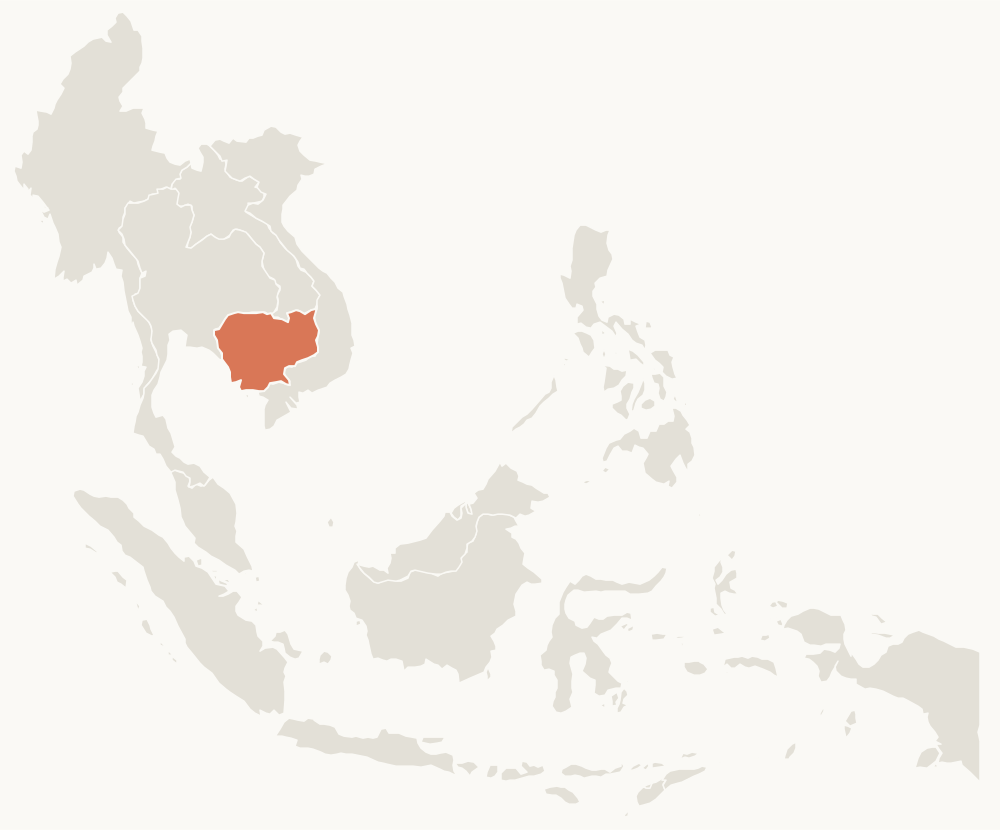
Cambodia
Verified September 29, 2026
- Strategy
- Draft National Artificial Intelligence Strategy 2025-2030Draft, 2025
- AI law
- None
- Data law
- Draft Law on Personal Data ProtectionDraft
- Sector rules
- Revision of the guidelines on technology and cyber risk management for banks and financial institutions (reported in the Annual Supervision Report 2025)2025The central bank names AI among emerging technologies driving its ongoing revision of technology-risk guidance, but no AI-specific NBC prakas or guideline has been issued.
- Law on Combating Technology-Based Fraud (five chapters, 24 articles), promulgated 2026-04-06, in force 2026-04-072026Creates five offences around online scam operations, including illicit collection of personal data; officials framed AI-enabled fraud as an enforcement target, but the text does not regulate AI systems.
- ICT and AI Competency Framework for Teachers (in development under STEPCam Phase II)2025A teacher-competency roadmap announced at the first National AI for Education Conference on 2025-11-24; not yet a published ministry instrument.
Naming: the strategy is 'National Artificial Intelligence Strategy 2025-2030' (Khmer: yuttheasastr cheat sdeipi panha sippanimmit 2025-2030); MPTC still labels it 'Draft'. The only public English text is the June 2025 consultation version (v5), mirrored by Open Development Cambodia and OECD.AI; no PDF was found on mptc.gov.kh or ai.gov.kh. MPTC's April 2025 press release targeted approval by the National Digital Economy and Society Council in August 2025 and a National AI Governance Framework by December 2025; neither had appeared by September 2026, and the PM's 17 July 2026 speech and CADT's 22 September 2026 UNESCO forum report both describe adoption as still ahead. Lead agency is contested in secondary sources: Lex Mundi and some trackers name MISTI, but the government's own documents give MPTC the drafting and coordination role, with MISTI as co-owner of the ai.gov.kh portal and author of the April 2026 ESCAP report. Two further bills matter for AI but are not AI laws: the draft Law on Cybersecurity was in technical review with the Ministry of Justice in July 2026 (MPTC page dated 2026-07-08), and a separate Interior-ministry Cybercrime Law has been in draft since 2020 with no 2026 movement found. The Law on Combating Technology-Based Fraud is variously translated as Anti-Technology Fraud Law, Anti-Online Fraud Law or Law on Combating Online Scams; the Royal Kram number was not located, and the AKP (state news agency) page was used in place of a gazette. The Digital Economy and Society Policy Framework 2021-2035 (2021, MEF/Supreme National Economic Council) and Digital Government Policy 2022-2035 (2022, MPTC) are the umbrella policies the AI strategy sits under; their PDFs were unreachable, so they are not entered as separate rows. No AI-specific instruments from the National Bank of Cambodia, the health ministry, the election commission or the telecoms regulator were found; the sectorRules entries are adjacent instruments and are labelled as such. Web search budget was exhausted before a final sweep of September 2026 news, so a very recent adoption announcement cannot be fully excluded; the MPTC English news archive for August and September 2026 showed none.
03
What researchers are finding
CambodiaLanguage and models
THA: Weighted Finite-State Text Normalization and Inverse Text Normalization for Khmer
Releases the first maintained open-source tool for turning written Khmer numbers and symbols into spoken words and back, which got almost all test cases right despite Khmer having no spaces between words.
Preprint · September 25, 2026 · arXiv 2609.30984
 Southeast Asia, Indonesia +6
Jobs and the economy
Generative AI and labour markets in ASEAN: Significant exposure, limited disruption, uneven preparedness
Puts nearly 80 million ASEAN workers (22.9 percent of employment) in GenAI-exposed occupations yet finds no sign of broad displacement so far, with women overrepresented in the most exposed jobs and a gap between exposure and institutional readiness.
Report · July 8, 2026 · ILO Brief
CambodiaLanguage and models
A Comparative Study of Language Models for Khmer Retrieval-Augmented Question Answering
Compares embedding and generation models in a retrieval-augmented QA system over Khmer telecom documents, one of the few LLM studies with Khmer as the primary case.
Preprint · May 21, 2026 · arXiv 2605.22099
CambodiaJobs and the economy
Digital Insights: The Future of AI for Development (Issue 01/2026)
Collects Cambodian applied research on using AI in agriculture, SMEs and public administration to map readiness and suggest policy paths.
Report · February 19, 2026 · CADT / KAS Digital Insights
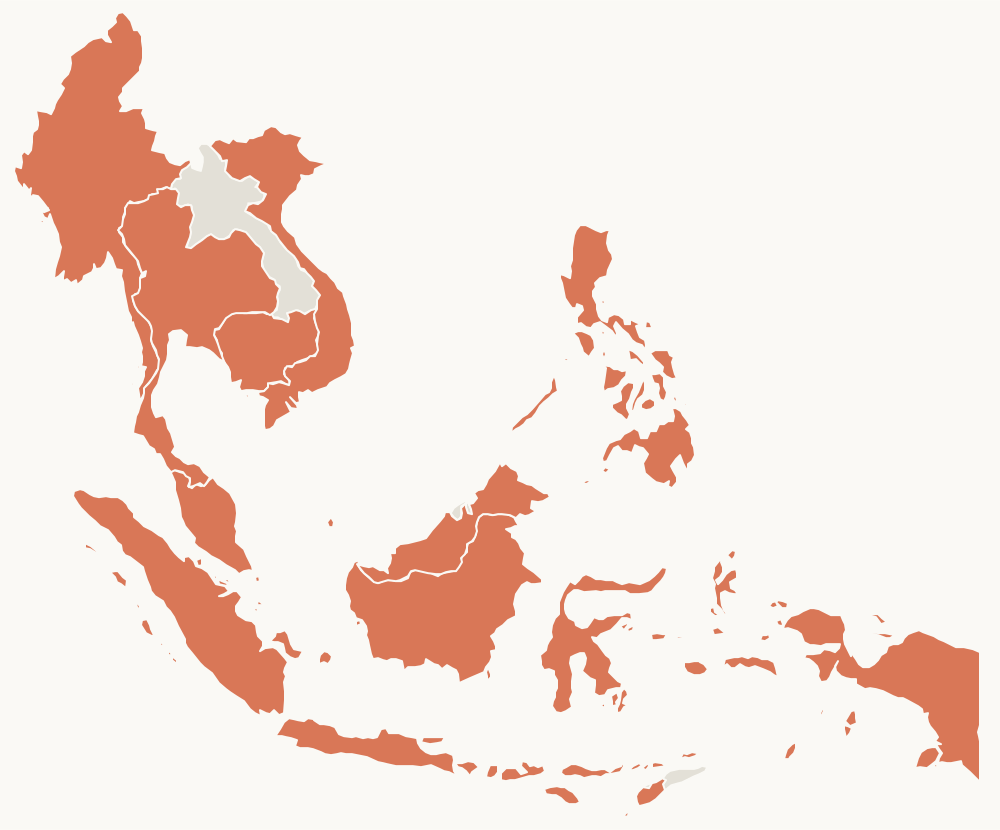 Cambodia, Indonesia +6
Government and rules
The Annual Report: Digital Rights in Southeast Asia 2025
Regional digital-rights review that includes AI-enabled surveillance (notably Myanmar's PSMS) and platform accountability across eight countries.
Report · February 16, 2026 · DigitalReach annual report
Southeast Asia, Brunei +10Government and rules
AI Safety Governance, the Southeast Asian Way
Surveys AI safety and governance moves in every Southeast Asian country, including Timor-Leste, and argues the region is converging on a pragmatic, development-first model distinct from EU or US approaches.
Report · August 25, 2025 · Brookings Governance Studies report
CambodiaGovernment and rules
Cambodia: Artificial Intelligence Readiness Assessment Report
Maps Cambodia's AI readiness across governance, skills, data and infrastructure and feeds directly into the draft National AI Strategy 2025-2030, noting limited data, compute and talent alongside growing pilot use cases.
Report · July 15, 2025 · UNESCO AI Readiness Assessment Methodology country report
CambodiaSchools and universities
Leveraging AI in education in Cambodia: A review of perceived concerns and associated benefits
Synthesizes Cambodian reporting and research to list five concerns (privacy, critical thinking, misconduct, assessment, misinformation) and four benefits of AI in the country's classrooms.
Journal article · August 1, 2024 · Asian Journal of Distance Education 19(2), 2024; also SSRN 4932278
04
What people are saying
Cambodia, Southeast AsiaModern DiplomacyOpinion
Agentic Financial Fraud Is Becoming a Test of State Capacity
Tuhu Nugraha · August 13, 2026
Uses OpenAI's 31 July disclosure of a Cambodia-based scam network using ChatGPT to argue that AI-enabled fraud now operates as one regional system while states respond as separate jurisdictions. He frames cross-border investigative and payment-system capacity as the real test for Southeast Asian governments.
Connects the OpenAI takedown to the wider scam-compound economy in Cambodia and Myanmar.
Southeast Asia, Cambodia +6Foreign PolicyAnalysis, paywalled
China Pitches Its AI Leadership to the World
Joseph Rachman · July 22, 2026
Reports from the Shanghai AI conference that five Southeast Asian states joined China's new World AI Cooperation Organisation as founders while Singapore and Thailand stayed out, and reads this split as the region hedging rather than aligning. China's open-source pitch lands well with governments that cannot afford proprietary Western stacks.
Frames the WAICO launch as Beijing's answer to Washington's more transactional AI posture.
Southeast Asia, Singapore +5Asia Society Policy Institute (Asia Policy Substack)Analysis
ASEAN Hedges With Pax Silica
Faye Simanjuntak · July 8, 2026
Examines why only Singapore and the Philippines have joined the US-led Pax Silica initiative to secure AI and semiconductor supply chains, while other ASEAN states prefer bilateral trade and critical-minerals deals with Washington. Argues the pattern reflects doubts about US commitment and a belief that bilateral arrangements deliver similar benefits without formal geopolitical alignment, with US restrictions on advanced AI models undercutting trust.
Responds to the Trump administration's Pax Silica push and its AI export package for allies.
Southeast Asia, Malaysia +2East Asia ForumOpinion
ASEAN must strike a balanced AI relationship with China
Kelly Forbes and Cass Maughan · July 3, 2026
Argues that China's open models, cloud and hardware give ASEAN real gains but that unmanaged integration risks dependency, lost sovereignty and friction with Washington. Calls for coordinated regional hedging through the Digital Economy Framework Agreement plus investment in domestic compute and capability.
Follows the 2026 ASEAN Digital Ministers' Meeting commitments to a joint AI centre with China and Malaysia's 2025 Huawei chip episode.