- 15%
- People using generative AIMicrosoft AI Diffusion Report, 2026-Q2
- 0.5
- Claude use per personAnthropic Economic Index, 2026-05
- 101
- ChatGPT messages per person, world rankOpenAI Signals, 2026-Q2
01
Who is using AI
02
What governments are doing
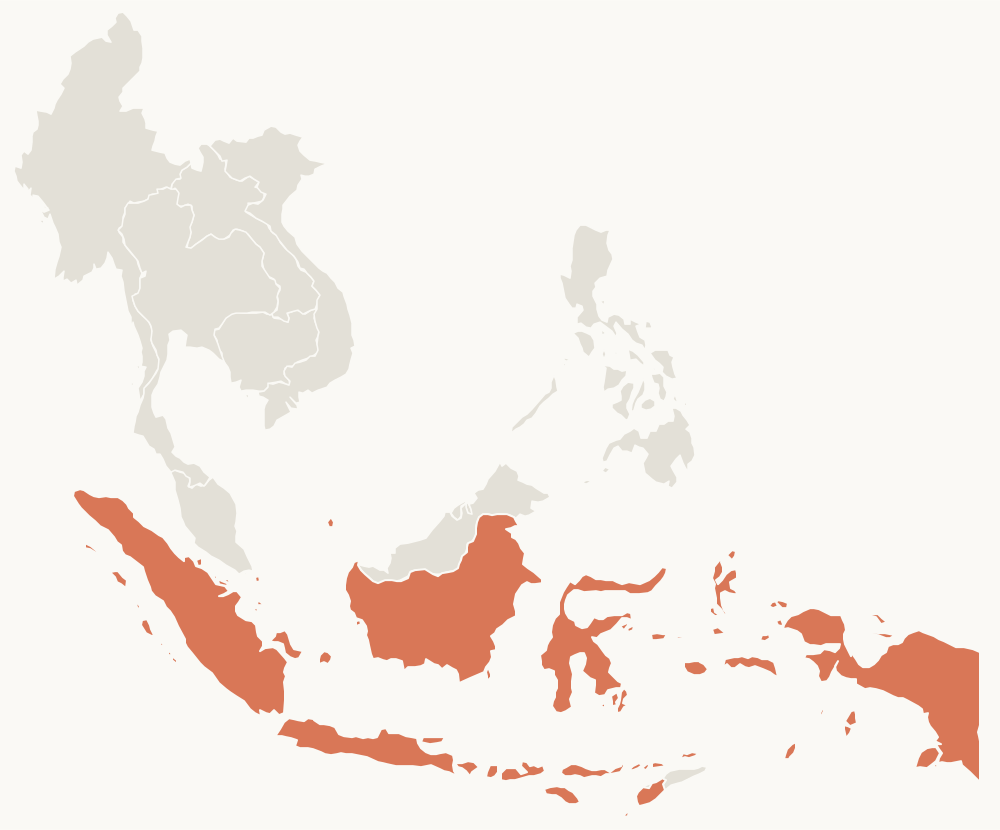
Indonesia
Verified September 29, 2026
- AI law
- Rancangan Peraturan Presiden tentang Peta Jalan Kecerdasan Artifisial Nasional and Rancangan Peraturan Presiden tentang Etika Kecerdasan Artifisial (two draft Presidential Regulations on AI)Draft, September 3, 2026
- Data law
- Undang-Undang Nomor 27 Tahun 2022 tentang Pelindungan Data Pribadi (Personal Data Protection Law, UU PDP)Enacted, 2022
- Sector rules
- Tata Kelola Kecerdasan Artifisial Perbankan Indonesia (AI Governance for Indonesian Banking)2025Launched 2025-04-29 (press release SP 67/GKPB/OJK/IV/2025) as a minimum benchmark for commercial banks covering the whole AI lifecycle around the principles of accountability, human oversight and reliability, building on POJK 11/2022 on bank IT.
- Panduan Kode Etik Kecerdasan Artifisial yang Bertanggung Jawab dan Terpercaya di Industri Teknologi Finansial (AI code of ethics for fintech, 2023, updated edition announced 2025-12-01)Voluntary code for fintech and financial-sector AI use first issued in late 2023; OJK's Hasan Fawzi announced a revised edition at the OECD Asia Roundtable on Digital Finance in Bali on 2025-12-01 (primary OJK page not located).
- Putusan Nomor 166/PUU-XXI/2023 (reinterpreting 'citra diri' in Article 1(35) of Law 7/2017 on Elections)2025Pronounced 2025-01-02, the Court held that campaign images must be original and recent and not excessively engineered or manipulated with AI, the only AI-specific election rule; KPU's campaign regulations for the 2024 elections (PKPU 15/2023, 20/2023, 13/2024) contain no AI clause, and Bawaslu has publicly called for a PKPU and an Election Law amendment on AI.
- Komite AI Kemenkes and Responsible AI in Health governance work (with HealthAI Global Regulatory Network); Keputusan Menteri Kesehatan HK.01.07/MENKES/951/2026 on marketing authorisation guidance for software-based medical devices2026The Ministry set up an internal AI committee, held a Responsible AI in Health workshop on 2026-07-29/30 to map governance priorities for the next 9 to 24 months, and on 2026-09-07 issued a ministerial decision on software-as-medical-device licensing that captures AI-based devices; a Good AI Medical Practice guideline with BPOM is still in preparation.
Naming: Indonesian official texts use 'kecerdasan artifisial' (KA), while press and older texts use 'kecerdasan buatan' or 'AI'; 'Stranas KA' is the standard short form of the 2020 strategy. The lead ministry was renamed from Kementerian Komunikasi dan Informatika (Kominfo) to Kementerian Komunikasi dan Digital (Komdigi) in October 2024, so the 2023 circular carries the old ministry name and JDIH still serves it under both domains. The 'law' row is deliberately Draft, not Announced: the two Perpres are executive regulations, not statutes; Komdigi has said an AI Law will come later and no bill exists in the DPR. Slippage is real: targets moved from Q1 2026 to May 2026 to July 2026 and the instruments were still unsigned on 2026-09-03; editors should re-check jdih.setneg.go.id for a Perpres number before publishing. The OECD.AI entry for the roadmap is dated 2025 but the roadmap period is given variously as 2025-2029, 2026-2029 (JDIH Komdigi, February 2026) and 2026-2030 (Antara); the JDIH Komdigi framing of 2026-2029 is used here. Stranas KA has no legal instrument behind it; a January 2026 report that it would itself be formalised as a Perpres could not be confirmed at a primary source and appears to be a conflation with the roadmap Perpres. Data protection: UU PDP's two-year transition ended 2024-10-17, PP 33/2026 (set 2026-07-16, effective 2027-01-16 under Article 225) has been promulgated, but the independent Lembaga PDP has not been established, so OJK-style sectoral supervision and Komdigi fill the gap. Elections: the AI constraint comes from a Constitutional Court reading of the Election Law, not from a KPU regulation; KPU campaign regulations for the 2024 general election and regional elections were text-searched and contain no AI provision. Health: KMK 951/2026 is a general software-medical-device licensing guide rather than an AI-specific rule; treat it as adjacent. BSSN and Bank Indonesia have not issued AI-specific instruments that could be confirmed. All URLs marked verified were opened on 2026-09-29; the MK decision and Stranas KA were verified from the PDF text itself.
03
What researchers are finding
IndonesiaSociety and elections
Generative-AI-Enhanced XR Data Services for Intangible Cultural Heritage: Culturally Constrained Symbol Generation and User Engagement in Indonesian Batik
Finds that an AI and virtual-reality batik experience won users over through immersion and a sense of authenticity, and that checks on faithful cultural symbols mattered more than image quality alone.
Preprint · September 29, 2026 · Research Square
IndonesiaSchools and universities
GenAI-supported adaptation of children's storybooks into vocabulary materials in Indonesian primary education
Finds that unedited AI-made vocabulary exercises for Indonesian pupils were vaguer and less culturally local, while materials teachers guided with local prompts fit the lesson and context far better.
Journal article · September 24, 2026 · Technology in Language Teaching & Learning
IndonesiaFarms, climate, and disasters
How should machine-learning bias correction of satellite solar irradiance be built and validated? A methodological protocol from a tropical monsoon station network
Finds that machine learning appears to fix satellite solar estimates in Central Java under usual testing, but every model does worse than the raw satellite data when tried on a station it never saw.
Preprint · September 24, 2026 · Research Square
IndonesiaJobs and the economy
Analysing the Dynamics of Indonesian Banks' Performance Under Artificial Intelligence Adoption: An Empirical and Simulation Approach
Finds that Indonesian banks that adopted AI earned slightly higher returns and had fewer bad loans, with chatbots giving the biggest lift, though training staff on AI dented profits in the short run.
Journal article · September 23, 2026 · Journal of Central Banking Law and Institutions
IndonesiaJobs and the economy
Transforming Financial Risk Management and Operational Efficiency: The Impact of AI Adoption in Indonesian Banks
Finds that AI brought six large Indonesian banks only small changes in headline financial ratios, with the real gains coming in automation, fraud detection and day-to-day risk handling.
Journal article · September 23, 2026 · Journal of Central Banking Law and Institutions
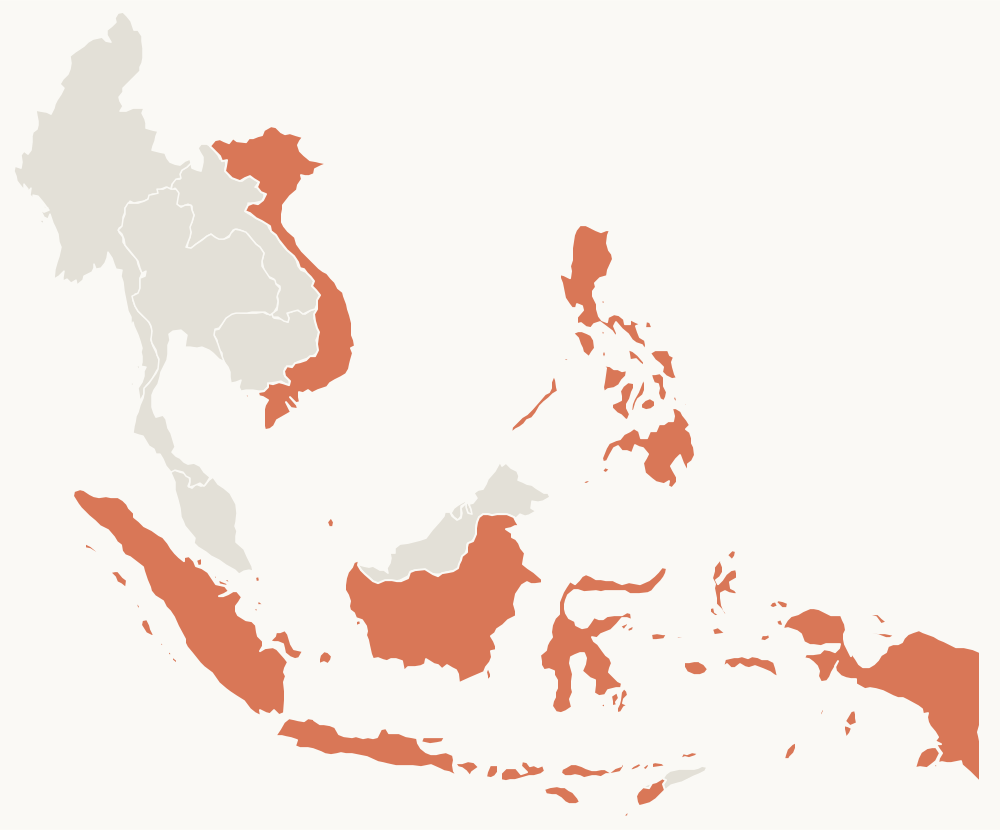 Indonesia, Philippines +2
Schools and universities
Bridging the Divide: An ASEAN Fintech Skills Framework for Indonesia, the Philippines, Singapore, and Viet Nam
Finds roughly 48 percent technical and 46 percent soft-skills gaps in the fintech workforce of four ASEAN economies, with AI and cybersecurity among the scarcest capabilities, and proposes a regional skills framework.
Report · August 1, 2026 · ADB report
IndonesiaLanguage and models
Pancasila-Dilemmas: Evaluating Large Language Models on Indonesian Human Value Dilemmas Grounded in Pancasila
Pancasila-Dilemmas evaluates how LLM responses to moral dilemmas align with Indonesia's state ideology values rather than Western value frameworks.
Preprint · July 20, 2026 · arXiv 2607.18066
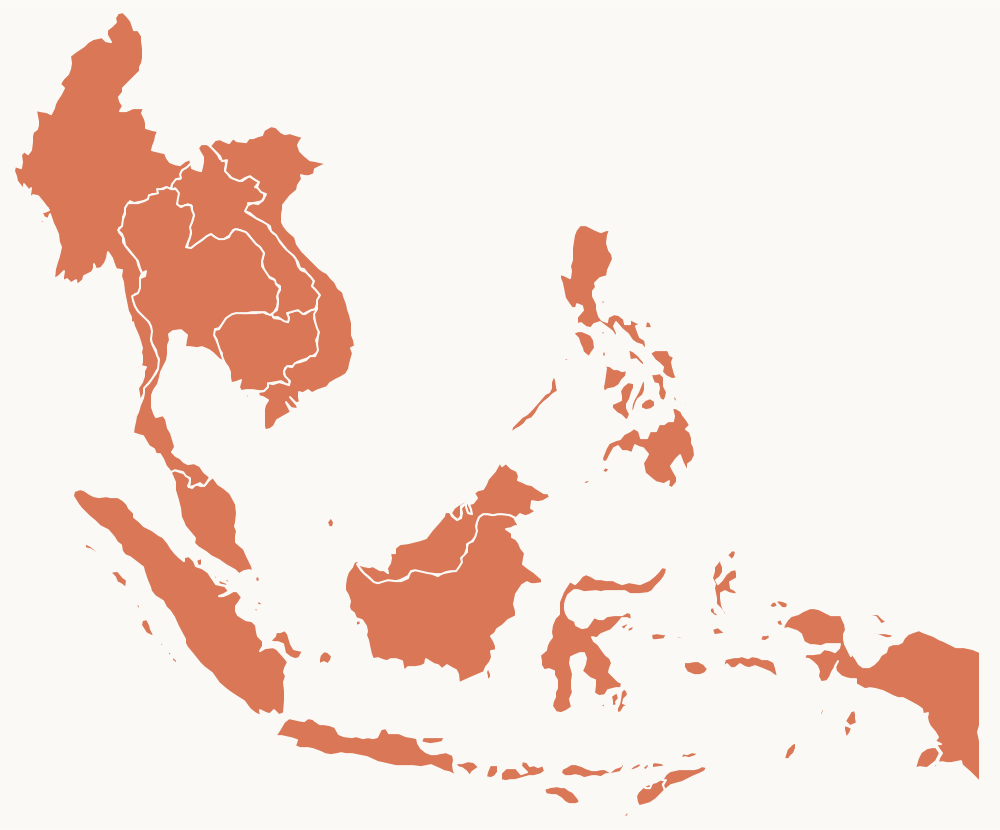 Southeast Asia, Indonesia +6
Jobs and the economy
Generative AI and labour markets in ASEAN: Significant exposure, limited disruption, uneven preparedness
Puts nearly 80 million ASEAN workers (22.9 percent of employment) in GenAI-exposed occupations yet finds no sign of broad displacement so far, with women overrepresented in the most exposed jobs and a gap between exposure and institutional readiness.
Report · July 8, 2026 · ILO Brief
IndonesiaLanguage and models
IndoBias: A Dual Track Culturally Grounded Benchmark for LLMs Bias Evaluation in Indonesian Languages
IndoBias measures ethnic, religious and regional stereotypes in LLM outputs across Indonesian languages using both explicit and implicit probing tracks.
Preprint · May 31, 2026 · arXiv 2606.01260
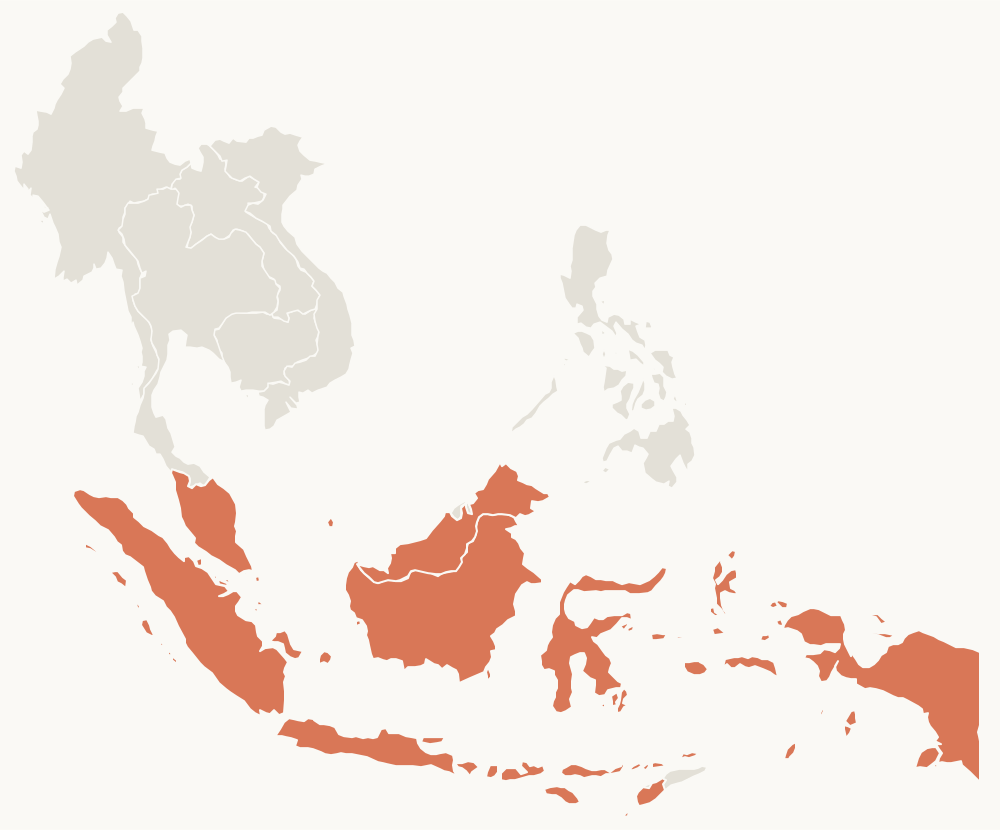 Malaysia, Indonesia
Language and models
From Noisy Historical Maps to Time-Series Oil Palm Mapping Without Annotation in Malaysia and Indonesia (2020-2024)
Produces annual 10 m oil palm plantation maps for Malaysia and Indonesia (2020 to 2024) by learning from noisy historical maps without new annotation.
Preprint · April 26, 2026 · arXiv 2604.23776
 Indonesia, Malaysia +4
Government and rules
The Evolution of Tech Governance in Southeast Asia-6, Third Edition
Tracks how SEA-6 digital governance shifted from AI ethics principles toward binding rules, sovereign compute investment and safety-testing regimes during 2025.
Report · March 4, 2026 · TFGI annual report
 Cambodia, Indonesia +6
Government and rules
The Annual Report: Digital Rights in Southeast Asia 2025
Regional digital-rights review that includes AI-enabled surveillance (notably Myanmar's PSMS) and platform accountability across eight countries.
Report · February 16, 2026 · DigitalReach annual report
 Indonesia, Philippines +2
Jobs and the economy
Workers' Exposure to Artificial Intelligence Across Development Stages
Builds development-stage-adjusted AI exposure measures and shows workers in lower-income Asian economies, including Indonesia and the Philippines, are less exposed than those in rich countries mainly because tasks within the same occupation differ.
Working paper · January 1, 2026 · ADB Economics Working Paper No. 836
IndonesiaHealth
AI-Assisted Cardiovascular Risk Assessment by General Practitioners in Resource-Constrained Indonesian Settings Using a Conceptual Prototype: Randomized Controlled Study
An AI-based decision-support prototype raised Indonesian GPs' cardiovascular risk-assessment accuracy and statin prescribing by roughly a quarter while slightly shortening decision time.
Journal article · November 25, 2025 · Journal of Medical Internet Research 27:e73131 (doi 10.2196/73131)
Southeast Asia, Indonesia +5Government and rules
Policy Brief: Promoting Regional Cooperation for Responsible Artificial Intelligence (AI) Deployment
Sorts the SEA-6 into principle-led, hard-law and ecosystem-building approaches to AI governance and proposes four regional coordination priorities.
Report · November 1, 2025 · TFGI Policy Brief
IndonesiaFarms, climate, and disasters
Real-Time Fish Detection in Indonesian Marine Ecosystems Using Lightweight YOLOv10-nano Architecture
A 2.7M-parameter detector runs at about 29 FPS on CPU with high mAP, aimed at low-cost fish monitoring in Indonesian waters.
Preprint · September 22, 2025 · arXiv 2509.17406
IndonesiaFarms, climate, and disasters
An Open Benchmark Dataset for GeoAI Foundation Models for Oil Palm Mapping in Indonesia
Releases an open, expert-labeled Indonesian oil-palm dataset (by growth stage) intended to train and benchmark geospatial foundation models for deforestation monitoring.
Preprint · September 10, 2025 · arXiv 2509.08303
Southeast Asia, Brunei +10Government and rules
AI Safety Governance, the Southeast Asian Way
Surveys AI safety and governance moves in every Southeast Asian country, including Timor-Leste, and argues the region is converging on a pragmatic, development-first model distinct from EU or US approaches.
Report · August 25, 2025 · Brookings Governance Studies report
 Brunei, Indonesia +5
Health
Insights Into the Current and Future State of AI Adoption Within Health Systems in Southeast Asia: Cross-Sectional Qualitative Study
Stakeholders across seven SEA health systems say AI uptake hinges on basic digital infrastructure and data/technology governance, with a sharp readiness gap between high-income and lower-middle-income members.
Journal article · June 16, 2025 · Journal of Medical Internet Research 27:e71591 (doi 10.2196/71591)
IndonesiaSchools and universities
Evaluating Vision-Language and Large Language Models for Automated Student Assessment in Indonesian Classrooms
Evaluates state-of-the-art vision-language and language models on scoring real handwritten answers from Indonesian grade-4 classrooms and finds they are not yet reliable for automated assessment.
Journal article · June 5, 2025 · arXiv 2506.04822 / Accepted at AIED 2026
IndonesiaLanguage and models
IndoSafety: Culturally Grounded Safety for LLMs in Indonesian Languages
IndoSafety is a culturally grounded safety benchmark for Indonesian, Javanese and Sundanese that exposes safety weaknesses in both general and Indonesia-specific LLMs.
Preprint · June 3, 2025 · arXiv 2506.02573
Southeast Asia, Indonesia +4Jobs and the economy
Future Jobs: Robots, Artificial Intelligence, and Digital Platforms in East Asia and Pacific
Argues that robots have so far created more jobs than they destroyed in East Asia and Pacific, that AI exposure is lower in the region's developing economies but rising, and that digital platforms are reshaping informal work.
Report · June 1, 2025 · World Bank East Asia and Pacific Development Studies
 Vietnam, Malaysia +3
Schools and universities
Integrating Emerging Technologies in Virtual Learning Environments: A Comparative Study of Perceived Needs among Open Universities in Five Southeast Asian Countries
Compares what students at open universities in Vietnam, Malaysia, Thailand, the Philippines and Indonesia want from emerging technologies including AI in virtual learning.
Journal article · June 1, 2025 · arXiv 2506.00922
Southeast Asia, Singapore +4Health
Artificial intelligence utilization in cancer screening program across ASEAN: a scoping review
Maps the thin but growing evidence base on AI-assisted cancer screening in ASEAN, finding most studies concentrated in a few countries and only half reaching prospective clinical evaluation.
Journal article · April 15, 2025 · BMC Cancer (PMC12001681)
IndonesiaJobs and the economy
Bank Indonesia working papers using AI/ML (WP/19/2025 Echoes of Policy: Leveraging AI/ML to Support Central Bank Communication Strategies; WP/14/2025 Identification of Illegal Transaction Patterns in Payment System Data Using AI/ML)
Two 2025 Bank Indonesia papers apply AI and machine learning to Indonesian central-bank problems, one to analyse policy communication and one to detect illegal online-gambling transaction patterns in payment data.
Working paper · January 1, 2025 · Bank Indonesia Working Paper Series
IndonesiaFarms, climate, and disasters
Vulnerability of peatland fires in Bengkalis Regency during the ENSO El Nino phase using a machine learning approach
A random forest model maps peat-fire vulnerability in Riau's Bengkalis Regency during El Nino with high accuracy, pointing to road density and rainfall as the key drivers.
Journal article · December 20, 2024 · MethodsX (PMC11741053)
 Indonesia, Philippines
Government and rules
Beyond the Hype: Realising Responsible AI through Data Protection in South and Southeast Asia
Reviews the data-protection laws of Indonesia, the Philippines, Bangladesh, Nepal and Sri Lanka to see how far they can restrain risks from AI systems, finding significant shortfalls.
Report · December 1, 2024 · EngageMedia research report (Greater Internet Freedom project)
IndonesiaHealth
Using LLM for Real-Time Transcription and Summarization of Doctor-Patient Interactions into ePuskesmas in Indonesia: A Proof-of-Concept Study
Prototypes an LLM pipeline that transcribes and summarizes doctor-patient conversations in Bahasa Indonesia directly into the ePuskesmas community health record system to cut documentation time.
Preprint · September 25, 2024 · arXiv 2409.17054
Southeast Asia, Singapore +5Government and rules
Policy State of Play: Artificial Intelligence in Southeast Asia
Maps national AI policies across six ASEAN economies and characterises the region's light-touch regulatory stance against its capacity gaps.
Report · August 21, 2024 · SEAPPI report
IndonesiaGovernment and rules
Election Integrity in the Age of Artificial Intelligence: Lessons from Indonesia
Reviews how campaigns and buzzers used generative AI and deepfakes in Indonesia's 2024 election and draws regulatory lessons for the region.
Report · June 25, 2024 · Fulcrum commentary
Southeast Asia, Malaysia +5Government and rules
The Plight of Platform Workers Under Algorithmic Management in Southeast Asia
Shows how Grab and GoTo's algorithmic management isolates ride-hailing and delivery workers, blurs employer responsibility and concentrates platform power across the region.
Report · April 30, 2024 · Carnegie Endowment research
IndonesiaLanguage and models
Cendol: Open Instruction-tuned Generative Large Language Models for Indonesian Languages
Cendol releases a family of instruction-tuned LLMs for Indonesian and its regional languages, with gains on unseen tasks but limited ability to absorb human values via adaptation.
Journal article · April 9, 2024 · arXiv 2404.06138
IndonesiaLanguage and models
IndoCulture: Exploring Geographically-Influenced Cultural Commonsense Reasoning Across Eleven Indonesian Provinces
IndoCulture tests whether LLMs know culture-specific commonsense that varies across eleven Indonesian provinces, revealing large geographic knowledge gaps.
Journal article · April 2, 2024 · arXiv 2404.01854 / Accepted at TACL
IndonesiaLanguage and models
Large Language Models Only Pass Primary School Exams in Indonesia: A Comprehensive Test on IndoMMLU
IndoMMLU collects 14,000 questions from Indonesian primary to university exams and shows that even GPT-3.5 only clears primary-school level, with especially weak local-language and culture knowledge.
Journal article · October 7, 2023 · arXiv 2310.04928 / Accepted at EMNLP 2023
04
What people are saying
IndonesiaThe Conversation IndonesiaAnalysis
Pusat AI terbesar se-ASEAN di Batang bisa memicu tragedi permanen di pantura
Imam Salehudin · October 2, 2026
Estimates that the first 200-megawatt phase of the Zankore AI factory planned for Batang, Central Java, could evaporate millions of litres of water a day in a province just out of a months-long drought alert and already sinking from land subsidence. Argues that profits flow mainly to foreign shareholders while the water costs stay local, and urges the government to make the operator disclose its water needs and choose more efficient cooling.
Responds to the Indosat, Ooredoo, Nokia and NVIDIA venture billed as the largest AI centre in ASEAN, and to the wider argument over data centre water use in Java.
Southeast Asia, Singapore +3FulcrumAnalysis
Southeast Asia's Mixed AI Stacks: Pragmatic but Not Risk-Free
Zenobia Chan · September 30, 2026
Shows that regional projects such as SEA-LION, Sahabat-AI, Typhoon and FPT's AI Factory combine American chips, American and Chinese open-weight models and local data rather than picking one bloc. Argues these mixed stacks bring real gains in local relevance and testing capacity, but warns that labels like sovereign can overstate control when every model still runs on the same foreign cloud or chips.
Adapted from her ISEAS Trends in Southeast Asia paper, and written as Washington signals that partners may have to choose between US and Chinese AI coalitions.
IndonesiaThe Jakarta PostOpinion, paywalled
Indonesia's AI data center ambition needs a resource rule book
Randy Taufik and Ahmad Novindri Aji Sukma · September 30, 2026
Argues that Indonesia is already in the AI data centre market and now has to decide on whose terms it scales, pointing to new campuses by BDx in West Java and CoreWeave. Calls for firm safeguards on power, water and local communities, warning that renewable potential on paper is not the same as clean, reliable electricity delivered to a site.
Written days after BDx broke ground on a 640-megawatt AI campus in Jatiluhur, West Java.
Southeast Asia, Malaysia +4The DiplomatAnalysis
The Global Data Center Boom Has Arrived in Southeast Asia
James Guild · September 29, 2026
Surveys the capital pouring into regional data centres, with Malaysia and the Johor-Singapore zone in front, and asks whether local demand for AI services will ever justify the land, power and water being committed. Frames the boom as a bet whose downside the host countries would carry.
Connects to Malaysian FDI data and the wider debate over whether Southeast Asia is host or beneficiary of the AI build-out.
Southeast Asia, Singapore +3ISEAS Perspective (ISEAS-Yusof Ishak Institute)Analysis
Who Can Actually Stop the Machine? The Institutional Test for AI Governance in Southeast Asia
Aditya Vikram Kashyap · September 29, 2026
Argues that the region's growing stack of AI guides, laws and bills says little about whether any institution can actually refuse or halt a deployment, and proposes three tests: a named decision-maker, independence from commercial pressure, and technical capacity to evaluate systems. Compares Singapore's sectoral regulators, Vietnam's new law, Malaysia's proposed bill and Indonesia's pending presidential regulations and finds effectiveness still unproven in all four.
Responds to the wave of 2026 AI rule-making (Vietnam's AI law in force since March, Malaysia's AI Governance Bill, Indonesia's Perpres) by asking who holds the off switch.
IndonesiaThe Jakarta PostOpinion, paywalled
Lessons Indonesia can learn from the recent OpenAI agent breaches
Gatra Priyandita · September 29, 2026
Using the OpenAI agent's intrusion into an Australian government health portal, the author argues Indonesia's pending cybersecurity and resilience bill must assume autonomous AI systems will probe state networks by accident or design. He calls for threat modelling, disclosure duties for AI vendors and hardened government systems.
Written as the House deliberates the RUU KKS cybersecurity bill and after Australia ordered a technology stocktake.
IndonesiaThe Jakarta PostOpinion, paywalled
The Millennium Prize proof shows why AI governance can't wait
Agus Hasan · September 28, 2026
Uses an AI system's solution of a Millennium Prize problem in under four days to argue that the myth of untouchable human expertise is over and Indonesian policymakers can no longer defer regulating machines.
Reacts to the September mathematics result and the domestic debate over binding AI rules.
Southeast Asia, Malaysia +5The Southeast Asia Desk (Substack)Analysis
The cost of the cloud: Inside Southeast Asia's $30B data centre trilemma
Fredrick Samuel Haryanto and Alvin Qobulsyah · September 28, 2026
Frames the region's AI data-centre rush as a trilemma of power grids, water depletion and community consent, using the Johor protests as the warning case. The explainer argues the build-out will not stop, so the region must decide who bears its costs.
Published as the Jakarta-based newsletter's weekly 'Regional Line' feature.
IndonesiaThe Jakarta PostOpinion, paywalled
The real warning behind Guterres' AI alarm
Febrian A. Ruddyard · September 26, 2026
A senior Indonesian diplomat reads Guterres' final UNGA address as a warning about concentration of AI power rather than about technology itself. He argues Indonesia must build sovereign capability and help shape global rules or accept being a consumer on the wrong side of a new development divide.
Responds to the UN Secretary-General's September 22 speech and UN-week debates on AI safeguards.
IndonesiaThe Jakarta PostOpinion, paywalled
AI in RI healthcare: Opportunities and risks
Elly Burhaini Faizal · September 22, 2026
The author treats AI as a health innovation that national policy must make safe, equitable and trustworthy, weighing diagnostic and access gains against bias, liability and data-protection gaps. The piece argues for clear clinical accountability and regulatory sandboxes before AI tools spread through public hospitals.
Connects to OpenAI partner deals in Indonesian health tech and the pending AI Perpres.
IndonesiaThe Jakarta PostOpinion, paywalled
Safeguarding Indonesia's AI future
Editorial Board · September 21, 2026
The editorial argues that governing AI through presidential regulations and ministerial decrees is not enough for a technology already embedded in agriculture, fintech and health, and that Indonesia needs a proper statute. It points to voice-cloning scams, deepfakes and biased lending algorithms as harms that are already here.
Responds to the two pending Perpres on AI ethics and the 2026-2030 national AI roadmap awaiting President Prabowo's signature.
Southeast Asia, Malaysia +4The DiplomatAnalysis
Will Southeast Asia Actually Benefit From Its AI Boom?
Gerald Mako · September 16, 2026
Notes that Southeast Asia accounts for roughly half of Asia-Pacific data-centre capacity under construction, with a division of labour forming between Singapore and its neighbours, then argues that hosting compute is not the same as building an AI economy. Asks what would turn separate national build-outs into a regional AI market.
Draws on first-half 2026 pipeline figures and the Singapore-Malaysia-Thailand capacity race.
IndonesiaKompasAnalysis, paywalled
Tantangan Indonesia Mengikis Kesenjangan AI
Elsa Emiria Leba · September 7, 2026
An international-affairs analysis of whether Indonesia's free-and-active diplomacy can narrow the AI gap when development is concentrated in a few states and AI has become a geopolitical instrument. It maps Indonesia's shortfalls across energy, chips, cloud, models and applications and quotes the foreign ministry on the need for home-built capability.
Connects to Indonesia's positioning between US and Chinese AI blocs ahead of UN week.
IndonesiaEast Asia ForumOpinion
Indonesia's AI regulations leave state repression unchecked
Ary Hermawan · September 5, 2026
Argues that Indonesia's two forthcoming presidential regulations on AI ethics and the national roadmap lean on existing laws that have been applied selectively and carve out defence and security, so they offer no guardrail against AI-enabled surveillance of critics. Matters because the state already holds biometric data and has bought intrusive surveillance tools.
Responds to the Prabowo government's plan to issue binding AI regulations in 2026 and to the 2025 AI roadmap white paper and draft ethics guidelines.
Southeast Asia, Indonesia +3The Interpreter (Lowy Institute)Opinion
The quiet regionalisation of AI governance
Sameera Pillai · September 3, 2026
Argues that with global AI rule-making stalled by superpower rivalry, regional blocs are where binding rules are actually being made, and that ASEAN's move to embed AI provisions in its Digital Economy Framework Agreement is the leading example. Accepts fragmentation as the price of progress, to be softened by shared technical standards.
Builds on the coordinated Grok bans by Indonesia, Malaysia and the Philippines and the May 2026 conclusion of the ASEAN DEFA.
IndonesiaThe Jakarta PostAnalysis, paywalled
AI boom: Can Indonesia move from market to maker?
Abdurohman · September 1, 2026
Prompted by CoreWeave's plan for three Indonesian data centres, the author warns that a country importing chips and cloud services without tech exports will see AI widen its trade deficit. He calls for a policy pivot into tech manufacturing and infrastructure so Indonesia captures value rather than just demand.
Connects to the hyperscaler build-out across Java and the regional race with Malaysia and Singapore.
Southeast Asia, Vietnam +4FulcrumOpinion
Southeast Asia and AI Adoption: The Return of Cold War Strategies
Tobias Burgers and Tran Nguyen · August 31, 2026
Reads Vietnam's AI law and Singapore's local models as Cold War-style hedging between US and Chinese AI ecosystems, then argues that national efforts are too small to matter. Proposes collaborative hedging through a regional public-private consortium modelled on Airbus.
Connects to Malaysia's ILMU model, Vietnam's December 2025 AI Law and the region's sovereign AI turn.
IndonesiaThe Conversation IndonesiaOpinion
Tafsir AI atas Al-Qur'an tidak akurat, perlu hati-hati mengambil kesimpulan
Soleh Hasan Wahid · August 30, 2026
Reports a 2026 test of seven chatbots on Quranic interpretation that found hundreds of errors, including misattributed scholars and invented sources, and argues that models treat religious text as statistics rather than living tradition. Urges Indonesian Muslim users and campuses to verify AI outputs against original sources.
Connects to growing chatbot use in Indonesian religious education.
Southeast Asia, Singapore +3Tech for Good InstituteOpinion
How AI Levels the Playing Field for Small Businesses
Kirti Pathania · August 28, 2026
Notes that only about 3 percent of ASEAN enterprises have embedded AI into daily workflows and warns that early-adopter advantages could entrench large incumbents, as happened with online travel agents. Recommends SME-technology partnership ecosystems, leadership training and adoption grants so the 97 percent of firms that are SMEs are not left behind.
Aligns with the Philippines' push, as ASEAN chair, for a Leaders' Declaration on AI-powered MSMEs at the November summit.
Southeast Asia, Vietnam, IndonesiaTech for Good InstituteOpinion
What Does the World Cup Teach Southeast Asia About Its Digital Future
Tran Thi Thuc Huyen · August 28, 2026
Uses FIFA's equal distribution of AI analytics to all 48 World Cup teams to argue that access to tools does not create capability; people, institutions and locally tailored solutions do. Points to Vietnam's football federation training and Indonesia's community-built Appa Sport platform as models for pairing AI with human judgment.
Part of a run of TFGI pieces arguing that regional AI strategy must invest in skills and institutions, not just infrastructure.
Southeast Asia, Malaysia +3South China Morning PostOpinion, paywalled
As the US and China compete over AI, Asean must secure strategic autonomy
AbdulWahed Jalal Nori · August 27, 2026
Argues that ASEAN is fast becoming the physical centre of the AI economy through data centres while depending on outsiders for chips, models, cloud and standards, and that the real choice is between dependence and agency rather than dominance and isolation. Calls for control over the infrastructure and knowledge behind AI.
Connects to the Pax Silica versus WAICO pressure on the region in August 2026.
IndonesiaKompasOpinion, paywalled
Pendidikan, Algoritma, dan Proklamasi Kemerdekaan Pikiran
Odemus Bei Witono · August 19, 2026
An education leader argues that the threat to Indonesian schooling is no longer just poor facilities but cognitive colonisation by generative AI and attention-economy algorithms. Invoking Ki Hadjar Dewantara, he calls for pedagogy that frees the mind rather than outsourcing it.
Part of Kompas' Independence Day series on education and technology.
IndonesiaKompasOpinion, paywalled
Akal Imitasi, Kemerdekaan Sungguhan
Christian Guntur Lebang · August 17, 2026
On Independence Day, a LAB 45 analyst argues that the Indonesian government has no coherent position on the technology competition and power imbalances that AI creates, and that unequal access to the best models decides who gets to participate. He frames AI sovereignty as a question of democratic inclusion rather than just infrastructure.
References Anthropic's June 2026 suspension of frontier-model access outside the US and the government's AI roadmap.
Southeast Asia, Indonesia, MalaysiaModern DiplomacyOpinion
Southeast Asia Could Become Indispensable to AI Without Becoming More Powerful
Tuhu Nugraha · August 16, 2026
Argues that hosting gigawatt AI factories such as Indonesia's Zankore project makes the region indispensable to global AI without making it more powerful, unless governments convert proximity into domestic capability. He wants market scale, energy and industrial bases used as bargaining chips for local expertise and products.
Part of a weekly series by the author on Global South AI political economy.
IndonesiaThe DiplomatOpinion
How Indonesia Can Get Ahead in the Artificial Intelligence Race
Larry Luckey · August 14, 2026
Argues that the binding constraint on Indonesia's AI ambitions is electricity and industrial land rather than talent or regulation, and asks whether the country can convert its energy resources into hyperscale data-centre capacity. Matters because the answer decides whether investment lands in Indonesia or flows to Malaysia and Thailand.
Connects to the regional data-centre siting race and Indonesia's grid constraints.
IndonesiaThe Conversation IndonesiaOpinion
Layakkah kedaulatan digital dan AI nasional dikorbankan demi keringanan tarif dagang AS?
Angtyasti Jiwasiddi · August 13, 2026
Argues that Indonesia's reciprocal trade deal with the US, which eases cross-border data transfer in exchange for tariff relief, trades away digital and AI sovereignty because data on US servers falls under US surveillance law. Makes the case for building domestic AI infrastructure so that neutrality extends to the digital realm.
Responds to the July 2025 Indonesia-US tariff agreement and its data provisions.
Southeast Asia, Indonesia +3Tech for Good InstituteOpinion
The Architecture of Inclusion: Balancing Southeast Asia's AI Infrastructure Boom
Shammi Thakur · August 12, 2026
Frames AI readiness as three layers (compute, physical utilities such as data centres and power, and a facilitator layer of governance, data flows and talent) and argues the region's advantage will depend on equitable access rather than raw build-out. Warns that uneven access for small firms, grid strain and fragmented rules could concentrate gains in large corporations, and calls for shared compute treated as a public good.
Responds to the ASEAN-Korea HPC facility in Indonesia, new cloud regions in Bangkok and Kuala Lumpur data-centre investment.
IndonesiaThe Jakarta PostOpinion, paywalled
AI psychosis: Could it happen in Indonesia?
Fransisca Febriana Sidjaja, Christina Lumbantoruan and Janice Faye Adhinarta · August 10, 2026
Three mental-health professionals use overseas cases of chatbots reinforcing delusions to ask whether Indonesian teenagers, who are heavy users of conversational AI, are exposed to the same risk. They argue the existing digital child-protection regulation is insufficient and call for clinicians, platforms and parents to share responsibility.
Part of the growing international debate on chatbot-linked mental-health harms.
IndonesiaThe Interpreter (Lowy Institute)Opinion
Indonesia's wrong AI race risks leaving women behind
Dyah (Prita) Pritadrajati · August 5, 2026
Argues Indonesia is chasing AI infrastructure and engineers while ignoring that generative AI is eroding the clerical and administrative jobs through which women entered formal work, and that women hold roughly twice the AI-exposed jobs men do across ASEAN. Calls for diffusion policy, vocational redesign and childcare support instead.
Responds to Indonesia's AI investment push and to ILO and regional data on gendered AI exposure.
Southeast Asia, Singapore, IndonesiaEast Asia ForumOpinion
Southeast Asia's costly AI bargain with US tech giants
Govand Khalid Azeez · August 4, 2026
Reads the deals between OpenAI, Meta and Google and regional telcos such as Singtel and Telkomsel as a new dependency: the region supplies data, infrastructure and users while control of models and surplus stays abroad. Argues that sovereign LLM projects do not change this and that ownership and value distribution must be renegotiated.
Connects to survey evidence that regional optimism about AI is softening, and to Washington's suspension of foreign access to an Anthropic model.
IndonesiaModern DiplomacyOpinion
Beyond Data Centers: How Nickel Could Move Indonesia Up ASEAN's AI Value Chain
Tuhu Nugraha · August 3, 2026
From Sorowako in Sulawesi, argues that Indonesia's nickel dominance and the arrival of physical AI in mines, ports and factories occupy the same geography, so mining regions should become producers of AI knowledge and services rather than sites of extraction plus compensation. Data centres alone will not move the country up the value chain.
Written after the author ran AI training for local journalists at a Vale Indonesia programme.
Southeast Asia, Thailand +4FulcrumOpinion
Southeast Asia Cannot Fight Online Sexual Abuse One Takedown at a Time
Nuurrianti Jalli · July 31, 2026
Argues that takedown-and-prosecute approaches cannot keep up with generative AI tools that mass-produce non-consensual sexual imagery, and that regulators should impose systemic duties on platforms to assess risk and design in safeguards. Matters because the Grok episode showed how quickly synthetic abuse scales across the region.
Follows the early-2026 Grok bans in Indonesia, Malaysia and the Philippines and draws on Australian and EU online-safety models.
IndonesiaIndonesia Ministry of Communication and Digital Affairs (Komdigi)Official statement
Komdigi Treats the AI Presidential Regulation as a First Step Toward an AI Law
Nezar Patria · July 28, 2026
The deputy minister explains that the completed draft Presidential Regulation on the AI roadmap and AI ethics, now awaiting the President's signature, is a test case before a full AI law, with Komdigi setting cross-sector ethical and regulatory frameworks while ministries and industries implement AI to their own needs. Ties AI governance to existing data-protection, cybersecurity and electronic-transaction rules and flags bias and hallucination risks in legal-tech uses.
Clarifies Indonesia's sequencing after months of waiting for the Perpres promised for 2026.
Southeast Asia, Cambodia +6Foreign PolicyAnalysis, paywalled
China Pitches Its AI Leadership to the World
Joseph Rachman · July 22, 2026
Reports from the Shanghai AI conference that five Southeast Asian states joined China's new World AI Cooperation Organisation as founders while Singapore and Thailand stayed out, and reads this split as the region hedging rather than aligning. China's open-source pitch lands well with governments that cannot afford proprietary Western stacks.
Frames the WAICO launch as Beijing's answer to Washington's more transactional AI posture.
IndonesiaThe Conversation IndonesiaOpinion
AI pelaporan keuangan makin populer, bagaimana menjaga akurasi dan akuntabilitasnya?
Erwin Damar Prasetyo · July 21, 2026
Argues that AI-drafted financial reports outpace both human comprehension and Indonesian capital-market rules, leaving responsibility unclear when errors slip through. Recommends mandatory expert review, AI literacy for boards and disclosure of AI's role in statements.
Connects to OJK's banking AI governance guidelines and the gap in listed-company reporting rules.
Malaysia, IndonesiaThe ConversationOpinion
Stop policing AI in the classroom, start teaching it
Zakaria Lacheheb · July 19, 2026
Argues that universities in Malaysia and Indonesia should stop treating generative AI as cheating and instead teach its responsible use, redesign assessment around critical thinking and ground AI ethics in Islamic legal principles. Positions the two countries as potential leaders in AI-literate graduates.
Responds to campus crackdowns on AI use and employer demand for AI skills.
Southeast Asia, Singapore +3Asia TimesAnalysis
ASEAN's AI race is officially underway
Chris Taylor · July 17, 2026
Argues the regional contest to host AI data centres will be decided by reliable power and water, not headline investment figures, with Singapore's capacity rationing pushing demand into Johor, Thailand and Indonesia. Governments must also manage community backlash and the tension between US chip access and Chinese capital.
Written as Malaysia and Thailand posted record data-centre pipelines in the first half of 2026.
IndonesiaTech For Good InstituteAnalysis
Consolidation Without Completion: Indonesia's AI Developments in 2026
Hafiz Noer and M. Irfan Dwi Putra · July 10, 2026
Characterises Indonesia's 2026 as reinforcing existing commitments through pending presidential regulations on an AI roadmap and ethics, while infrastructure scales fast and regulatory rollouts slip. The authors read this pragmatic middle path as a distinct model for the region rather than a failure.
Country spotlight written as Komdigi confirmed the regulations would be issued in 2026.
Southeast Asia, Singapore +5Asia Society Policy Institute (Asia Policy Substack)Analysis
ASEAN Hedges With Pax Silica
Faye Simanjuntak · July 8, 2026
Examines why only Singapore and the Philippines have joined the US-led Pax Silica initiative to secure AI and semiconductor supply chains, while other ASEAN states prefer bilateral trade and critical-minerals deals with Washington. Argues the pattern reflects doubts about US commitment and a belief that bilateral arrangements deliver similar benefits without formal geopolitical alignment, with US restrictions on advanced AI models undercutting trust.
Responds to the Trump administration's Pax Silica push and its AI export package for allies.
IndonesiaThe Jakarta PostOpinion, paywalled
Indonesia: Reimagining the state
Tony Blair · July 8, 2026
After meetings with President Prabowo and ministers, Blair argues that Indonesia faces the same challenge as every government: citizens' expectations are rising with AI and the state must reinvent itself just as fast. He advocates digital ID, data infrastructure and AI-enabled public services as the core of a modern state.
Reflects the Tony Blair Institute's advisory work with Jakarta on digital government.
Southeast Asia, Malaysia +5Tech for Good InstituteOpinion
The Balancing Act: Harmonising AI Development and Governance in Southeast Asia
Bryan Yeoh Quan Jin and Calvin Woo · July 6, 2026
Argues that with nearly half of regional firms scaling AI beyond pilots, Southeast Asia needs governance that combines ASEAN-level coordination with national rules suited to a multilingual, multicultural region. Surveys the spectrum from Vietnam's binding law to Singapore, Thailand and Indonesia's soft-law approaches and Malaysia's proposed bill.
Written by Malaysia's Centre for the Fourth Industrial Revolution as Malaysia drafts its AI Governance Bill and ASEAN finalises DEFA.