- 21%
- People using generative AIMicrosoft AI Diffusion Report, 2026-Q2
- 0.4
- Claude use per personAnthropic Economic Index, 2026-05
- 92
- ChatGPT messages per person, world rankOpenAI Signals, 2026-Q2
01
Who is using AI
02
What governments are doing
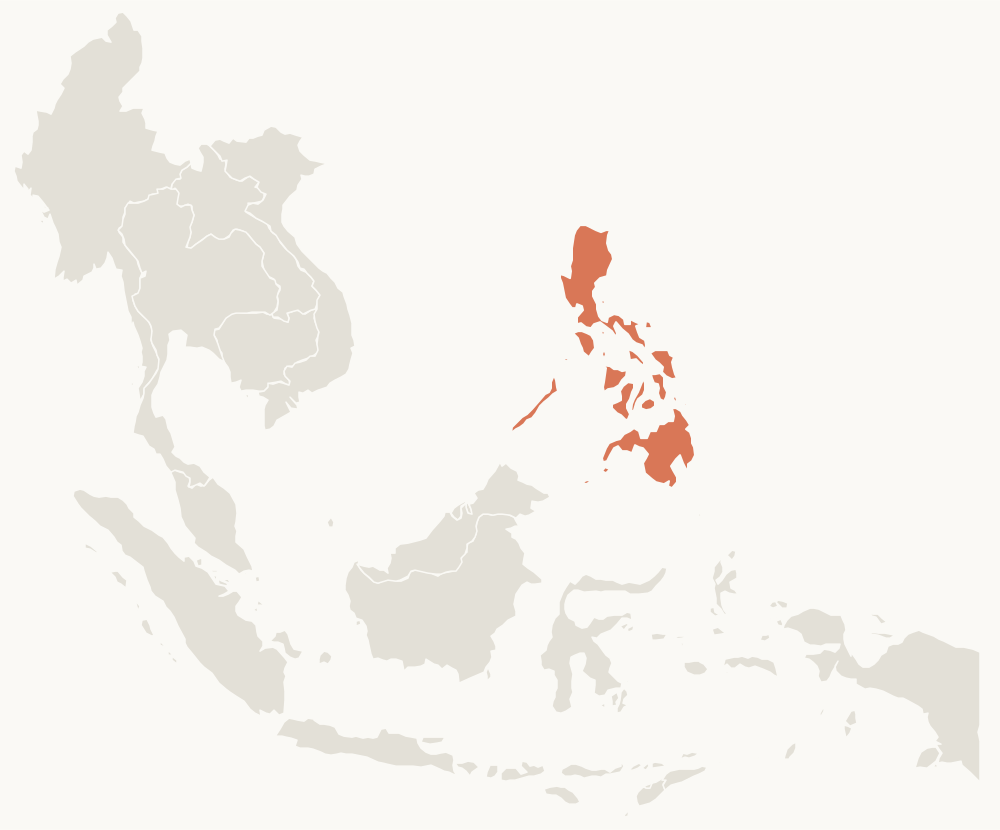
Philippines
Verified September 29, 2026
- AI law
- Artificial Intelligence Development and Regulation Act (consolidated House substitute bill) and Senate Bill No. 25, Artificial Intelligence Regulation Act (AIRA)Draft, July 14, 2026
- Data law
- Republic Act No. 10173, Data Privacy Act of 2012Enacted, September 8, 2012
- Sector rules
- NPC Advisory No. 2024-04: Guidelines on the Application of RA 10173 (Data Privacy Act), its IRR and NPC Issuances to Artificial Intelligence Systems Processing Personal DataDecember 19, 2024Applies the existing data protection law to every phase of an AI system's life cycle, requiring controllers to disclose AI processing, run privacy impact assessments, keep humans able to intervene, address bias and honour objection, rectification and erasure rights.
- Memorandum No. M-2026-031: Guidance Paper on Governance Principles for Artificial Intelligence (AI) in Financial ServicesJune 23, 2026Sets supervisory expectations, framed around the STARS principles (sustainability, transparency, accountability, responsibility, security), for BSP-supervised institutions to build proportionate AI governance and risk management, including accountability for third-party AI.
- Memorandum No. M-2026-034: Recommendations for Managing Emerging Risks Arising from Frontier Artificial Intelligence SystemsJuly 5, 2026Companion memorandum on cybersecurity and operational risks that frontier AI systems create for supervised financial institutions.
- Resolution No. 11064: Guidelines on the Use of Social Media, Artificial Intelligence, and Internet Technology for Digital Election Campaign, and the Prohibition and Punishment of Its Misuse for Disinformation and Misinformation, for the 2025 National and Local Elections and the BARMM Parliamentary ElectionsSeptember 17, 2024Required candidates to register social media accounts and label AI-generated campaign material with conspicuous disclaimers, and treated deepfakes, cheapfakes, bots and coordinated inauthentic behaviour as election offences for the 2025-05-12 midterms.
Lead-agency question: three departments share AI policy and the answer has shifted. DTI owned the 2021 NAISR and the July 2024 NAISR 2.0 plus CAIR; since the President approved DOST's NAIS-PH in May 2025 the strategy has been DOST-led (NAICRI launched 2026-02-26), while DICT owns AI infrastructure (PAIIM 2026-2033), public-sector AI governance (JMC 003 with CSC) and data residency (EO 119), and the House substitute bill would seat a Philippine AI Commission under DICT whereas SB 852 would put a council under DOST. Editors should not describe NAISR 2.0 as the current national strategy without qualification; the CAIR site itself calls it superseded, though no DTI page formally withdraws it. No dedicated AI statute exists and none has passed either chamber; bill counts (about 40 House and 7 Senate measures per Rappler, 2026-06-06) change weekly and the 20th Congress runs to mid-2028. HB 7396 cited by some trackers is a 19th Congress number and is not the live vehicle. The DICT-CSC JMC is binding on government bodies even though it is listed here under framework, because it is the closest thing to cross-cutting AI governance guidance and its reach into private vendors is only contractual. BSP memoranda are guidance (non-binding) rather than circulars. DOH has issued no AI rule; its activity is advisory (2025-10-21 warning on AI for mental health) and membership of the HealthAI GRN (2026-03-18). The Data Privacy Act took effect 15 days after publication; 2012-09-08 is the commonly cited date and the full text was read on lawphil.net because the Official Gazette is behind Cloudflare. Local name for NAIS-PH is a pun on 'nais' (Filipino for 'wish'). A draft cross-cutting 'AI Governance Framework' was reported in early 2026 as in finalization but no official document was found. Do not cite the naisr.cair.ph site as DTI's own domain; it is a CAIR reference page. Web search budget was exhausted mid-audit; later checks used Google through the built-in browser.
03
What researchers are finding
PhilippinesJobs and the economy
Generative AI and Labor Displacement in the Global South: Evidence from Philippine Business Process Outsourcing
After ChatGPT's release, employment growth in Philippine BPO stalled in the provinces most exposed to generative AI while continuing elsewhere, an early sign of displacement in an outsourcing hub.
Working paper · August 1, 2026 · SSRN
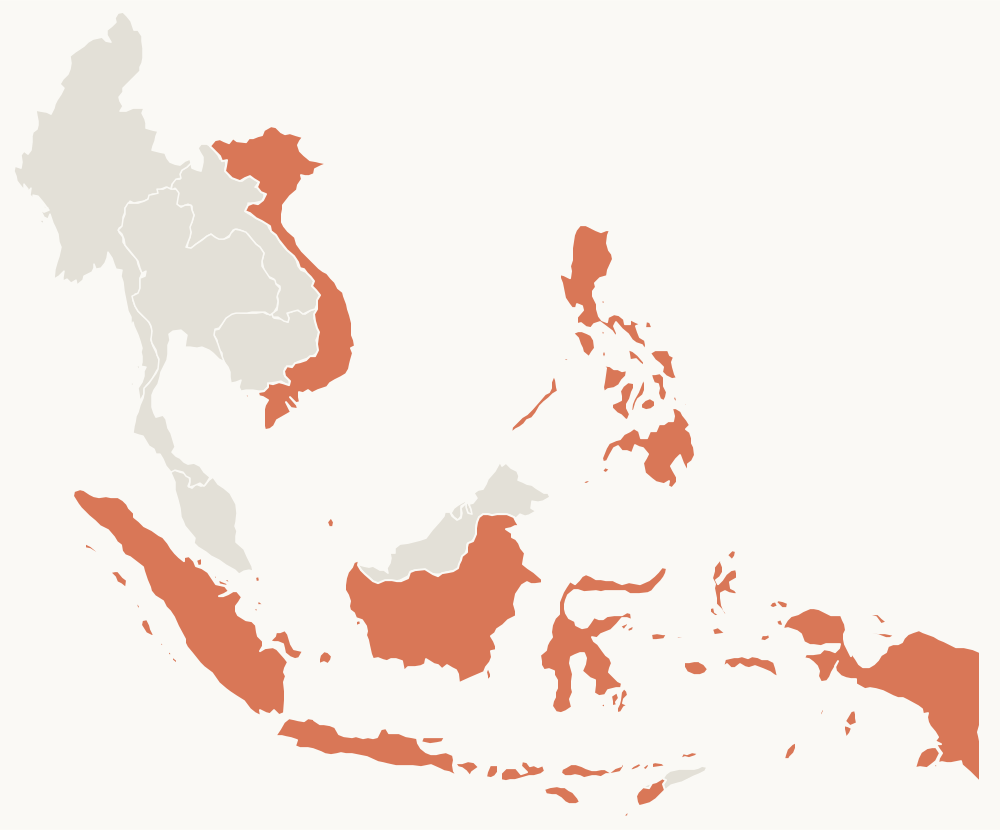 Indonesia, Philippines +2
Schools and universities
Bridging the Divide: An ASEAN Fintech Skills Framework for Indonesia, the Philippines, Singapore, and Viet Nam
Finds roughly 48 percent technical and 46 percent soft-skills gaps in the fintech workforce of four ASEAN economies, with AI and cybersecurity among the scarcest capabilities, and proposes a regional skills framework.
Report · August 1, 2026 · ADB report
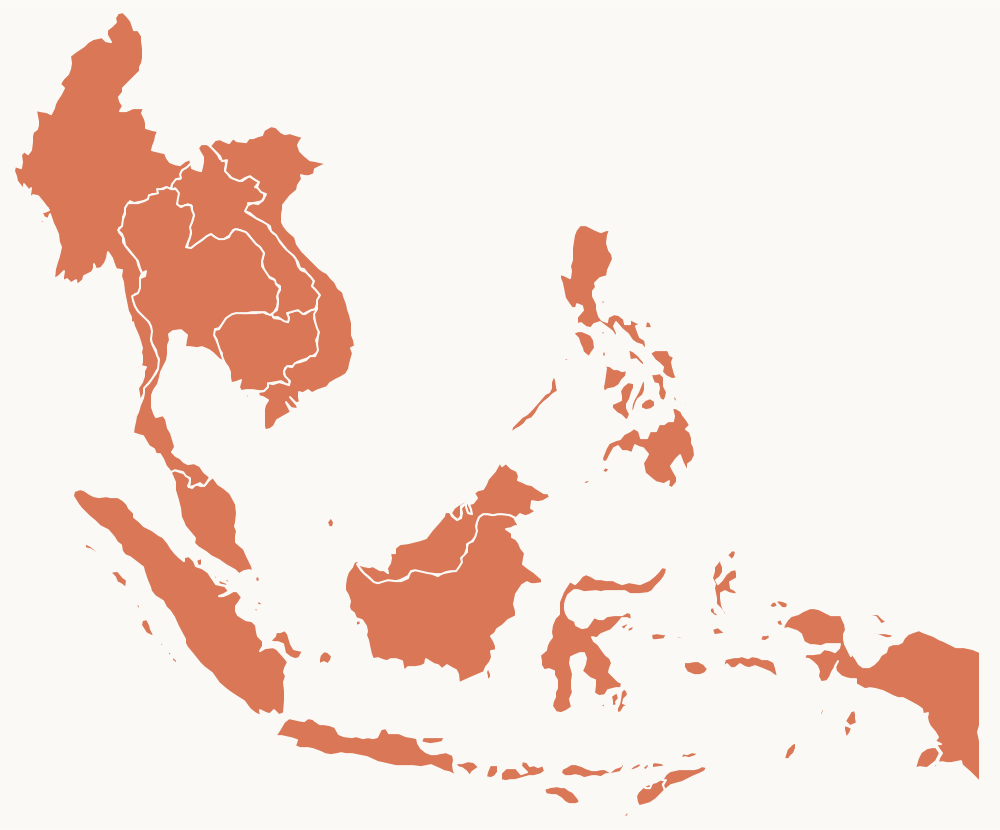 Southeast Asia, Indonesia +6
Jobs and the economy
Generative AI and labour markets in ASEAN: Significant exposure, limited disruption, uneven preparedness
Puts nearly 80 million ASEAN workers (22.9 percent of employment) in GenAI-exposed occupations yet finds no sign of broad displacement so far, with women overrepresented in the most exposed jobs and a gap between exposure and institutional readiness.
Report · July 8, 2026 · ILO Brief
PhilippinesFarms, climate, and disasters
Typhoon-Driven Flood Occurrence Prediction in Western Visayas Using Machine Learning: A Comparative Study with SHAP-Based Feature Analysis
Finds same-day and prior rainfall dominate flood prediction in Western Visayas, with a sharp risk threshold around 27 to 32 mm per day.
Preprint · June 15, 2026 · Zenodo 20697452
PhilippinesSchools and universities
Profiles of AI Dependency: A Latent Class Analysis of Filipino Students' Academic Competencies
Identifies profiles of AI dependency among Filipino college students and links them to self-reported declines in writing, research and critical-thinking competencies.
Journal article · April 30, 2026 · arXiv 2604.27349 / Proc. 9th Int. Conf. on Education and Multimedia Technology (ICEMT), 2025, pp. 299-302
PhilippinesHealth
Filipino Students' Willingness to Use AI for Mental Health Support: A Path Analysis of Behavioral, Emotional, and Contextual Factors
Among Filipino students, habitual AI use and feeling emotionally safe with AI were the strongest predictors of willingness to turn to AI for mental-health support.
Preprint · March 30, 2026 · arXiv 2603.27994
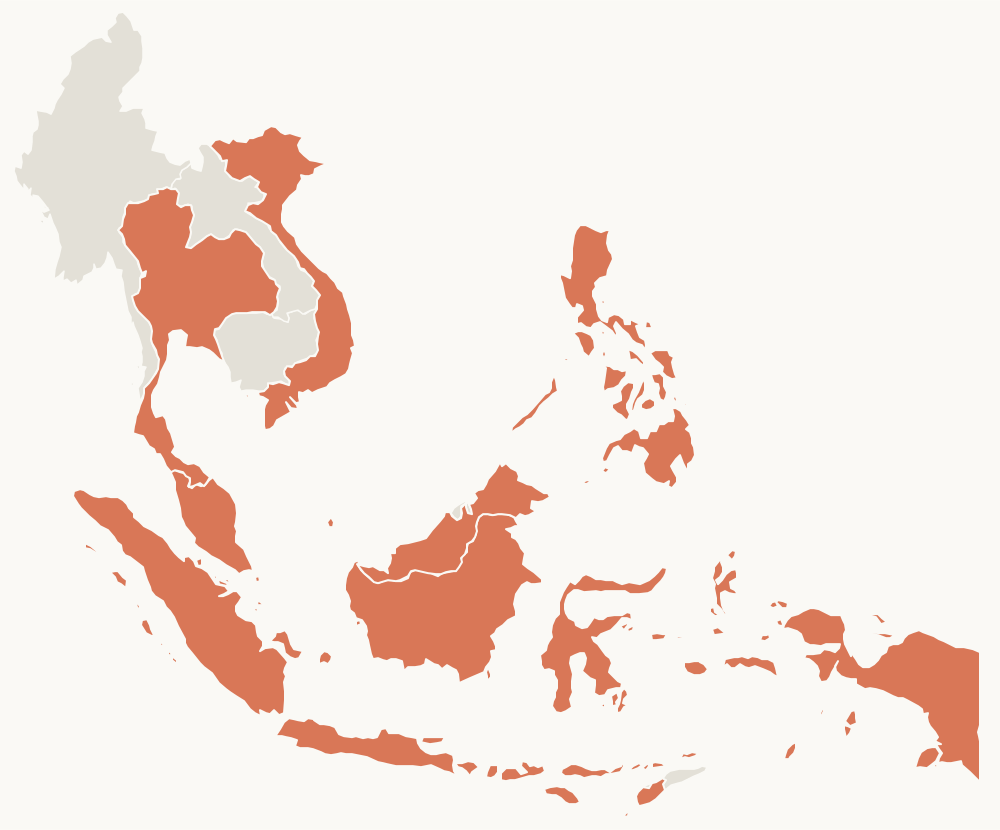 Indonesia, Malaysia +4
Government and rules
The Evolution of Tech Governance in Southeast Asia-6, Third Edition
Tracks how SEA-6 digital governance shifted from AI ethics principles toward binding rules, sovereign compute investment and safety-testing regimes during 2025.
Report · March 4, 2026 · TFGI annual report
PhilippinesJobs and the economy
Digital Financial Platform Engagement and Financial Inclusion in the Philippines: Insights on AI Deployment and Policy Implications
Shows that active use of digital financial platforms is strongly tied to formal account ownership in the Philippines and that AI in finance is concentrated in large institutions, mostly in fraud detection and credit scoring.
Working paper · February 18, 2026 · PIDS Discussion Paper No. 2026-03
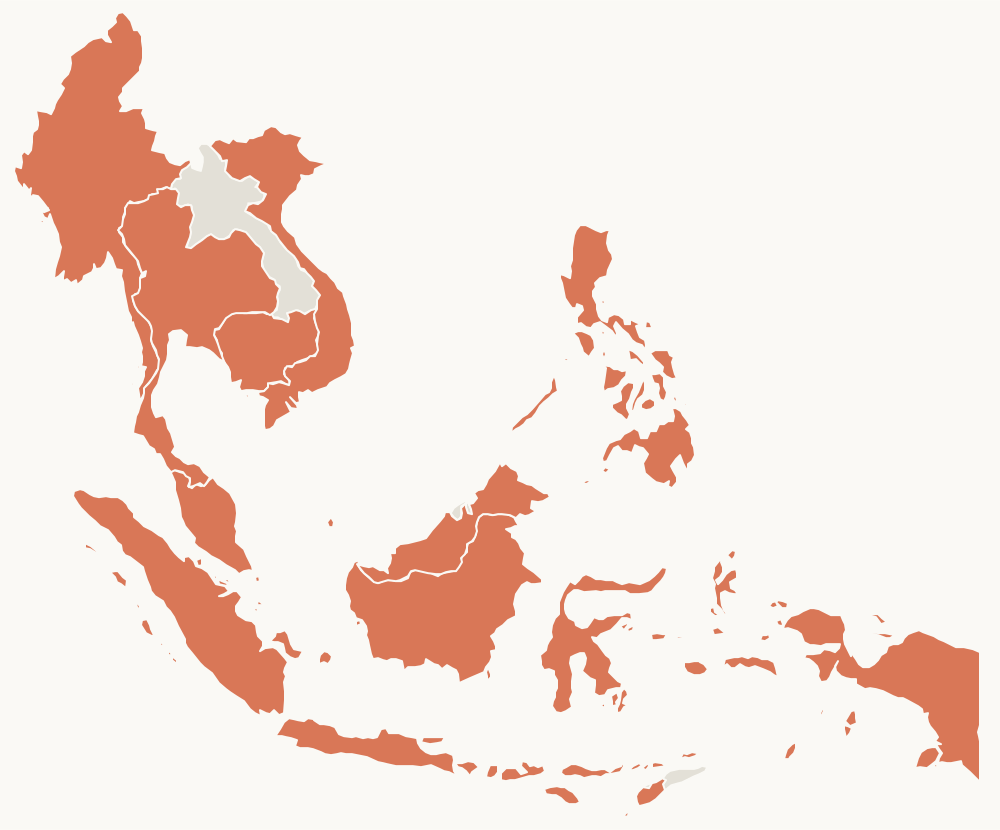 Cambodia, Indonesia +6
Government and rules
The Annual Report: Digital Rights in Southeast Asia 2025
Regional digital-rights review that includes AI-enabled surveillance (notably Myanmar's PSMS) and platform accountability across eight countries.
Report · February 16, 2026 · DigitalReach annual report
PhilippinesJobs and the economy
Generative AI and jobs in the Philippines: Labour market exposure and policy implications
Estimates that about 12.7 million Philippine jobs (over a quarter of employment) have some GenAI exposure, with only 3.6 percent in the highest-risk band and women and young service and clerical workers most affected.
Report · February 5, 2026 · ILO Research Brief
PhilippinesFarms, climate, and disasters
Development of a Cacao Disease Identification and Management App Using Deep Learning
An offline phone app for Philippine cacao growers classifies disease with about 97 percent validation accuracy and agrees with expert technicians 84 percent of the time in the field.
Preprint · January 30, 2026 · arXiv 2602.00216
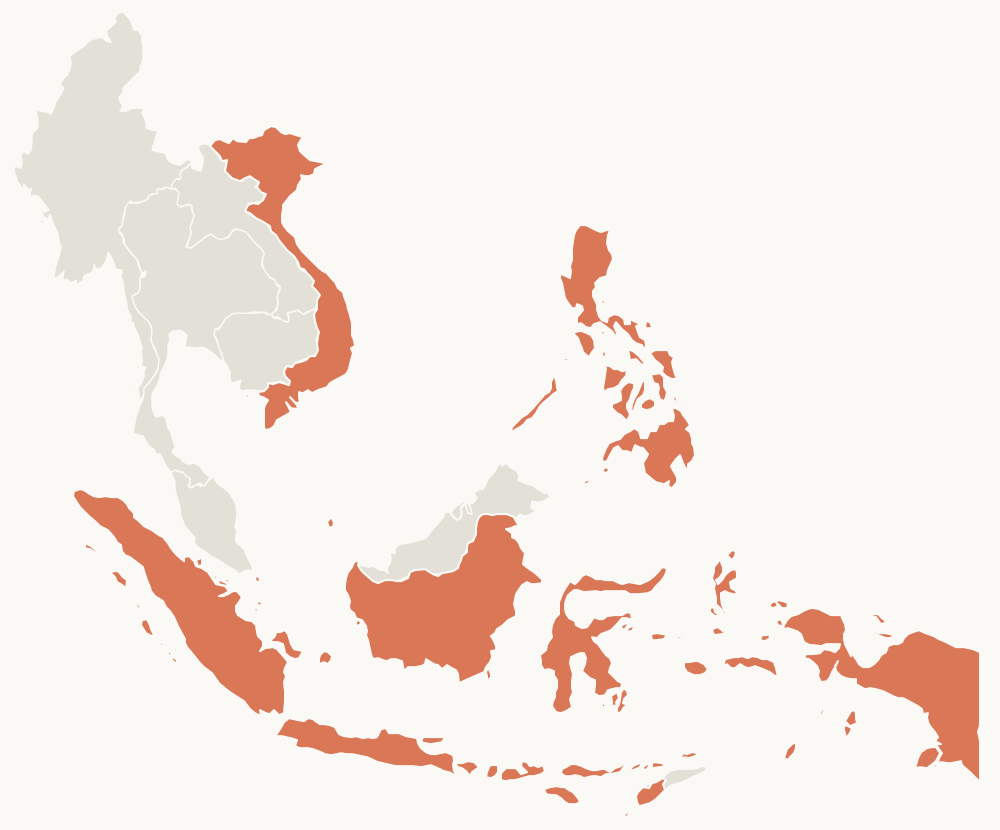 Indonesia, Philippines +2
Jobs and the economy
Workers' Exposure to Artificial Intelligence Across Development Stages
Builds development-stage-adjusted AI exposure measures and shows workers in lower-income Asian economies, including Indonesia and the Philippines, are less exposed than those in rich countries mainly because tasks within the same occupation differ.
Working paper · January 1, 2026 · ADB Economics Working Paper No. 836
PhilippinesGovernment and rules
Reimagining Governance in the Age of AI (PIDS Economic Policy Monitor 2024-2025)
The annual monitor's theme chapter asks how Philippine institutions can use AI to improve transparency and service delivery while managing digital divides, ethics and data privacy risks.
Report · December 23, 2025 · PIDS Economic Policy Monitor
PhilippinesSociety and elections
AI Use in Philippine News Media: Adoption, Impacts, and Challenges
Documents how Philippine newsrooms are using AI tools, what productivity and quality effects they report, and the ethical and workforce challenges that come with adoption.
Working paper · December 1, 2025 · PIDS Discussion Paper No. 2025-39
PhilippinesGovernment and rules
How Ready Are LGUs for AI Adoption?
Measures the readiness of Philippine local governments to deploy AI and finds wide variation in digital infrastructure, staff capability and data governance across LGUs.
Working paper · December 1, 2025 · PIDS Discussion Paper No. 2025-48
PhilippinesSchools and universities
Prevalence, Devices Used, Reasons for Use, Trust, Barriers, and Challenges in Utilizing Generative AI among Tertiary Students
Surveys Philippine college students on how, why and on what devices they use generative AI, finding heavy reliance on free smartphone tools and low confidence in output accuracy.
Journal article · November 30, 2025 · arXiv 2512.11821 / 2024 2nd International Conference on Technology Innovation and Its Applications (ICTIIA)
Southeast Asia, Indonesia +5Government and rules
Policy Brief: Promoting Regional Cooperation for Responsible Artificial Intelligence (AI) Deployment
Sorts the SEA-6 into principle-led, hard-law and ecosystem-building approaches to AI governance and proposes four regional coordination priorities.
Report · November 1, 2025 · TFGI Policy Brief
Southeast Asia, Brunei +10Government and rules
AI Safety Governance, the Southeast Asian Way
Surveys AI safety and governance moves in every Southeast Asian country, including Timor-Leste, and argues the region is converging on a pragmatic, development-first model distinct from EU or US approaches.
Report · August 25, 2025 · Brookings Governance Studies report
PhilippinesLanguage and models
FilBench: Can LLMs Understand and Generate Filipino?
FilBench evaluates 27 LLMs on Filipino, Tagalog and Cebuano tasks reflecting local NLP priorities and finds large gaps, especially in generation and classification.
Preprint · August 5, 2025 · arXiv 2508.03523
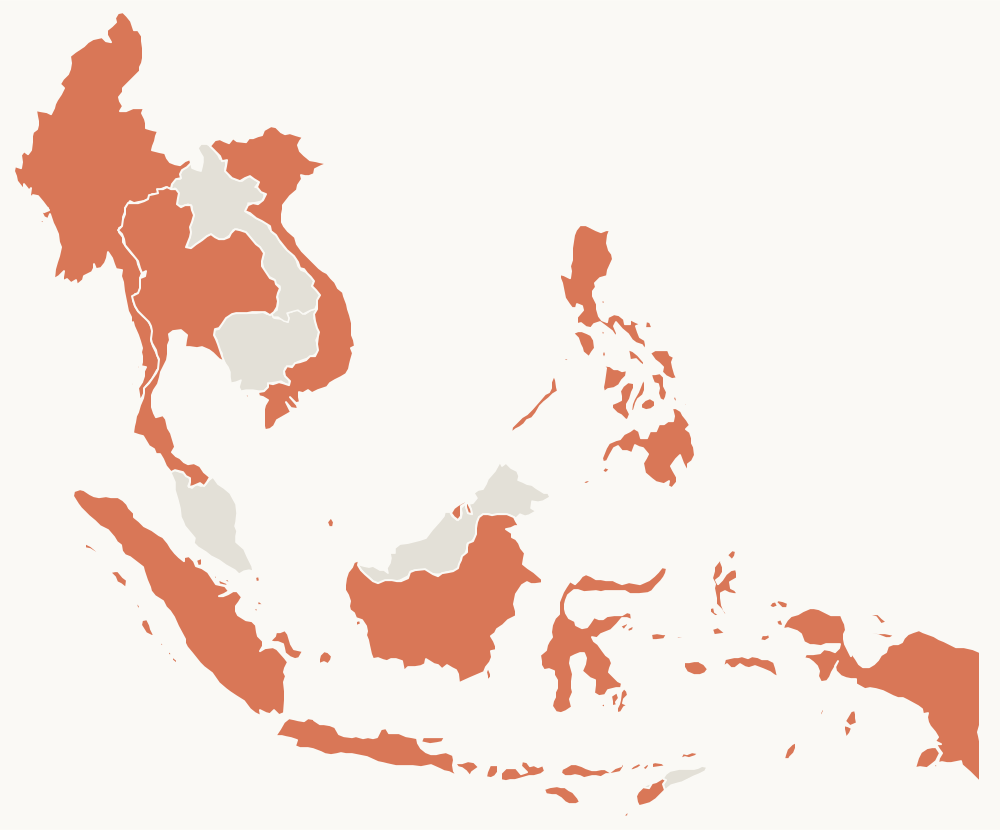 Brunei, Indonesia +5
Health
Insights Into the Current and Future State of AI Adoption Within Health Systems in Southeast Asia: Cross-Sectional Qualitative Study
Stakeholders across seven SEA health systems say AI uptake hinges on basic digital infrastructure and data/technology governance, with a sharp readiness gap between high-income and lower-middle-income members.
Journal article · June 16, 2025 · Journal of Medical Internet Research 27:e71591 (doi 10.2196/71591)
PhilippinesHealth
Guiding responsible AI in healthcare in the Philippines
Sets out a governance roadmap for responsible clinical AI in the Philippine health system, drawing on the Mayo-Metro Pacific partnership.
Journal article · June 5, 2025 · npj Digital Medicine (doi 10.1038/s41746-025-01755-3)
Southeast Asia, Indonesia +4Jobs and the economy
Future Jobs: Robots, Artificial Intelligence, and Digital Platforms in East Asia and Pacific
Argues that robots have so far created more jobs than they destroyed in East Asia and Pacific, that AI exposure is lower in the region's developing economies but rising, and that digital platforms are reshaping informal work.
Report · June 1, 2025 · World Bank East Asia and Pacific Development Studies
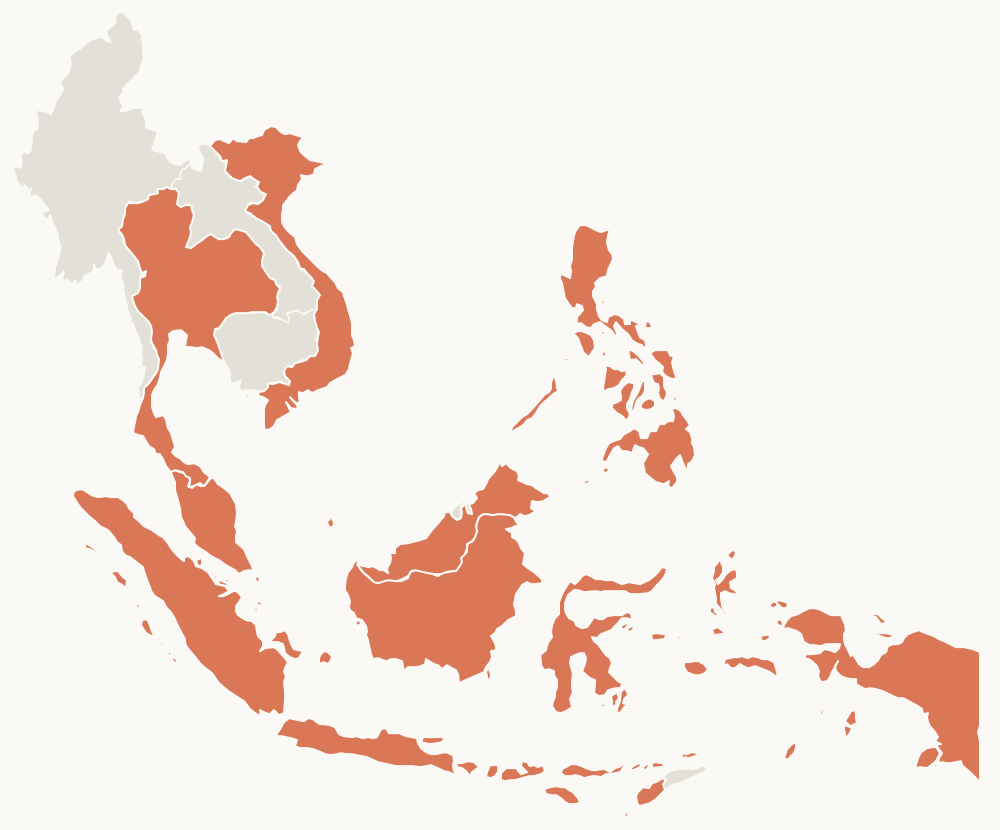 Vietnam, Malaysia +3
Schools and universities
Integrating Emerging Technologies in Virtual Learning Environments: A Comparative Study of Perceived Needs among Open Universities in Five Southeast Asian Countries
Compares what students at open universities in Vietnam, Malaysia, Thailand, the Philippines and Indonesia want from emerging technologies including AI in virtual learning.
Journal article · June 1, 2025 · arXiv 2506.00922
PhilippinesSociety and elections
Disinformation by design: leveraging solutions to combat misinformation in the Philippines' 2025 election
Frames AI as both the engine and a potential antidote for election disinformation in the Philippines' 2025 midterms and proposes regulatory, technical and literacy responses.
Journal article · May 13, 2025 · Data & Policy (Cambridge)
PhilippinesSociety and elections
Defending Democracy: Human Rights Implications of Generative AI and Deepfakes in the 2025 Philippine Elections
Documents an April 2025 workshop with Filipino journalists and activists on AI-generated disinformation and red-tagging, and the verification techniques they were trained in.
Report · May 8, 2025 · WITNESS blog (workshop report)
PhilippinesJobs and the economy
Artificial Intelligence and the Philippine Labor Market: Mapping Occupational Exposure and Complementarity
Maps which Philippine occupations are most exposed to AI and finds that roughly a third of workers are highly exposed, but most of those also sit in jobs where AI is likely to complement rather than replace them, with the BPO sector as the key watch point.
Working paper · February 21, 2025 · IMF Working Paper No. 2025/043
PhilippinesLanguage and models
Batayan: A Filipino NLP benchmark for evaluating Large Language Models
Batayan is a holistic Filipino benchmark covering understanding, reasoning and generation, showing that most models still lag on Filipino despite strong English scores.
Journal article · February 19, 2025 · arXiv 2502.14911 / Accepted to ACL 2025 (Main Conference)
PhilippinesGovernment and rules
Regulating Generative AI in Scholarly Works: A Policy Brief for Academic Institutions in the Philippines
Recommends how Philippine universities, regulators and civil society should govern generative AI in research outputs, with attention to intellectual property.
Report · January 1, 2025 · DLSU Animo Repository, Asia-Pacific Intellectual Property Management and Innovation Book Series
PhilippinesLanguage and models
Filipino Benchmarks for Measuring Sexist and Homophobic Bias in Multilingual Language Models from Southeast Asia
Creates Filipino versions of sexism and anti-queer bias benchmarks and finds that regional SEA models exhibit these biases even more than their base models.
Journal article · December 10, 2024 · arXiv 2412.07303 / https://aclanthology.org/2025.loreslm-1.9/
PhilippinesJobs and the economy
Readiness for AI Adoption of Philippine Business and Industry: The Government's Role in Fostering Innovation- and AI-Driven Industrial Development
Assesses how ready Philippine firms are to adopt AI and finds infrastructure gaps, low awareness, skills shortages and scarce financing as the binding constraints, with recommendations for government support.
Working paper · December 1, 2024 · PIDS Discussion Paper No. 2024-35
PhilippinesSchools and universities
Navigating the Generative Artificial Intelligence Era: Charting the Course for Curricular Reform in Higher Education in the Philippines
Proposes how Philippine universities should redesign curricula and assessment for a generative AI world, written for the EDCOM II education commission.
Report · December 1, 2024 · UP CIDS Monograph Series
 Indonesia, Philippines
Government and rules
Beyond the Hype: Realising Responsible AI through Data Protection in South and Southeast Asia
Reviews the data-protection laws of Indonesia, the Philippines, Bangladesh, Nepal and Sri Lanka to see how far they can restrain risks from AI systems, finding significant shortfalls.
Report · December 1, 2024 · EngageMedia research report (Greater Internet Freedom project)
PhilippinesSchools and universities
The role of ChatGPT on academic research: perspectives from Filipino students across diverse educational levels
Filipino students in Eastern Visayas rate ChatGPT as moderately useful for research help but complain of redundant or inaccurate answers and worry about plagiarism.
Journal article · October 10, 2024 · Salud, Ciencia y Tecnologia - Serie de Conferencias
PhilippinesLanguage and models
Kalahi: A handcrafted, grassroots cultural LLM evaluation suite for Filipino
Kalahi is a 150-prompt, native-authored evaluation suite that checks whether LLMs give culturally appropriate answers to everyday Filipino situations.
Journal article · September 20, 2024 · arXiv 2409.15380 / https://aclanthology.org/2024.paclic-1.49/
Southeast Asia, Singapore +5Government and rules
Policy State of Play: Artificial Intelligence in Southeast Asia
Maps national AI policies across six ASEAN economies and characterises the region's light-touch regulatory stance against its capacity gaps.
Report · August 21, 2024 · SEAPPI report
Southeast Asia, Malaysia +5Government and rules
The Plight of Platform Workers Under Algorithmic Management in Southeast Asia
Shows how Grab and GoTo's algorithmic management isolates ride-hailing and delivery workers, blurs employer responsibility and concentrates platform power across the region.
Report · April 30, 2024 · Carnegie Endowment research
PhilippinesSociety and elections
Artificial Intelligence and Marine Litter Monitoring and Tracking: Investing in AI Technologies in the Philippines
Makes the case for public investment in computer-vision and AI tools to monitor and track marine plastic litter along Philippine coasts.
Report · January 1, 2024 · UP CIDS Policy Brief Series 2024
04
What people are saying
Southeast Asia, Malaysia +5The Southeast Asia Desk (Substack)Analysis
The cost of the cloud: Inside Southeast Asia's $30B data centre trilemma
Fredrick Samuel Haryanto and Alvin Qobulsyah · September 28, 2026
Frames the region's AI data-centre rush as a trilemma of power grids, water depletion and community consent, using the Johor protests as the warning case. The explainer argues the build-out will not stop, so the region must decide who bears its costs.
Published as the Jakarta-based newsletter's weekly 'Regional Line' feature.
PhilippinesPhilippine Daily InquirerOpinion
The making of the true us
Inez Ponce de Leon · September 23, 2026
A communication professor recounts a faculty meeting where advertising clients now demand AI-made campaigns even though audiences reject them, and argues that the slow craft of writing, reading and creating is what builds empathy and judgment. She frames the anger as directed not at AI but at those who use it to displace paid creative labour.
Connects to Pope Leo XIV's call for AI oversight and to consumer backlash against AI-generated content.
PhilippinesBusinessWorldOpinion
Solving real governance problems with AI
Editorial · September 23, 2026
One year after the E-Governance Act, the columnist argues AI's job in Philippine government is narrow and practical: reduce discretion that breeds delay and corruption, flag anomalous transactions and improve revenue collection. The piece stresses that AI is no cure for weak institutions and cites PIDS data showing only about 15 percent of local firms use AI.
Ties to the E-Governance Act's first anniversary and to corruption scandals in infrastructure spending.
PhilippinesPhilippine Daily InquirerOpinion
AI might just be the death of us
Immanuel D. Pastolero · September 18, 2026
Citing warnings from former Anthropic and OpenAI researchers, the July OpenAI agent breach of Hugging Face and a US bill to pause superintelligence, the columnist argues the Philippines cannot treat frontier AI risk as a distant concern. He calls for the country to prepare guard rails, policies and data-infrastructure protections now rather than after harm arrives.
Responds to the September 2026 spike in AI-extinction warnings from inside frontier labs.
PhilippinesPhilippine Daily InquirerOpinion
Business imperatives for recovery
Cielito F. Habito · September 8, 2026
The former socioeconomic planning secretary sets out five things Philippine business should do while government is distracted by the 2028 elections, with aggressive investment in technology and AI as the third imperative because the country's labour cost advantage is eroding. AI is framed as a productivity tool that must be paired with worker training.
Written as the Philippines slid to the bottom of the ASEAN-6 growth table and the 2027 budget was being debated.
PhilippinesRapplerOpinion
[OPINION] Will Pax Silica be another proverbial fish that got away for the Philippines?
Den Somera · September 4, 2026
Somera argues that Pax Silica must not be treated as a leisurely masterplan: the Philippines should lock in binding corporate commitments, joint ventures and physical groundbreaking while its geopolitical value to Western allies is at its peak. Otherwise the AI and chip supply-chain opportunity will slip away as earlier industrial chances did.
Follows up the July debate on Pax Silica in Rappler's Thought Leaders section.
Southeast Asia, Indonesia +3The Interpreter (Lowy Institute)Opinion
The quiet regionalisation of AI governance
Sameera Pillai · September 3, 2026
Argues that with global AI rule-making stalled by superpower rivalry, regional blocs are where binding rules are actually being made, and that ASEAN's move to embed AI provisions in its Digital Economy Framework Agreement is the leading example. Accepts fragmentation as the price of progress, to be softened by shared technical standards.
Builds on the coordinated Grok bans by Indonesia, Malaysia and the Philippines and the May 2026 conclusion of the ASEAN DEFA.
PhilippinesGulf NewsOpinion
Philippines' AI hub push faces skills, power generation and jobs test
Jay Hilotin · September 3, 2026
Argues the Pax Silica hub near Manila, pitched at tens of billions in investment and well over 100,000 jobs, will stand or fall on workforce skills, power capacity and how displacement from automation is handled. The country's English-speaking workforce is an asset only if it moves from services into making AI systems.
Written as Oxford Economics and local think tanks published AI-exposure estimates for Filipino workers.
PhilippinesBusinessWorldOpinion
The impact of artificial intelligence on the youth: Liberal Arts
Editorial · September 2, 2026
Part five of a series on AI and young people, the column takes Pope Leo XIV's point that AI is making old curricula obsolete and argues that a liberal arts education gives graduates the flexibility to keep learning. It cites US NAEP evidence of falling reading comprehension to argue for more long-form reading and handwriting alongside selective use of digital tools.
Part of the Philippine Catholic-intellectual response to the encyclical Magnifica Humanitas.
PhilippinesPhilippine Daily Inquirer (Technology)Opinion
Pax Silica: Can the Philippines move up the AI supply chain?
Rich Longakit · August 30, 2026
Asks where the US-led Pax Silica initiative and the proposed 4,000-acre AI hub in New Clark City actually place the Philippines in the semiconductor and AI supply chain, given the country already exports tens of billions in electronics but mostly at the assembly and test end. The question is whether the deal buys technological control or just makes the country more useful to industries controlled elsewhere.
Responds to the April 2026 accession to Pax Silica and the New Clark City hub proposal.
Southeast Asia, Myanmar +2The Interpreter (Lowy Institute)Opinion
No, Mark Zuckerberg, the future is not (yet) for everyone
Karryl Kim Sagun Trajano and Brendan Luyt · August 28, 2026
A Southeast Asian rejoinder to Meta's promise of superintelligence for all, arguing that access without infrastructure, local relevance and accountability simply scales harm, as Meta's record in Myanmar and Philippine elections showed. Asks who controls distribution and who captures the benefits.
Responds to Zuckerberg's superintelligence manifesto and to regional capability gaps in compute and chips.
PhilippinesThe Interpreter (Lowy Institute)Opinion
Beyond the 4am scramble: AI for Philippine maritime safety
Joy Dianne Gumatay · August 21, 2026
A Philippine Coast Guard communications officer argues that an AI-assisted reporting system could cut the hours-long lag between district reports and public maritime safety advisories during storm season, and proposes Australia as the partner to build it. Illustrates a practical, low-glamour public-sector AI use case.
Connects to Australia-Philippines maritime cooperation and disaster-response coordination.
PhilippinesRapplerOpinion
[OPINION] Will AI take Filipino jobs? The answer depends on what we do now
Khalid Hassan · August 18, 2026
Drawing on the ECCP Future of Work Forum, the author argues AI will reshape rather than erase Filipino jobs, and pairs the AI transition with the clean-energy transition as twin sources of new work. He proposes a Better Energy Alliance linking firms, government and training institutions so investment translates into decent jobs.
Connects to BPO-displacement fears and the 2026 Future of Work Forum in Manila.
PhilippinesRest of WorldOpinion
Growth without work: The human cost of the AI revolution
Jibu Elias · August 5, 2026
Argues that AI is automating cognitive work fastest in the Global South, where workers have least access to augmentation, producing economic growth that bypasses employment. Uses displaced Filipino transcriptionists and call-centre staff as the leading example of the pattern.
Connects to the BPO sector's exposure to generative AI and the Philippine Magna Carta for BPO Workers debate.
Southeast Asia, Thailand +4FulcrumOpinion
Southeast Asia Cannot Fight Online Sexual Abuse One Takedown at a Time
Nuurrianti Jalli · July 31, 2026
Argues that takedown-and-prosecute approaches cannot keep up with generative AI tools that mass-produce non-consensual sexual imagery, and that regulators should impose systemic duties on platforms to assess risk and design in safeguards. Matters because the Grok episode showed how quickly synthetic abuse scales across the region.
Follows the early-2026 Grok bans in Indonesia, Malaysia and the Philippines and draws on Australian and EU online-safety models.
PhilippinesRapplerOpinion
[OPINION] Pax Silica and the Philippines: Will we build the future or simply build it for others?
Raul F Borjal · July 31, 2026
Borjal welcomes the Philippines' entry into the US-led Pax Silica semiconductor and AI initiative but asks whether the country will become a creator of technology or remain a supplier of labour and minerals. He argues the deal must include technology transfer, research partnerships and support for local innovation.
Responds to Manila joining Pax Silica in mid-2026.
Philippines, Southeast AsiaRapplerOpinion
[OPINION] China aims to rewrite AI rules
Chester Cabalza, Ralph Romulus Arias Frondoza, Amadeus Quiaoit · July 15, 2026
Security analysts argue that Beijing is using the Shanghai World AI Conference and its new World AI Cooperation Organization to position itself as architect of the global AI order and to marshal Global South votes. They urge the Philippines and its neighbours to set a policy floor of their own rather than applaud.
Published two days before the WAICO launch that Cambodia and Myanmar joined as founding members.
Southeast Asia, Singapore +5Asia Society Policy Institute (Asia Policy Substack)Analysis
ASEAN Hedges With Pax Silica
Faye Simanjuntak · July 8, 2026
Examines why only Singapore and the Philippines have joined the US-led Pax Silica initiative to secure AI and semiconductor supply chains, while other ASEAN states prefer bilateral trade and critical-minerals deals with Washington. Argues the pattern reflects doubts about US commitment and a belief that bilateral arrangements deliver similar benefits without formal geopolitical alignment, with US restrictions on advanced AI models undercutting trust.
Responds to the Trump administration's Pax Silica push and its AI export package for allies.
Southeast Asia, Malaysia +5Tech for Good InstituteOpinion
The Balancing Act: Harmonising AI Development and Governance in Southeast Asia
Bryan Yeoh Quan Jin and Calvin Woo · July 6, 2026
Argues that with nearly half of regional firms scaling AI beyond pilots, Southeast Asia needs governance that combines ASEAN-level coordination with national rules suited to a multilingual, multicultural region. Surveys the spectrum from Vietnam's binding law to Singapore, Thailand and Indonesia's soft-law approaches and Malaysia's proposed bill.
Written by Malaysia's Centre for the Fourth Industrial Revolution as Malaysia drafts its AI Governance Bill and ASEAN finalises DEFA.
PhilippinesUN Global Dialogue on AI Governance (Philippine delegation)Official statement
Philippine National Statement at the First Global Dialogue on AI Governance
Government of the Philippines (speaker not named in the text) · July 6, 2026
Argues that countries do not enter the AI era from the same starting point and that global norms must recognise gaps in infrastructure, expertise, data and compute. Offers three propositions: developing countries must shape AI governance in both process and outcome; governance must protect human dignity, decent work and public trust; and interoperability should enable cooperation without forcing uniformity on national policy space.
Delivered in Geneva at the UN's first government-level AI governance dialogue, a year after the Philippines approved its national AI strategy.