- 13%
- People using generative AIMicrosoft AI Diffusion Report, 2026-Q2
- 0.7
- Claude use per personAnthropic Economic Index, 2026-05
- 96
- ChatGPT messages per person, world rankOpenAI Signals, 2026-Q2
01
Who is using AI
02
What governments are doing
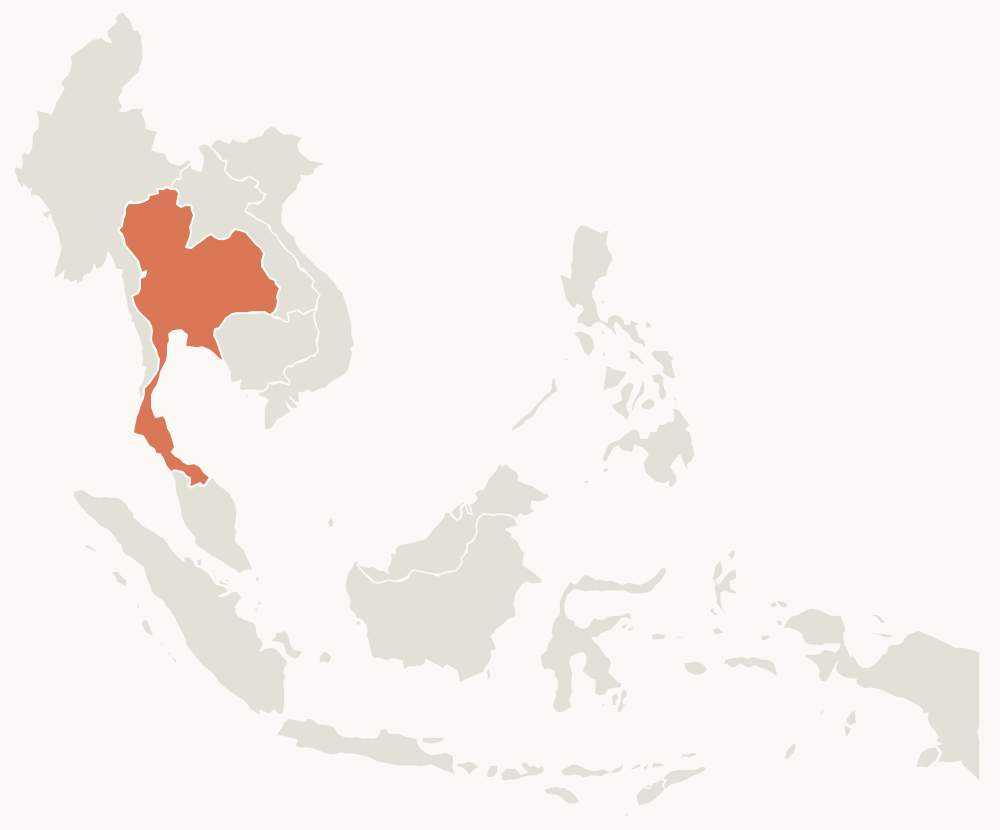
Thailand
Verified September 29, 2026
- Strategy
- Thailand National AI Strategy and Action Plan (2022-2027)July 26, 2022
- AI law
- Draft Act on Artificial Intelligence (Draft AI Act) B.E. ....Draft, August 14, 2026
- Guidance
- Thailand's AI Governance Guideline for Executives (plus the ETDA AI governance guideline and toolkit series)2023
- Data law
- Personal Data Protection Act B.E. 2562 (2019) (PDPA)Enacted, June 1, 2022
- Sector rules
- Bank of Thailand Policy Direction on Risk Management of the Use of AI Systems (Guiding Principles for AI Risk Management)September 12, 2025A policy direction (not a formal notification) for BOT-supervised financial institutions and payment providers covering in-house and third-party AI, organised around governance and development-and-security pillars, FEAT principles, and data, model and cyber risks; draft consulted June 2025.
- Guideline on AI Governance for Insurance Companies (AI Governance Guideline)2025Risk-proportionate guidance for insurers in four parts (AI governance, robustness and security, transparency and explainability, fairness and consumer protection), aimed especially at customer-facing and high-risk uses such as underwriting and claims.
- Governance Framework for the Use of AI and Machine Learning in the Capital Market2023Best-practice manual transmitted to securities, derivatives, asset-management and advisory firms (circular Kor Lor Tor. Tor Tor. (Wor) 57/2566); non-binding but treated as the SEC's expectations, and law-firm coverage in April 2026 describes an updated framework that signals future formal rules.
- Guidelines on the Use of Artificial Intelligence for Telecommunications ServicesJuly 2, 2026Non-binding, risk-based guidance for telecom licensees on governance committees, six principles (compliance, fairness, security and privacy, transparency, accountability, reliability), lifecycle controls, vendor oversight and consumer disclosure; the document itself was not located on the NBTC site.
Naming: the current bill is referred to variously as the Draft AI Act, the Draft Act on Artificial Intelligence, and in Thai ร่างพระราชบัญญัติปัญญาประดิษฐ์; it replaced the mid-2025 (Draft) Principles of the AI Law (ร่างหลักการของกฎหมายว่าด้วยปัญญาประดิษฐ์), which itself merged the 2022 ONDE Draft Royal Decree on Business Operations Using AI Systems and the 2023 ETDA Draft Act on the Promotion and Support for National AI Innovation. Both of those older drafts are dead as standalone instruments. Sources disagree on whether the 2026 draft was released on 2 July (Mondaq, Norton Rose) or 9 July (Baker McKenzie, TFGI); the consultation close of 14 August 2026 is consistent. Status on 2026-09-29: consultation closed, ETDA processing comments, no Cabinet submission yet; the Business Software Alliance and AMCHAM have lobbied against strict and joint liability, data localisation and government control of contract terms (AMCHAM met ETDA on 2026-09-22). Draft penalties include criminal liability for AI-generated sexual content and false election statements, which is the closest thing Thailand has to a deepfake or election rule; the Election Commission had no AI-specific campaign rule for the 2026-02-08 general election (Thai PBS Verify, 2026-01-16), and deepfakes are otherwise handled under the Computer-related Crime Act and Criminal Code defamation. Other binding-ish sector items not in the four slots: OCPB notification of 2025-07-18 requiring labelling of AI-generated advertising; Civil Court directive B.E. 2568 requiring disclosure of AI-prepared pleadings; Supreme Court President guidance B.E. 2568 on judges' AI use; NCSA AI security guideline (September 2025). ETDA's AIGC was rebranded the AI Governance Practice Center (AIGPC) in 2026 and Thailand is seeking UNESCO Category 2 status for it. The OECD.AI entry lists NESDC as responsible organisation, but the strategy is run operationally by NECTEC/NSTDA via ai.in.th; MHESI and MDES co-own it. TH-AI Passport: official sites are aipass.go.th and de.aipass.net; registration opened 2026-08-19, service 2026-08-31, program ends 2027-08-31; the THB 1.6 billion figure and the Digital Economy Fund funding route come from press (Fulcrum 2026-09-28, Bangkok Post) and were not seen on the official site. Minister's name is romanised as Chaichanok or Chaiyanok Chidchob. The ETDA AI Governance Guideline for Executives PDF is a slide-style 18-page document dated 2023; ETDA also publishes a broader Thai AI Ethics Guideline series under MDES. The BOT instrument is a policy direction (แนวนโยบาย), formally non-binding but treated as supervisory expectation. The OIC guideline PDF is dated November 2025 and was read directly. The NBTC guideline is known only from law-firm summaries; the NBTC URL given is the regulator's home page, not the document.
03
What researchers are finding
ThailandHealth
ASCRIBE: Atomic and Significance-Based Reasoning for Thai Clinical SOAP Note Generation
Shows that having an AI rank how clinically important each fact in a Thai doctor-patient conversation is before writing the visit note makes the notes more complete, and lets a small model trained on synthetic data match a leading commercial one.
Preprint · October 1, 2026 · arXiv 2610.01234
ThailandLanguage and models
Reference-Grounded Data Curation for Instruction-Following Thai-English Machine Translation
Releases small open Thai-English translation models trained on carefully filtered examples that follow instructions on terminology and formatting without losing accuracy, matching or beating same-size rivals.
Preprint · September 28, 2026 · arXiv 2609.34770
ThailandSchools and universities
Not human, still social: Thai EFL learners' willingness to communicate with ChatGPT
Finds that Thai learners of English stayed willing to speak with ChatGPT because it felt socially present yet clearly not human, understood them and never judged their mistakes.
Journal article · September 28, 2026 · Technology in Language Teaching & Learning
ThailandSchools and universities
Factors Influencing the Acceptance and Application of Artificial Intelligence Technologies among University Lecturers in Thailand
Finds that Thai lecturers plan to use AI when they expect it to help, enjoy it, see colleagues using it and have made it a habit, while ease of use and cost make little difference.
Journal article · September 24, 2026 · Human Behavior, Development and Society
ThailandLanguage and models
ThaiTrees: Thai Syntactic Dependency Trees Across Domains
Releases a 342-million-word Thai corpus from news, Wikipedia, speech transcripts and social media, machine-parsed for grammar so researchers and language tools can study how Thai sentences are built.
Preprint · September 23, 2026 · arXiv 2609.27558
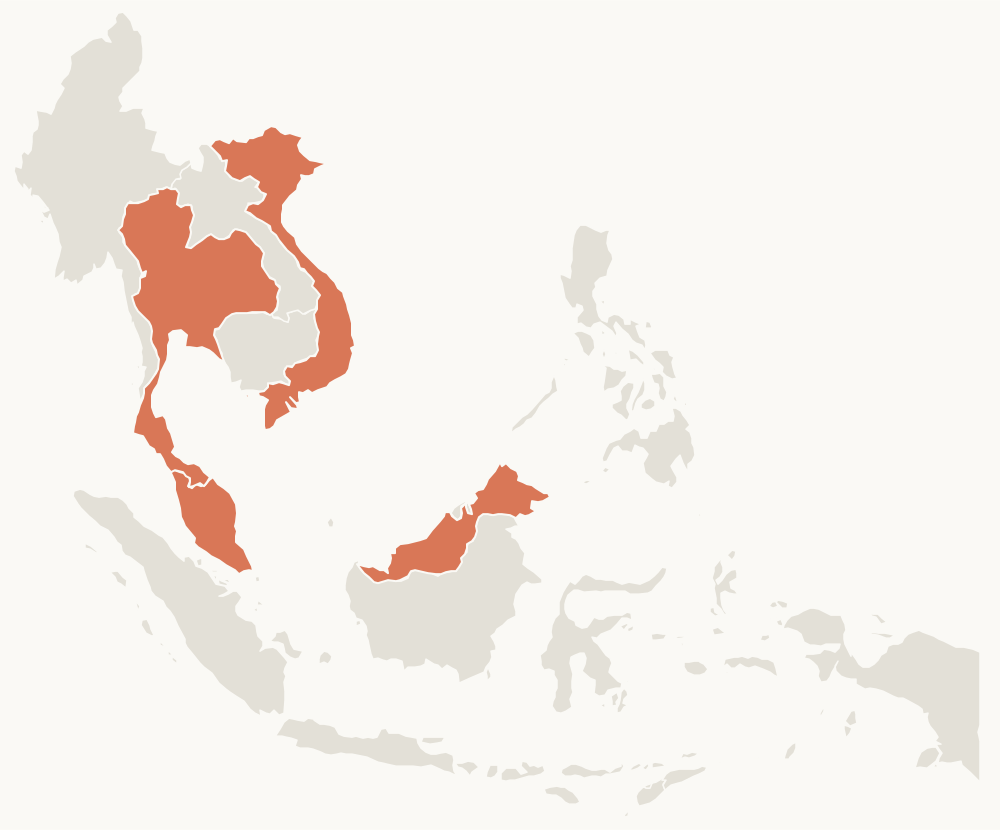 Singapore, Malaysia +2
Government and rules
Governing for Adoption: The Role of Legal and Regulatory Frameworks in Shaping AI Uptake in Southeast Asia
Compares four ASEAN legal regimes to show how sandboxes, data-sharing rules and AI assurance mechanisms, not tax incentives, drive AI commercialisation and adoption.
Journal article · July 31, 2026 · IntechOpen (perspective chapter)
ThailandHealth
From Classification to Localization and Clinical Validation: Large-Scale Development of a Deep Learning System for Thoracic Disease Detection on Chest Radiographs in Thailand
Documents the multi-year build of a Thai chest X-ray AI (Inspectra CXR) that generalizes across hospitals with AUROC near 0.97 and is rated highly usable by radiologists.
Preprint · July 10, 2026 · arXiv 2607.09305
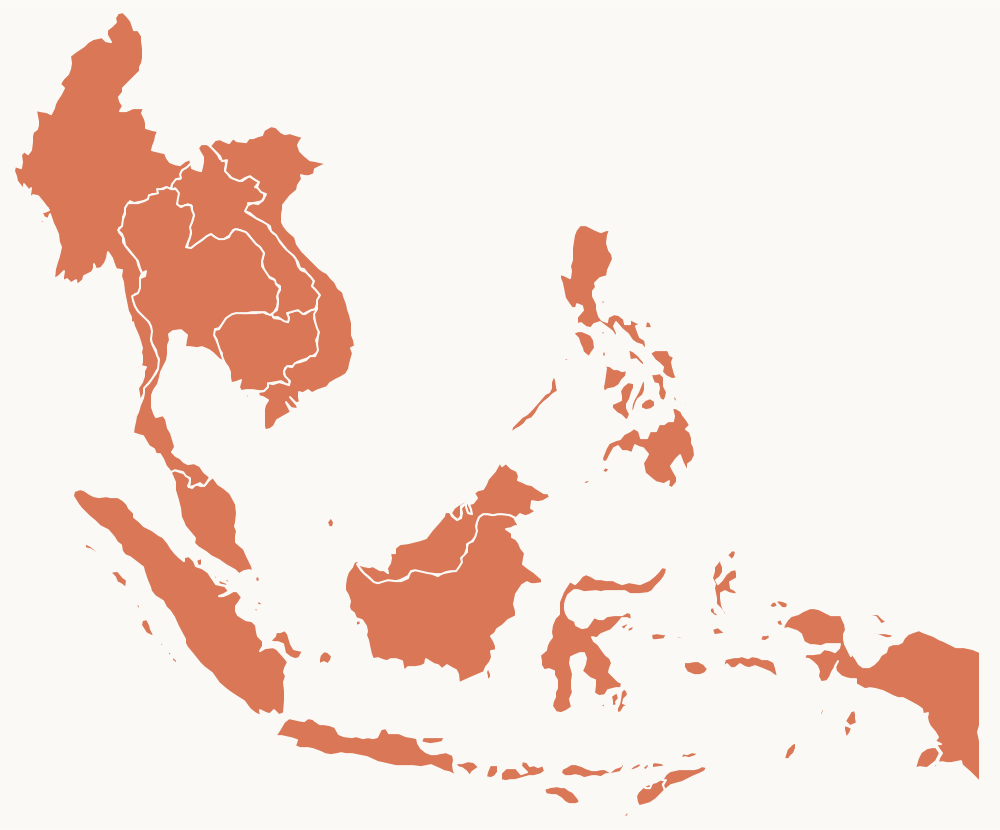 Southeast Asia, Indonesia +6
Jobs and the economy
Generative AI and labour markets in ASEAN: Significant exposure, limited disruption, uneven preparedness
Puts nearly 80 million ASEAN workers (22.9 percent of employment) in GenAI-exposed occupations yet finds no sign of broad displacement so far, with women overrepresented in the most exposed jobs and a gap between exposure and institutional readiness.
Report · July 8, 2026 · ILO Brief
ThailandLanguage and models
ThaiSafetyBench: Assessing Language Model Safety in Thai Cultural Contexts
ThaiSafetyBench introduces culturally grounded Thai jailbreak and harm prompts, including Thai legal and social taboos, to evaluate LLM safety.
Journal article · March 5, 2026 · arXiv 2603.04992
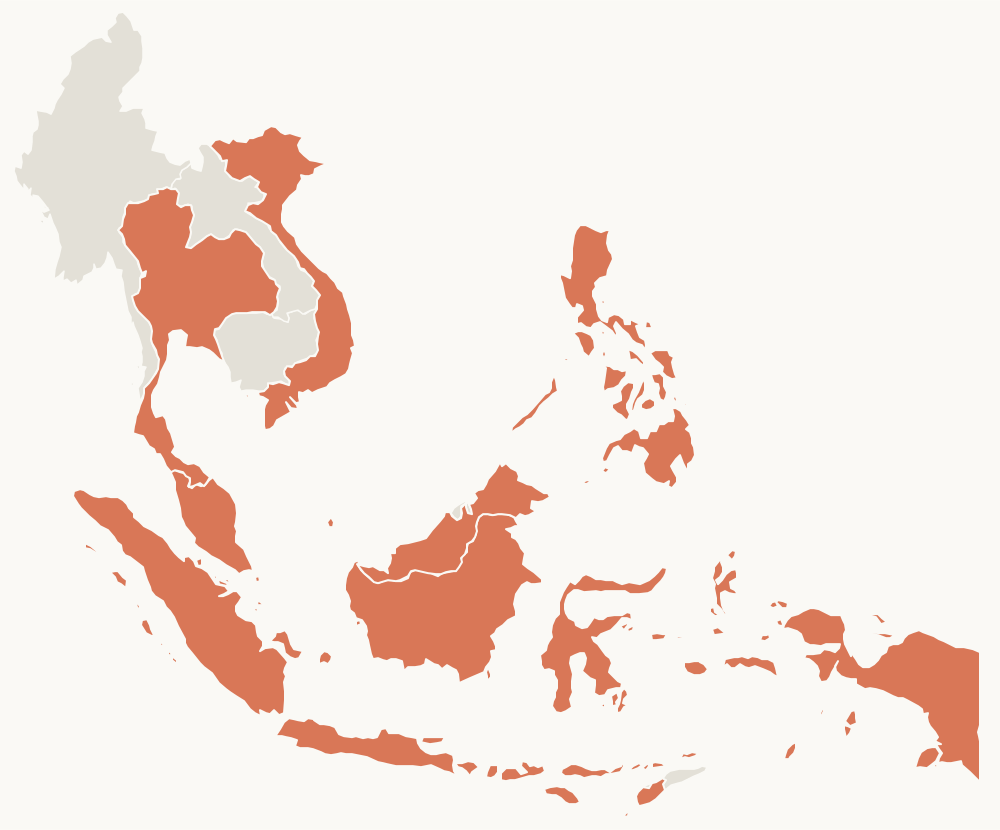 Indonesia, Malaysia +4
Government and rules
The Evolution of Tech Governance in Southeast Asia-6, Third Edition
Tracks how SEA-6 digital governance shifted from AI ethics principles toward binding rules, sovereign compute investment and safety-testing regimes during 2025.
Report · March 4, 2026 · TFGI annual report
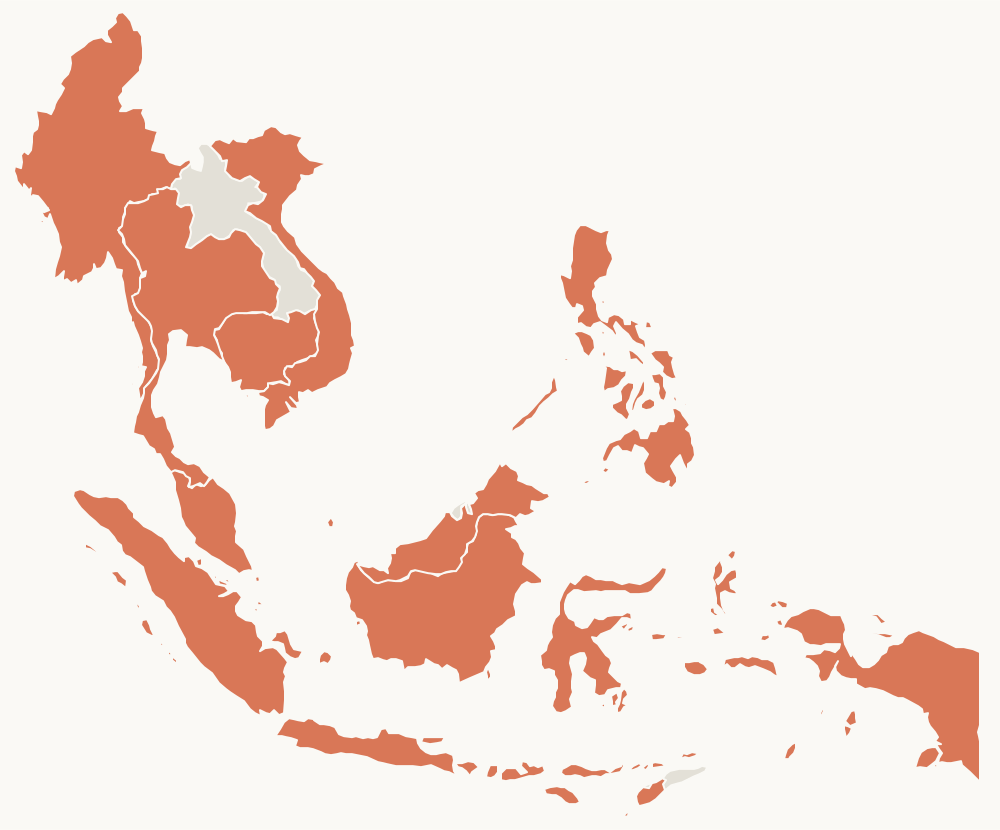 Cambodia, Indonesia +6
Government and rules
The Annual Report: Digital Rights in Southeast Asia 2025
Regional digital-rights review that includes AI-enabled surveillance (notably Myanmar's PSMS) and platform accountability across eight countries.
Report · February 16, 2026 · DigitalReach annual report
ThailandHealth
Study of the Effectiveness of Artificial Intelligence in Diagnosing Pulmonary Tuberculosis from Chest Radiographs at Samrongthap Hospital, Surin Province
Evaluates the real-world diagnostic performance of an AI chest X-ray reader for pulmonary TB in a Thai district hospital.
Journal article · January 1, 2026 · Journal of Health Science of Thailand (thaidj.org)
Southeast Asia, Indonesia +5Government and rules
Policy Brief: Promoting Regional Cooperation for Responsible Artificial Intelligence (AI) Deployment
Sorts the SEA-6 into principle-led, hard-law and ecosystem-building approaches to AI governance and proposes four regional coordination priorities.
Report · November 1, 2025 · TFGI Policy Brief
ThailandHealth
Efficacy of tuberculosis screening using the AI Chest 4All (DMS-TU) for Thai People innovation at Udonthani Cancer Hospital
Reports how the Thai Department of Medical Services' home-grown AI Chest 4All tool performs at TB screening in a provincial cancer hospital.
Journal article · October 25, 2025 · The Thai Journal of Radiological Technology (ThaiJO)
ThailandLanguage and models
JAI-1: A Thai-Centric Large Language Model
JAI-1 is a 75B-parameter Thai-centric LLM that grows the architecture during Thai adaptation rather than overwriting existing knowledge.
Preprint · October 8, 2025 · arXiv 2510.08620
Southeast Asia, Brunei +10Government and rules
AI Safety Governance, the Southeast Asian Way
Surveys AI safety and governance moves in every Southeast Asian country, including Timor-Leste, and argues the region is converging on a pragmatic, development-first model distinct from EU or US approaches.
Report · August 25, 2025 · Brookings Governance Studies report
ThailandLanguage and models
WangchanThaiInstruct: An instruction-following Dataset for Culture-Aware, Multitask, and Multi-domain Evaluation in Thai
WangchanThaiInstruct is a native-written Thai instruction dataset spanning four domains that reveals gaps between translated and native Thai evaluation.
Journal article · August 21, 2025 · arXiv 2508.15239 / Accepted to EMNLP 2025 (Main)
ThailandGovernment and rules
Thailand: Artificial Intelligence Readiness Assessment Report 2025
Finds Thailand has a national AI strategy but no AI-specific law or risk-based regulator, a shortfall of about 80,000 AI professionals, and persistent digital access gaps for rural, minority and elderly groups.
Report · June 26, 2025 · UNESCO AI Readiness Assessment Methodology country report
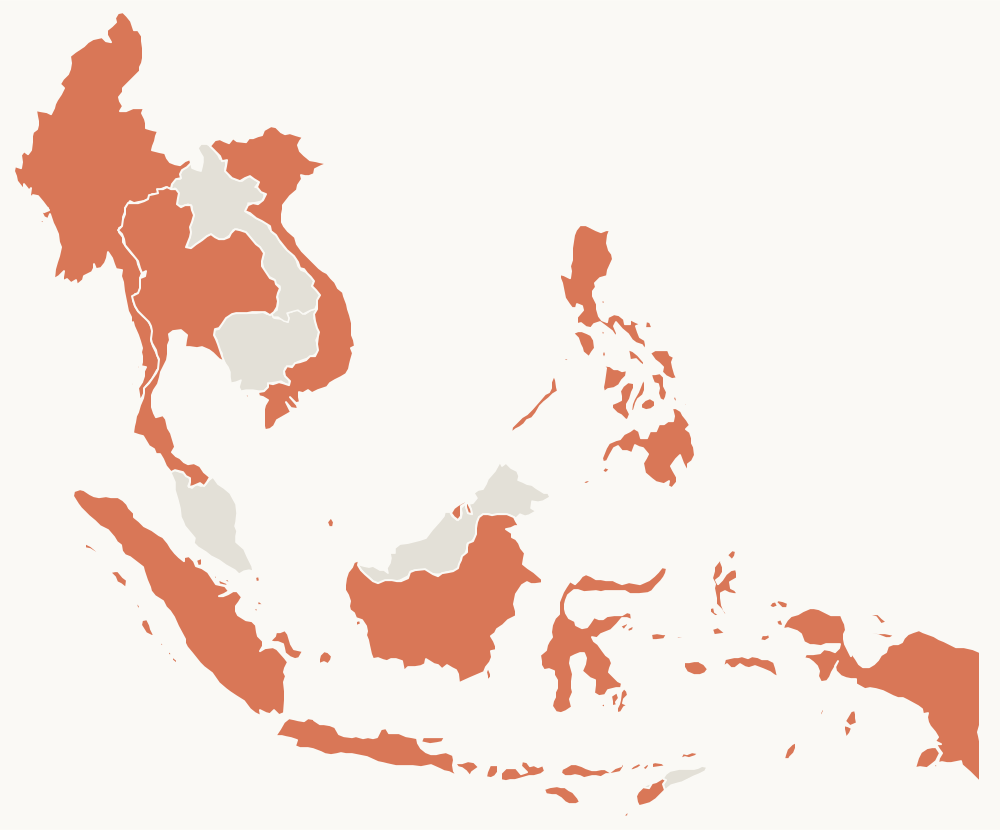 Brunei, Indonesia +5
Health
Insights Into the Current and Future State of AI Adoption Within Health Systems in Southeast Asia: Cross-Sectional Qualitative Study
Stakeholders across seven SEA health systems say AI uptake hinges on basic digital infrastructure and data/technology governance, with a sharp readiness gap between high-income and lower-middle-income members.
Journal article · June 16, 2025 · Journal of Medical Internet Research 27:e71591 (doi 10.2196/71591)
Southeast Asia, Indonesia +4Jobs and the economy
Future Jobs: Robots, Artificial Intelligence, and Digital Platforms in East Asia and Pacific
Argues that robots have so far created more jobs than they destroyed in East Asia and Pacific, that AI exposure is lower in the region's developing economies but rising, and that digital platforms are reshaping informal work.
Report · June 1, 2025 · World Bank East Asia and Pacific Development Studies
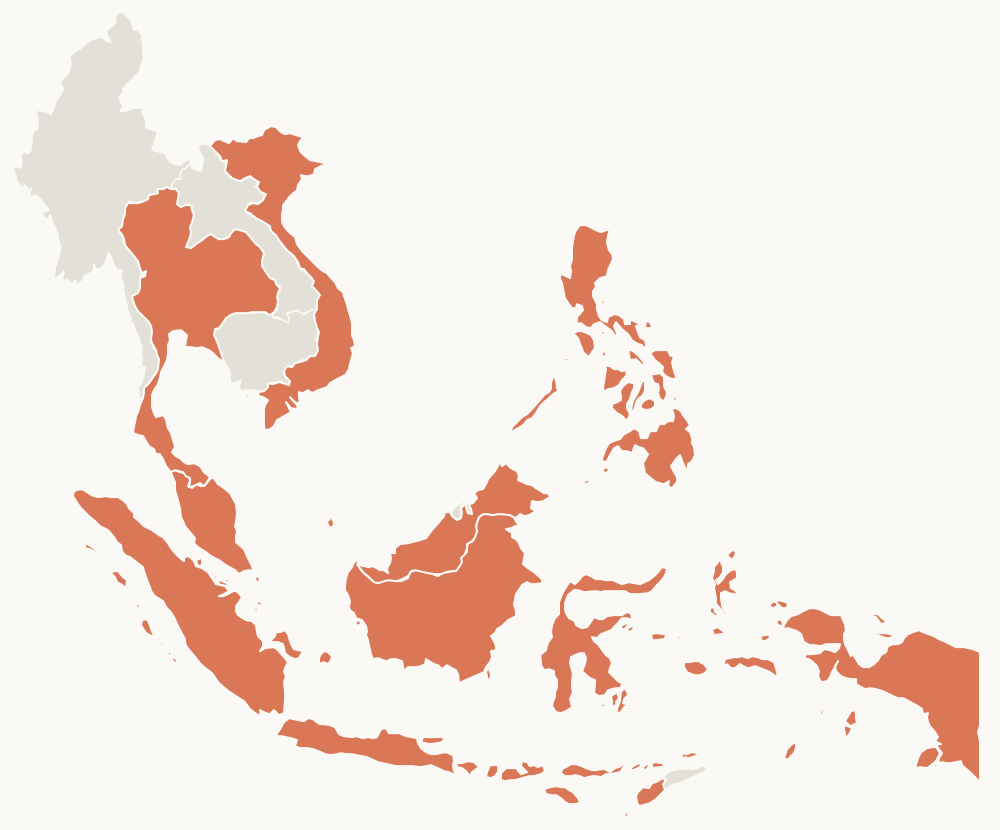 Vietnam, Malaysia +3
Schools and universities
Integrating Emerging Technologies in Virtual Learning Environments: A Comparative Study of Perceived Needs among Open Universities in Five Southeast Asian Countries
Compares what students at open universities in Vietnam, Malaysia, Thailand, the Philippines and Indonesia want from emerging technologies including AI in virtual learning.
Journal article · June 1, 2025 · arXiv 2506.00922
ThailandSociety and elections
AI and Forbidden Knowledge in the Context of Thailand
Tests how ChatGPT, Copilot and Gemini handle Thai taboo and legally sensitive topics (e.g., lese majeste, religion) and whether their refusals align with Thai social norms.
Journal article · May 27, 2025 · Journal of Integrative and Innovative Humanities 5(1)
Southeast Asia, Singapore +4Health
Artificial intelligence utilization in cancer screening program across ASEAN: a scoping review
Maps the thin but growing evidence base on AI-assisted cancer screening in ASEAN, finding most studies concentrated in a few countries and only half reaching prospective clinical evaluation.
Journal article · April 15, 2025 · BMC Cancer (PMC12001681)
ThailandGovernment and rules
NitiBench: A Comprehensive Study of LLM Framework Capabilities for Thai Legal Question Answering
NitiBench benchmarks retrieval-augmented and long-context LLM setups on Thai legal question answering, showing retrieval and legal structure both limit accuracy.
Preprint · February 15, 2025 · arXiv 2502.10868
ThailandHealth
Challenges and Opportunities for Data Sharing Related to Artificial Intelligence Tools in Health Care in Low- and Middle-Income Countries: Systematic Review and Case Study From Thailand
Thai health stakeholders confirm that infrastructure, policy and organizational barriers identified in the LMIC literature block the data sharing needed for clinical AI, and call for unified platforms and standards.
Journal article · February 4, 2025 · Journal of Medical Internet Research (PMC11836587)
ThailandJobs and the economy
Exploring the Thai Job Market Through the Lens of Natural Language Processing and Machine Learning
Builds an algorithm that standardises Thai online job-posting data into occupation codes so that vacancy and skills trends can be tracked in near real time, filling a gap in Thai labour statistics.
Working paper · January 13, 2025 · PIER Discussion Paper No. 228
ThailandLanguage and models
Typhoon 2: A Family of Open Text and Multimodal Thai Large Language Models
Typhoon 2 extends the Thai LLM family to text, vision and audio models with safety tuning, reporting strong Thai performance at small parameter counts.
Preprint · December 18, 2024 · arXiv 2412.13702
ThailandHealth
Attitudes and perceptions of Thai medical students regarding artificial intelligence in radiology and medicine
Only about a third of Thai medical students had a basic grasp of AI, yet almost all wanted it in the curriculum and those who understood it better were more upbeat about AI in radiology.
Journal article · October 22, 2024 · BMC Medical Education (PMC11515691)
Southeast Asia, Singapore +5Government and rules
Policy State of Play: Artificial Intelligence in Southeast Asia
Maps national AI policies across six ASEAN economies and characterises the region's light-touch regulatory stance against its capacity gaps.
Report · August 21, 2024 · SEAPPI report
Southeast Asia, Malaysia +5Government and rules
The Plight of Platform Workers Under Algorithmic Management in Southeast Asia
Shows how Grab and GoTo's algorithmic management isolates ride-hailing and delivery workers, blurs employer responsibility and concentrates platform power across the region.
Report · April 30, 2024 · Carnegie Endowment research
ThailandFarms, climate, and disasters
Chatbot Application to Support Smart Agriculture in Thailand
Builds a LINE-based chatbot that delivers crop cultivation recommendations to Thai farmers as a complement to IoT sensor-based smart farming.
Journal article · July 31, 2023 · arXiv 2308.02524 / 2022 Joint International Conference on Digital Arts, Media and Technology with ECTI Northern Section Conference on Electrical, Electronics, Computer and Telecommunications Engineering (ECTI DAMT and NCON), Chiang Rai university, Jan 2022, Chiang Rai, Thailand. pp.364-367
04
What people are saying
Southeast Asia, Singapore +3FulcrumAnalysis
Southeast Asia's Mixed AI Stacks: Pragmatic but Not Risk-Free
Zenobia Chan · September 30, 2026
Shows that regional projects such as SEA-LION, Sahabat-AI, Typhoon and FPT's AI Factory combine American chips, American and Chinese open-weight models and local data rather than picking one bloc. Argues these mixed stacks bring real gains in local relevance and testing capacity, but warns that labels like sovereign can overstate control when every model still runs on the same foreign cloud or chips.
Adapted from her ISEAS Trends in Southeast Asia paper, and written as Washington signals that partners may have to choose between US and Chinese AI coalitions.
Southeast Asia, Malaysia +4The DiplomatAnalysis
The Global Data Center Boom Has Arrived in Southeast Asia
James Guild · September 29, 2026
Surveys the capital pouring into regional data centres, with Malaysia and the Johor-Singapore zone in front, and asks whether local demand for AI services will ever justify the land, power and water being committed. Frames the boom as a bet whose downside the host countries would carry.
Connects to Malaysian FDI data and the wider debate over whether Southeast Asia is host or beneficiary of the AI build-out.
ThailandFulcrumOpinion
Thailand's Passport to AI Controversy
Mathis Lohatepanont · September 28, 2026
Examines the Thai government's TH-AI Passport scheme, which promises free AI tool access to five million citizens, and argues its goals are muddled, its usage quotas too tight, and its procurement opaque. It matters because a flagship AI-adoption programme risks becoming a subsidy without measurable productivity gains.
Responds to the budget and procurement controversy around the TH-AI Passport rollout and the prime minister's AI pitch at the Shanghai World AI Conference.
Southeast Asia, Malaysia +5The Southeast Asia Desk (Substack)Analysis
The cost of the cloud: Inside Southeast Asia's $30B data centre trilemma
Fredrick Samuel Haryanto and Alvin Qobulsyah · September 28, 2026
Frames the region's AI data-centre rush as a trilemma of power grids, water depletion and community consent, using the Johor protests as the warning case. The explainer argues the build-out will not stop, so the region must decide who bears its costs.
Published as the Jakarta-based newsletter's weekly 'Regional Line' feature.
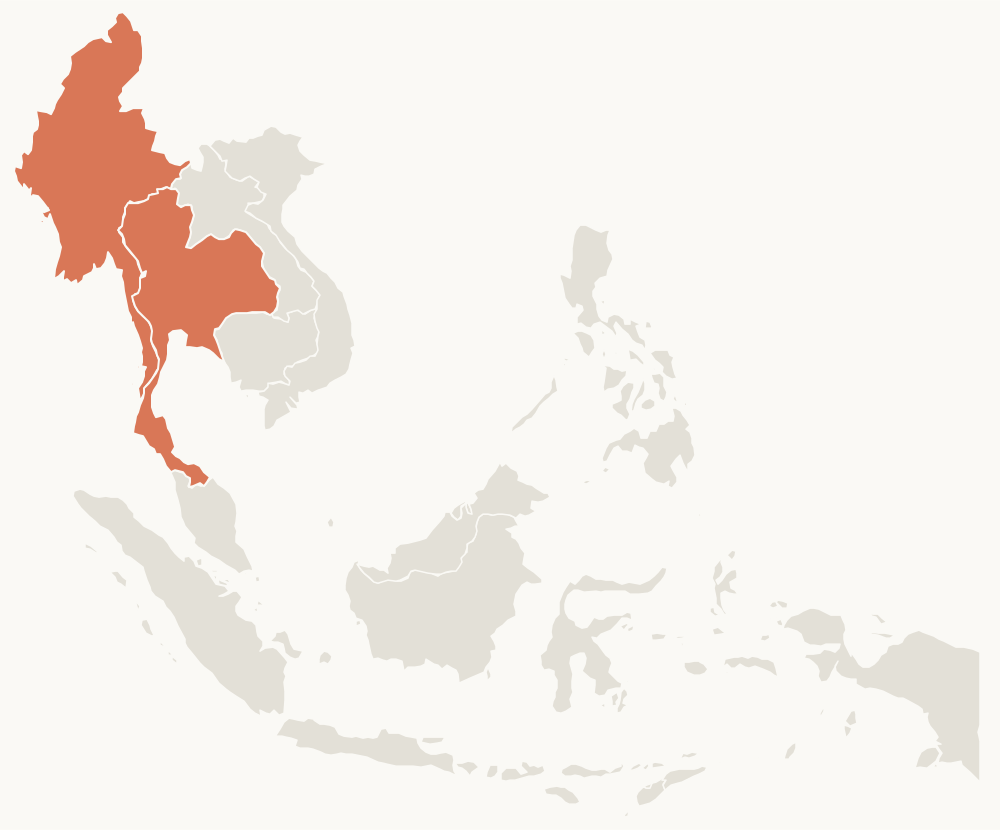 Thailand, Myanmar
Carnegie Endowment for International PeaceAnalysis
The Disruptive Politics of AI
Steven Feldstein and Shreya Joshi (editors) · September 22, 2026
Edited collection arguing that AI gives governments scale, speed and efficiency for repression while also handing activists new tools, documenting digital repression in 91 countries. Southeast Asian chapters cover how Thailand's domestic surveillance enables transnational repression of regional dissidents and how Myanmar's junta coerces internet providers to control information.
Compiles Carnegie's 2026 digital-repression series, including Janjira Sombatpoonsiri's June essay on Thailand's 'swap mart'.
ThailandBangkok PostOpinion
When are policy decisions actually made?
Vanich Kittichai · September 19, 2026
Contrasting Bangkok's stalled electric garbage-truck plan with the 1.6-billion-baht TH-AI Passport that raced through procurement, the columnist asks why some policies are treated as foregone conclusions and others as unthinkable. The AI scheme becomes a case study in opaque decision-making and misplaced priorities.
Follows the Democrat Party's request for a State Audit Office probe into the TH-AI Passport contract.
Southeast Asia, Malaysia +4The DiplomatAnalysis
Will Southeast Asia Actually Benefit From Its AI Boom?
Gerald Mako · September 16, 2026
Notes that Southeast Asia accounts for roughly half of Asia-Pacific data-centre capacity under construction, with a division of labour forming between Singapore and its neighbours, then argues that hosting compute is not the same as building an AI economy. Asks what would turn separate national build-outs into a regional AI market.
Draws on first-half 2026 pipeline figures and the Singapore-Malaysia-Thailand capacity race.
ThailandThe Coffee Parliament (Substack)Opinion
Thailand's AI Passport: A Walkthrough
Ken (Mathis) Lohatepanont · September 7, 2026
A hands-on tour of the TH-AI Passport platform a week after its 31 August launch, noting that sign-ups lagged far behind the five-million target and that the default free model is a low-end one with unlimited use while frontier models are rationed. He asks whether the 1.6 billion baht outlay buys much beyond what free consumer chatbots already offer.
Follows the June political row over the DES ministry's TH-AI Passport procurement and the scheme's slow uptake at launch.
ThailandBangkok PostOpinion
So the goal is control?
Vanich Kittichai · September 5, 2026
The columnist bristles at an Ipsos report that framed Thais' reluctance to hand AI complete control as a business challenge to overcome, noting that Thais are already more optimistic about AI than most countries. He argues that wanting humans to keep decision-making authority is sound judgment, not a barrier.
Responds to the Ipsos Global Insights 2026 survey release in Bangkok.
Southeast Asia, Vietnam +4FulcrumOpinion
Southeast Asia and AI Adoption: The Return of Cold War Strategies
Tobias Burgers and Tran Nguyen · August 31, 2026
Reads Vietnam's AI law and Singapore's local models as Cold War-style hedging between US and Chinese AI ecosystems, then argues that national efforts are too small to matter. Proposes collaborative hedging through a regional public-private consortium modelled on Airbus.
Connects to Malaysia's ILMU model, Vietnam's December 2025 AI Law and the region's sovereign AI turn.
Southeast Asia, Singapore +3Tech for Good InstituteOpinion
How AI Levels the Playing Field for Small Businesses
Kirti Pathania · August 28, 2026
Notes that only about 3 percent of ASEAN enterprises have embedded AI into daily workflows and warns that early-adopter advantages could entrench large incumbents, as happened with online travel agents. Recommends SME-technology partnership ecosystems, leadership training and adoption grants so the 97 percent of firms that are SMEs are not left behind.
Aligns with the Philippines' push, as ASEAN chair, for a Leaders' Declaration on AI-powered MSMEs at the November summit.
Southeast Asia, Malaysia +3South China Morning PostOpinion, paywalled
As the US and China compete over AI, Asean must secure strategic autonomy
AbdulWahed Jalal Nori · August 27, 2026
Argues that ASEAN is fast becoming the physical centre of the AI economy through data centres while depending on outsiders for chips, models, cloud and standards, and that the real choice is between dependence and agency rather than dominance and isolation. Calls for control over the infrastructure and knowledge behind AI.
Connects to the Pax Silica versus WAICO pressure on the region in August 2026.
ThailandBangkok PostOpinion
Rethinking how to teach about AI
Worsak Kanok-Nukulchai · August 19, 2026
A veteran Thai engineering educator argues that earlier technologies gave universities decades to adapt while AI gives them years, so degrees lose relevance before graduates reach mid-career. He calls for teaching judgment and continual renewal of skills rather than fixed AI knowledge.
Written as Thai universities revise curricula and the TH-AI Passport scheme rolled out to students.
Southeast Asia, Indonesia +3Tech for Good InstituteOpinion
The Architecture of Inclusion: Balancing Southeast Asia's AI Infrastructure Boom
Shammi Thakur · August 12, 2026
Frames AI readiness as three layers (compute, physical utilities such as data centres and power, and a facilitator layer of governance, data flows and talent) and argues the region's advantage will depend on equitable access rather than raw build-out. Warns that uneven access for small firms, grid strain and fragmented rules could concentrate gains in large corporations, and calls for shared compute treated as a public good.
Responds to the ASEAN-Korea HPC facility in Indonesia, new cloud regions in Bangkok and Kuala Lumpur data-centre investment.
ThailandThailand Development Research Institute (TDRI)Analysis
AI in Thai Classrooms: New Technology in an Old Teaching World, or a Turning Point for Learning? (AI ในห้องเรียนไทย: เทคโนโลยีใหม่ในโลกการสอนเก่า หรือจุดเปลี่ยนการเรียนรู้?)
Supanutt Sasiwuttiwat and Pongtat Vanichanan · August 11, 2026
Evaluates the Craft AI programme across 68 schools and 8,500 students and finds only modest gains in reading and critical thinking, with schools using both teacher training and the KapiBarian app doing slightly worse than comparison schools. Concludes AI works as a time-and-knowledge shortcut for teachers already committed to improving pedagogy, and that administrative burden and personnel systems, not technology, are the binding constraint.
Follow-up to the July piece; tempers enthusiasm about AI edtech with evaluation data.
Southeast Asia, Thailand +4FulcrumOpinion
Southeast Asia Cannot Fight Online Sexual Abuse One Takedown at a Time
Nuurrianti Jalli · July 31, 2026
Argues that takedown-and-prosecute approaches cannot keep up with generative AI tools that mass-produce non-consensual sexual imagery, and that regulators should impose systemic duties on platforms to assess risk and design in safeguards. Matters because the Grok episode showed how quickly synthetic abuse scales across the region.
Follows the early-2026 Grok bans in Indonesia, Malaysia and the Philippines and draws on Australian and EU online-safety models.
Southeast Asia, Cambodia +6Foreign PolicyAnalysis, paywalled
China Pitches Its AI Leadership to the World
Joseph Rachman · July 22, 2026
Reports from the Shanghai AI conference that five Southeast Asian states joined China's new World AI Cooperation Organisation as founders while Singapore and Thailand stayed out, and reads this split as the region hedging rather than aligning. China's open-source pitch lands well with governments that cannot afford proprietary Western stacks.
Frames the WAICO launch as Beijing's answer to Washington's more transactional AI posture.
ThailandThe Coffee Parliament (Substack)Analysis
Anutin's First Official Visit to China
Ken (Mathis) Lohatepanont · July 20, 2026
Reads Prime Minister Anutin's appearance at Shanghai's World AI Conference as deliberately non-committal: Thailand offered a bland 'protection, potential, prosperity' formula and did not sign on to China's new AI cooperation body. He treats the trip as a case study in Thai hedging on AI between Washington and Beijing.
Responds to the July 2026 WAIC in Shanghai and the launch of China's World AI Cooperation Organisation.
Southeast Asia, Singapore +3Asia TimesAnalysis
ASEAN's AI race is officially underway
Chris Taylor · July 17, 2026
Argues the regional contest to host AI data centres will be decided by reliable power and water, not headline investment figures, with Singapore's capacity rationing pushing demand into Johor, Thailand and Indonesia. Governments must also manage community backlash and the tension between US chip access and Chinese capital.
Written as Malaysia and Thailand posted record data-centre pipelines in the first half of 2026.
ThailandThailand Development Research Institute (TDRI)Analysis
Gen AI: A New Hope for Thai Education? (Gen AI ความหวังใหม่ของการศึกษาไทย?)
Supanutt Sasiwuttiwat and Pongtat Vanichanan · July 11, 2026
Drawing on a survey of more than 13,000 secondary students and 330 teachers in three provinces, finds roughly 63 percent of students use generative AI to learn, with frequent users scoring slightly higher on reading and critical thinking, but about 15 percent let AI do most of their homework and adoption tracks existing achievement, risking wider gaps. Argues the benefits require deliberate system design because teachers lack skills and students learn AI from social media.
First public write-up of TDRI's Craft AI classroom research, feeding Thailand's AI-in-education policy debate.
Southeast Asia, Singapore +5Asia Society Policy Institute (Asia Policy Substack)Analysis
ASEAN Hedges With Pax Silica
Faye Simanjuntak · July 8, 2026
Examines why only Singapore and the Philippines have joined the US-led Pax Silica initiative to secure AI and semiconductor supply chains, while other ASEAN states prefer bilateral trade and critical-minerals deals with Washington. Argues the pattern reflects doubts about US commitment and a belief that bilateral arrangements deliver similar benefits without formal geopolitical alignment, with US restrictions on advanced AI models undercutting trust.
Responds to the Trump administration's Pax Silica push and its AI export package for allies.
Southeast Asia, Malaysia +5Tech for Good InstituteOpinion
The Balancing Act: Harmonising AI Development and Governance in Southeast Asia
Bryan Yeoh Quan Jin and Calvin Woo · July 6, 2026
Argues that with nearly half of regional firms scaling AI beyond pilots, Southeast Asia needs governance that combines ASEAN-level coordination with national rules suited to a multilingual, multicultural region. Surveys the spectrum from Vietnam's binding law to Singapore, Thailand and Indonesia's soft-law approaches and Malaysia's proposed bill.
Written by Malaysia's Centre for the Fourth Industrial Revolution as Malaysia drafts its AI Governance Bill and ASEAN finalises DEFA.
Southeast Asia, Thailand +2FulcrumAnalysis
The US-China AI Chip War: Southeast Asia's Compliance Dilemma
Gerald Mako · July 2, 2026
Explains how regional governments are squeezed between courting AI data-centre investment and policing the diversion of export-controlled Nvidia hardware to China, as Washington shifts to enforcement based on ultimate ownership. Argues the region must build export-control capacity or risk sanctions and investor flight.
Prompted by US allegations in May 2026 against a Bangkok firm linked to Thailand's national AI push; compares Malaysia's strategic trade permits and Singapore's controls.