- 10%
- People using generative AIMicrosoft AI Diffusion Report, 2026-Q2
- no data
- Claude use per person
- 127
- ChatGPT messages per person, world rankOpenAI Signals, 2026-Q2
01
Who is using AI
02
What governments are doing
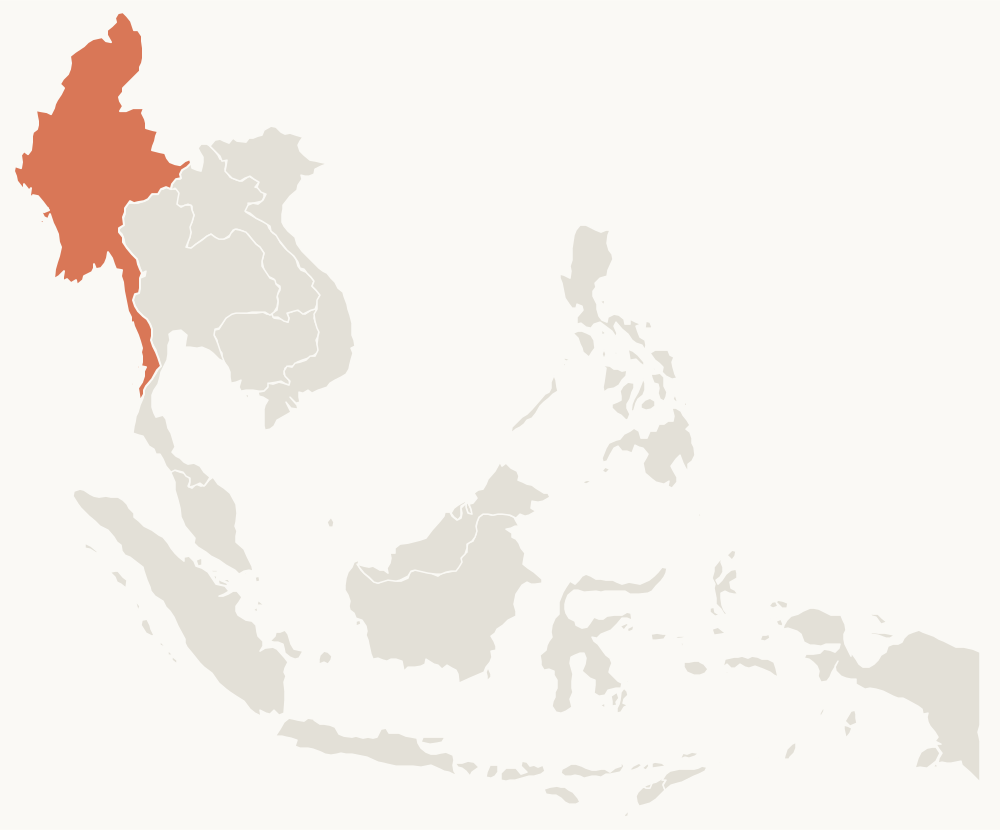
Myanmar
Verified September 29, 2026
- Strategy
- National AI Strategy (2025-2030) and National AI Policy (draft)Draft, 2025
- AI law
- None
- Guidance
- None
Legitimacy: every instrument since 2021-02-01 was issued by the military administration. The State Administration Council (SAC) enacted laws by decree under article 419 of the 2008 Constitution until it was dissolved on 2025-07-31, when the National Defence and Security Council took over and created the State Security and Peace Commission; after the 2025-12 to 2026-01 election Min Aung Hlaing was sworn in as president on 2026-04-10. The sacoffice.gov.mm domain now carries the National Defence and Security Council Office name. The opposition National Unity Government and much of the international community do not recognise these bodies, so an editor should describe them as the military administration rather than the government of Myanmar, and note that the same officials have been issuing policy across the SAC, SSPC and presidential phases. Lead ministry: contrary to the audit lead, the AI strategy is being drafted by the Ministry of Science and Technology (Union Minister Dr Myo Thein Kyaw), not the Ministry of Transport and Communications; MoTC leads cybersecurity, e-government and the Cybersecurity Law, and the Digital Economy Development Committee is chaired by the Minister of Commerce with MoTC as patron. Strategy status: the Myanmar Computer Federation (an industry body working with MoST on an AI taskforce) published two decks (2025-01-16 and later in 2025) listing a National AI Strategy 2025-2030 and a National AI Development Policy as under drafting, with a six-pillar structure and a 2025-2026 policy alignment phase; the ai-gov.world tracker (2026) also records the strategy as still in draft. Cybersecurity Law: the English text read is the Lincoln Legal Services convenience translation hosted by ICNL (also at lincolnmyanmar.com), not an official translation; the Burmese text is the authoritative one. Different sources give the platform registration threshold as 100,000 users (law text section 30) versus 10,000 (one MCF slide, which appears to be a typo). The commencement date of 2025-07-30 is reported by law firms and not confirmed from a gazette. Data: the Cybersecurity Law's three-year retention rule (section 33) and the ETL 2021 privacy chapter are the only statutory data rules of general application; no data protection authority exists. Surveillance context: Human Rights Myanmar's August 2025 submission to the UN Special Rapporteur on counter-terrorism and its 2026-01-20 civic-space report document AI facial recognition under Safe City projects in Naypyidaw, Mandalay and Yangon (Huawei, Dahua, Hikvision hardware, first reported by Human Rights Watch on 2021-03-12), the Person Scrutinisation and Monitoring System with 1,657 arrests claimed between 2025-03-07 and 2025-05-21, and AI-assisted deep packet inspection; the Myanmar Internet Project has criticised the Cybersecurity Law's surveillance effects but its site (myanmarelectionwatch.org) did not resolve. These are civil-society claims, not government instruments. International: WAICO founding membership (2026-07-16) is reported by secondary sources only; the ai-gov.world tracker also lists a China-Myanmar joint statement of 2026-06-17 that was not located. Name variants: the strategy is referred to as National Artificial Intelligence Strategy (NAS), National AI Policy (NAP) and National Artificial Intelligence Development Policy; Digital Economy Roadmap 2030 is also written Digital Economy Roadmap 2024-2030; the e-Governance Master Plan 2030 is sometimes called the Digital Governance Master Plan 2030. Web search budget was exhausted mid-audit, so 2026 items after February rely on the NDSC office site search only.
03
What researchers are finding
MyanmarSchools and universities
Convenience Amid Crisis: Explaining Generative AI Misuse and Compliance Intention Among Myanmar University Students
Finds that Myanmar students misuse generative AI mainly when peers treat it as acceptable and they can excuse it to themselves, and that visible enforcement by universities does most to curb it.
Journal article · September 27, 2026 · Journal of ICT and Education
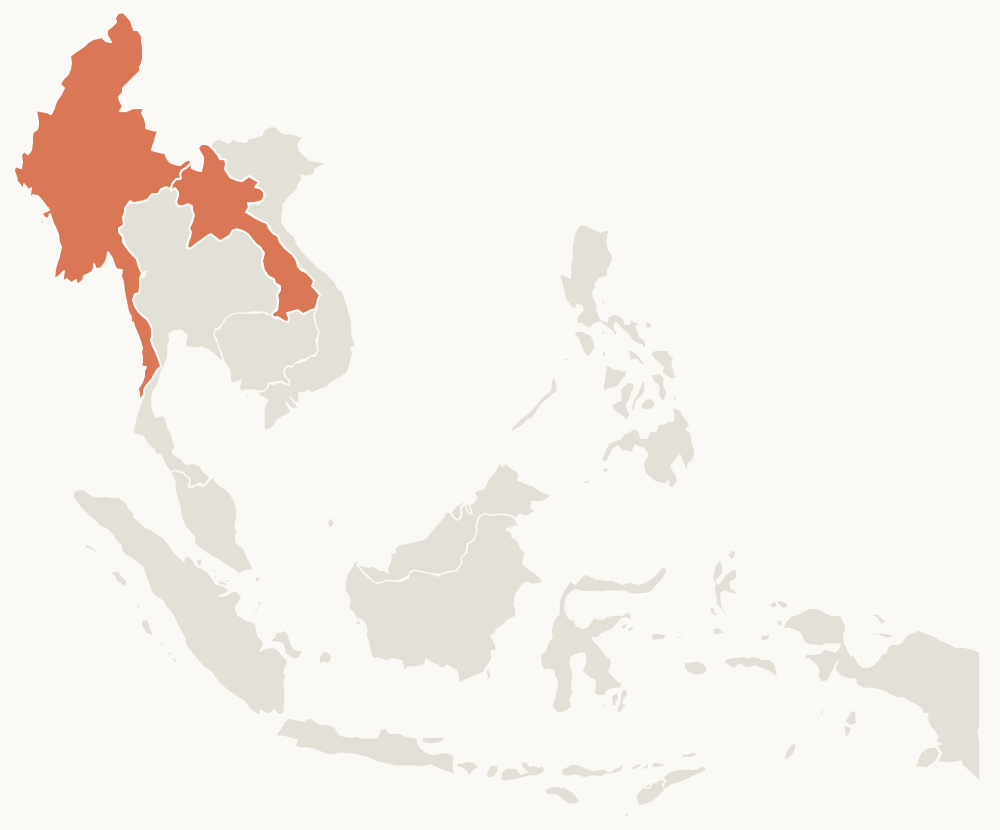 Myanmar, Laos
Language and models
From Reliable Text to Real Voices: Trust-Aware Progressive Adaptation for Low-Resource TTS
Shows that Burmese and Lao voice-cloning systems pronounce words more accurately when trained first on clean synthetic speech and only then on real recordings, with unreliable automatic transcripts down-weighted.
Preprint · September 22, 2026 · arXiv 2609.25951
MyanmarLanguage and models
BURMESE-SAN: Burmese NLP Benchmark for Evaluating Large Language Models
BURMESE-SAN is the first holistic benchmark for evaluating LLMs on Burmese across understanding, reasoning and generation tasks.
Preprint · February 21, 2026 · arXiv 2602.18788
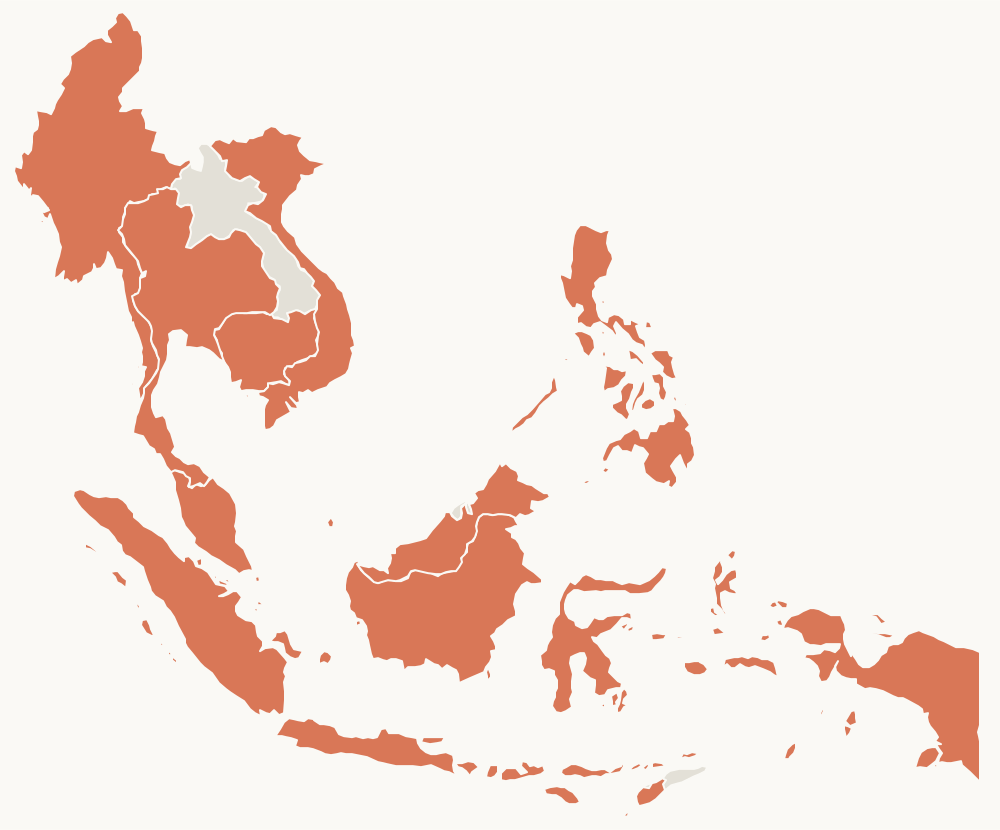 Cambodia, Indonesia +6
Government and rules
The Annual Report: Digital Rights in Southeast Asia 2025
Regional digital-rights review that includes AI-enabled surveillance (notably Myanmar's PSMS) and platform accountability across eight countries.
Report · February 16, 2026 · DigitalReach annual report
MyanmarGovernment and rules
2025 Yearly Report on Digital Repression in Myanmar
Tallies 2025 internet shutdowns and online-speech arrests and details the AI-backed Person Scrutinization and Monitoring System, Tiangou gateway and Huawei banking AI used to identify dissidents.
Report · January 30, 2026 · MIP annual report
MyanmarGovernment and rules
Myanmar's Digital Authoritarianism: Building a Surveillance State with Chinese Technology Transfers
Explains how the junta assembled facial recognition, biometric databases and telecom monitoring from Chinese vendors into an integrated surveillance state.
Report · January 30, 2026 · Fulcrum commentary
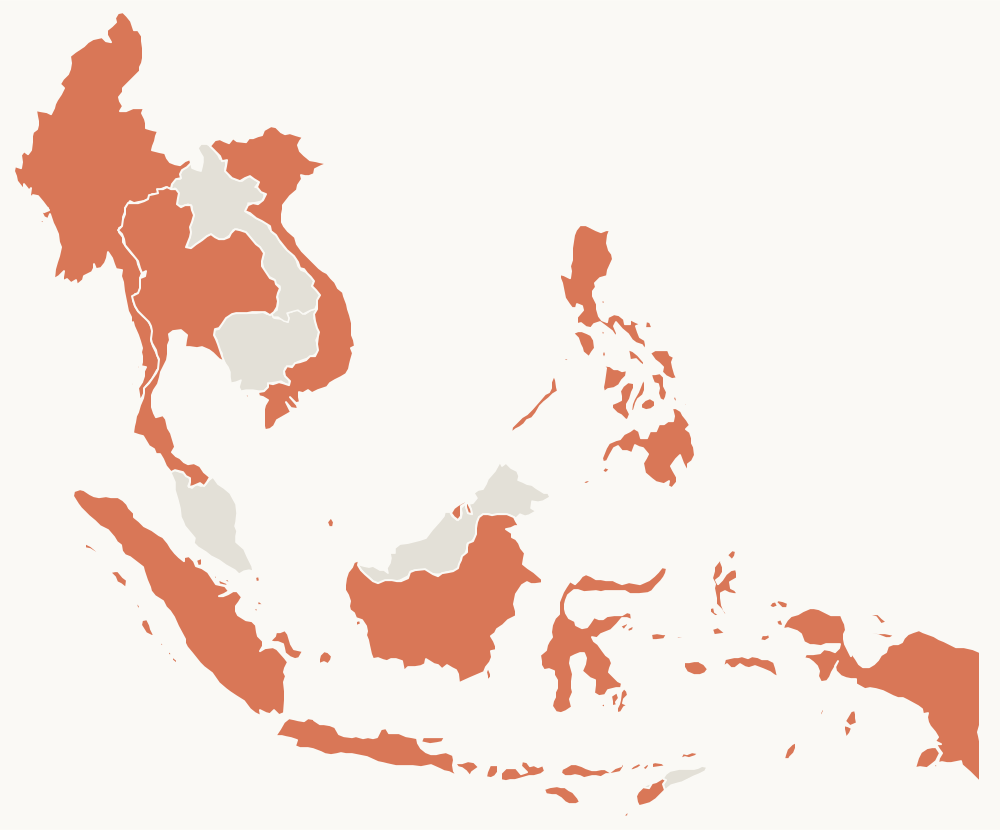
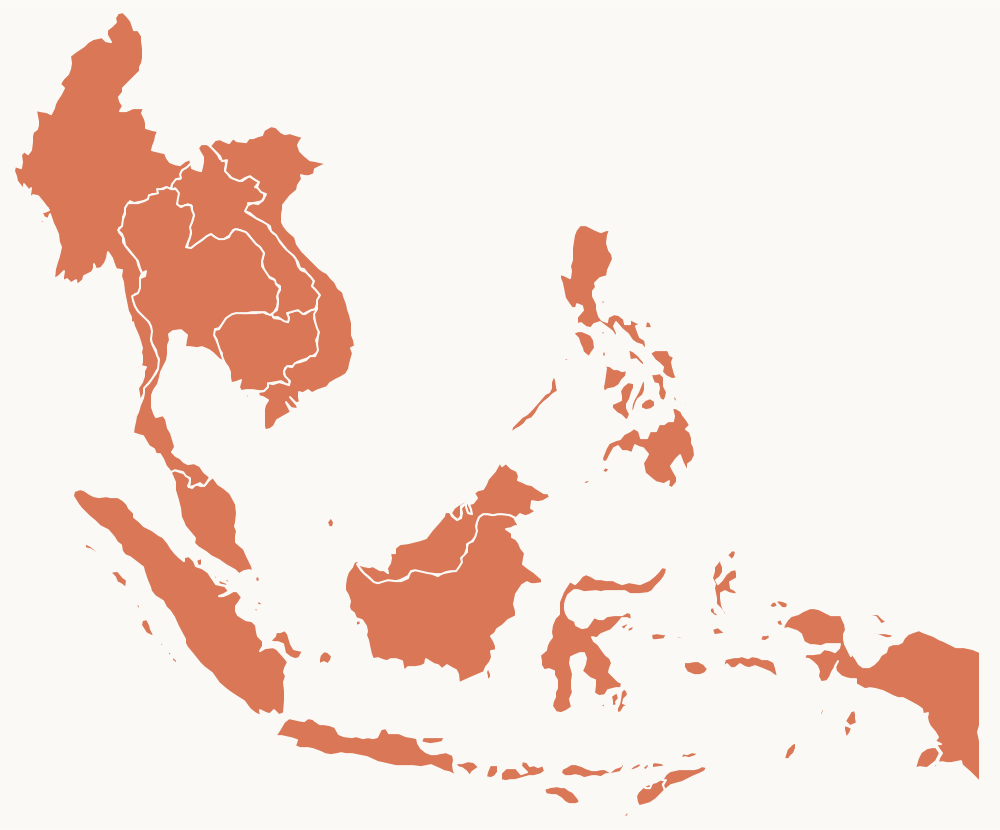 Southeast Asia, Brunei +10
Government and rules
AI Safety Governance, the Southeast Asian Way
Surveys AI safety and governance moves in every Southeast Asian country, including Timor-Leste, and argues the region is converging on a pragmatic, development-first model distinct from EU or US approaches.
Report · August 25, 2025 · Brookings Governance Studies report
MyanmarGovernment and rules
Myanmar's Repressive Use of AI to Counter 'Terrorism'
Documents the junta's AI-enabled biometric database, facial-recognition camera networks and firewall as a pipeline from digital identification to arrest and torture, and names the foreign supply chain enabling it.
Report · August 20, 2025 · Submission to the UN Special Rapporteur on counter-terrorism and human rights
 Brunei, Indonesia +5
Health
Insights Into the Current and Future State of AI Adoption Within Health Systems in Southeast Asia: Cross-Sectional Qualitative Study
Stakeholders across seven SEA health systems say AI uptake hinges on basic digital infrastructure and data/technology governance, with a sharp readiness gap between high-income and lower-middle-income members.
Journal article · June 16, 2025 · Journal of Medical Internet Research 27:e71591 (doi 10.2196/71591)
MyanmarSociety and elections
Disasters and Disinformation: AI and the Myanmar 7.7 Magnitude Earthquake
Documents how AI-generated images and videos spread after the March 2025 Sagaing earthquake, compounding a response already hampered by conflict and telecom shutdowns.
Report · May 1, 2025 · IDSS Paper No. 055/2025
MyanmarLanguage and models
Myanmar XNLI: Building a Dataset and Exploring Low-resource Approaches to Natural Language Inference with Myanmar
Extends the XNLI inference benchmark to Myanmar and tests inexpensive approaches for a language largely absent from LLM training data.
Preprint · April 13, 2025 · arXiv 2504.09645
04
What people are saying
 Thailand, Myanmar
Carnegie Endowment for International PeaceAnalysis
The Disruptive Politics of AI
Steven Feldstein and Shreya Joshi (editors) · September 22, 2026
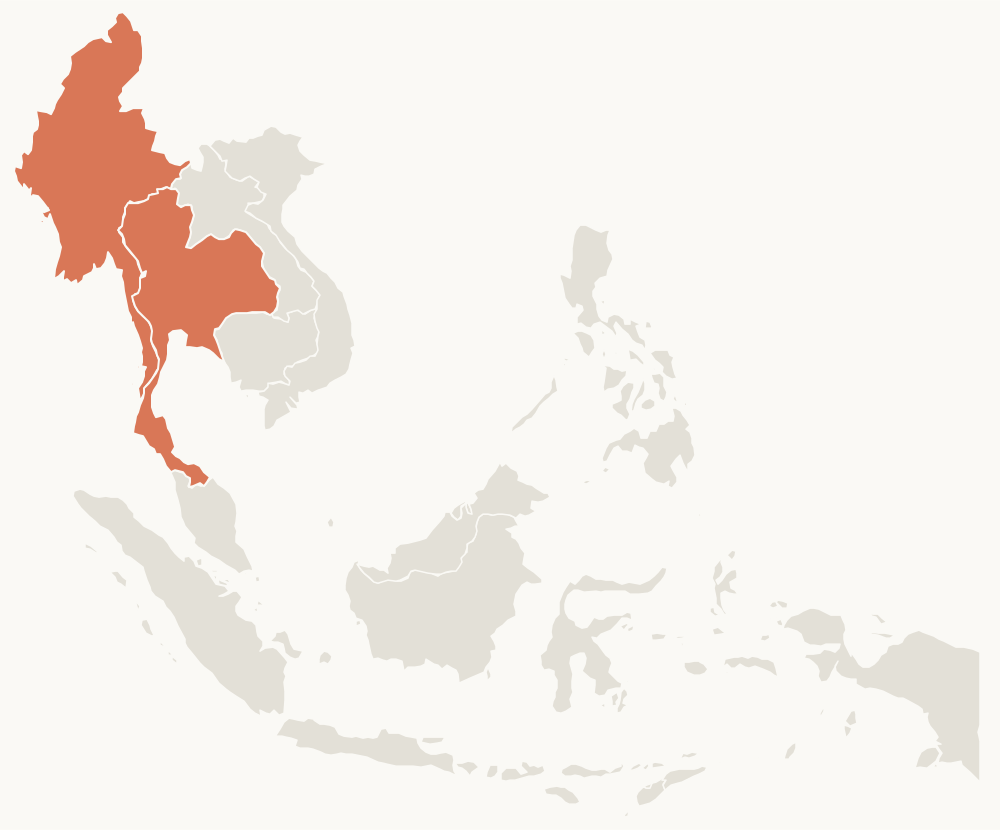
Edited collection arguing that AI gives governments scale, speed and efficiency for repression while also handing activists new tools, documenting digital repression in 91 countries. Southeast Asian chapters cover how Thailand's domestic surveillance enables transnational repression of regional dissidents and how Myanmar's junta coerces internet providers to control information.
Compiles Carnegie's 2026 digital-repression series, including Janjira Sombatpoonsiri's June essay on Thailand's 'swap mart'.
Southeast Asia, Myanmar +2The Interpreter (Lowy Institute)Opinion
No, Mark Zuckerberg, the future is not (yet) for everyone
Karryl Kim Sagun Trajano and Brendan Luyt · August 28, 2026
A Southeast Asian rejoinder to Meta's promise of superintelligence for all, arguing that access without infrastructure, local relevance and accountability simply scales harm, as Meta's record in Myanmar and Philippine elections showed. Asks who controls distribution and who captures the benefits.
Responds to Zuckerberg's superintelligence manifesto and to regional capability gaps in compute and chips.
Southeast Asia, Cambodia +6Foreign PolicyAnalysis, paywalled
China Pitches Its AI Leadership to the World
Joseph Rachman · July 22, 2026
Reports from the Shanghai AI conference that five Southeast Asian states joined China's new World AI Cooperation Organisation as founders while Singapore and Thailand stayed out, and reads this split as the region hedging rather than aligning. China's open-source pitch lands well with governments that cannot afford proprietary Western stacks.
Frames the WAICO launch as Beijing's answer to Washington's more transactional AI posture.
MyanmarThe IrrawaddyAnalysis
Myanmar Joins China's AI Club, Dependency on China's Power Grid, and More
The Irrawaddy (China Briefing column) · July 17, 2026
The weekly China Briefing column reads Myanmar's signing on as a founding member of Beijing's World AI Cooperation Organization as a step toward deeper integration of Chinese AI into the junta's surveillance and governance systems. It notes the membership skews toward Global South and non-Western-aligned states and links the move to the regime's existing monitoring tools.
Follows Min Aung Hlaing's June visit to Beijing and the WAICO launch ahead of the Shanghai World AI Conference.