- 23%
- People using generative AIMicrosoft AI Diffusion Report, 2026-Q2
- 0.9
- Claude use per personAnthropic Economic Index, 2026-05
- 59
- ChatGPT messages per person, world rankOpenAI Signals, 2026-Q2
01
Who is using AI
02
What governments are doing
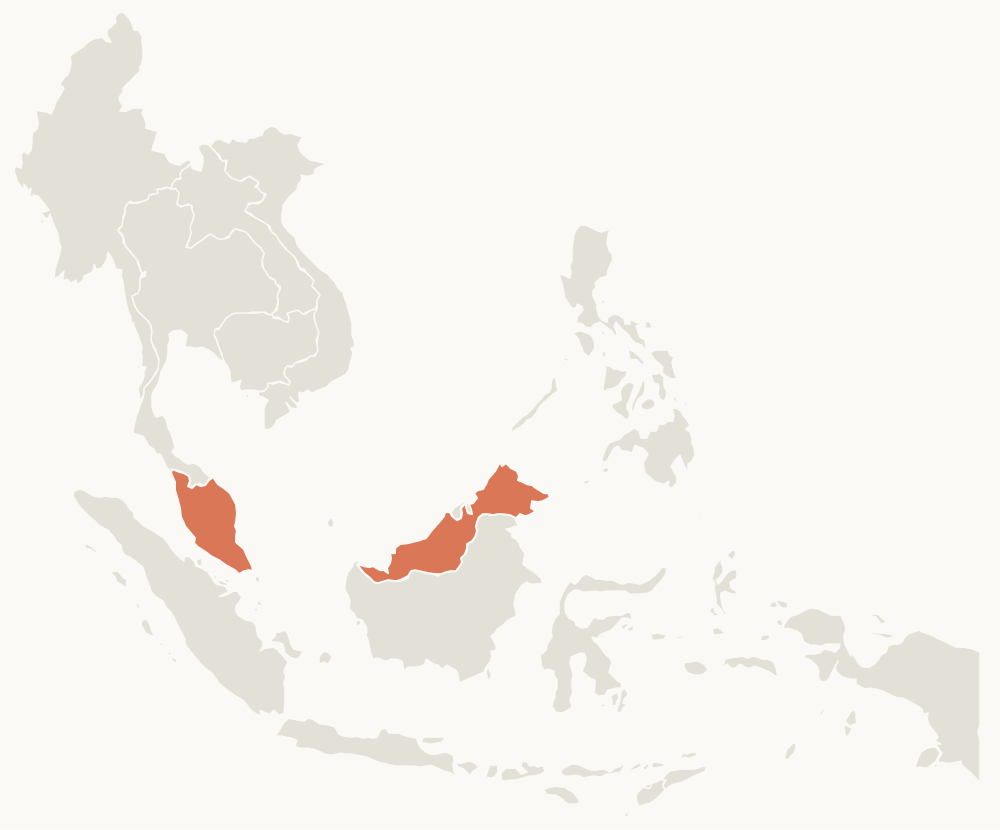
Malaysia
Verified September 29, 2026
- AI law
- Artificial Intelligence Governance Bill (Rang Undang-Undang Tadbir Urus Kecerdasan Buatan)Draft, September 10, 2026
- Guidance
- The National Guidelines on AI Governance and Ethics (AIGE), theme AI for Malaysia, AI for All2024
- Data law
- Personal Data Protection Act 2010 (Act 709), as amended by the Personal Data Protection (Amendment) Act 2024 (Act A1727)Enacted, November 15, 2013
- Sector rules
- Discussion Paper on Artificial Intelligence in the Malaysian Financial Sector2025Published 2025-08-05 with feedback due 2025-10-17, the paper sets out BNM's proposed supervisory expectations for AI use by financial institutions (governance, risk, consumer outcomes) and will inform future policy; BNM's revised Risk Management in Technology policy document (reported effective 2025-11-28) is said to extend binding tech-risk duties to AI but that revision was not opened at the source.
- Online Safety Act 2025 (Act 866): Risk Mitigation Code2026Issued 2026-05-22 and enforced from 2026-06-01 under the Online Safety Act 2025 (assented 2025-05-06, gazetted 2025-05-22, in force 2026-01-01), the code requires licensed large platforms to test their recommender algorithms for harm and to label AI-generated or manipulated images, audio and video that could pass as authentic.
- Johor State Data Centre Development Planning Guidelines2024Approved by the State Planning Committee and Johor Executive Council in April 2024, the guidelines set siting, power, water and connectivity requirements plus a Data Centre Development Coordinating Committee approval route; in November 2025 the state additionally stopped approving Tier 1 and Tier 2 (high water use) data centres, per state assembly statements reported in the press.
- MMC Guideline on the Ethical Use of Artificial Intelligence (AI) in Medical Practice, Version 1/20252025Professional guidance for registered doctors built on five principles (autonomy, well-being and safety, transparency and explainability, responsibility and accountability, privacy) that keeps the practitioner accountable for AI-assisted clinical decisions.
Naming: the Malay title of the bill is Rang Undang-Undang Tadbir Urus Kecerdasan Buatan; press often calls it the AI Act or AI Governance Act, but no bill has been tabled in Parliament, so the status is Draft (post-consultation, pre-Cabinet). The National AI Office was first a unit inside the Ministry of Digital (2024-12-12) and is now a company limited by guarantee, AI Malaysia Berhad; ai.gov.my still carries both names. The Action Plan PDF is served from a Strapi host (strapi.naio.okie.my) linked from ai.gov.my, not from a gov.my domain. The 2021-2025 roadmap belongs to MOSTI and its PDF is not linked on the MOSTI news page; the new plan's Part 1 contains a Lessons from AI Roadmap 2021-2025 section. AIGE is voluntary; the ai.gov.my governance page also lists an AI Code of Ethics (AICE), the ASEAN Guide on AI Governance and Ethics, and MY-AI Standards (aistandards.my) developed with SIRIM, which the minister described as the standards layer of a three-tier standards, regulations, law approach. The PDPA phased commencement is set by P.U. (B) 522 (dated 2024-12-19, gazetted 2024-12-24), which lists section numbers rather than topics; JPDP guidelines on DPO appointment, breach notification and cross-border transfer were issued in 2025. The Cybercrimes Bill 2026 is the operative deepfake instrument but its royal assent and gazettal were not confirmed at a primary source; treat as Passed, not Enacted. The MCMC Act page URL slug reads communications-and-multimedia-amendment-act-20-1 but is the official Online Safety Act 2025 page. Two web searches on BNM RMiT and further September 2026 news were cut off when the session's search budget was exhausted, so the latest row is anchored on the 2026-09-10 ministerial statement (news source) and the 2026-09-11 AI Malaysia board statement (primary).
03
What researchers are finding
MalaysiaSchools and universities
Students' Readiness for Generative Artificial Intelligence in Malay Language Learning: A Survey Study
Finds Malaysian lower-secondary students fairly ready to use generative AI overall but least sure how to apply it to learning Malay, pointing to a need for subject-specific guidance.
Journal article · September 24, 2026 · International Journal of Research and Innovation in Social Science
MalaysiaSchools and universities
Beyond the arms race: An exploratory study on shadow AI usage and competency risks among DBA students in Sarawak
Finds that doctoral business students in Sarawak use AI quietly to cope with workloads and unclear rules rather than to cheat, but that the habit risks weakening their own judgement over time.
Journal article · September 22, 2026 · Journal of Education and e-Learning Research
MalaysiaJobs and the economy
Behind Malaysia's Data Centre Boom
Explains how Johor became one of the world's largest emerging AI infrastructure clusters and the policy, geopolitical and grid problems that follow.
Report · September 1, 2026 · Trends in Southeast Asia 2026/22
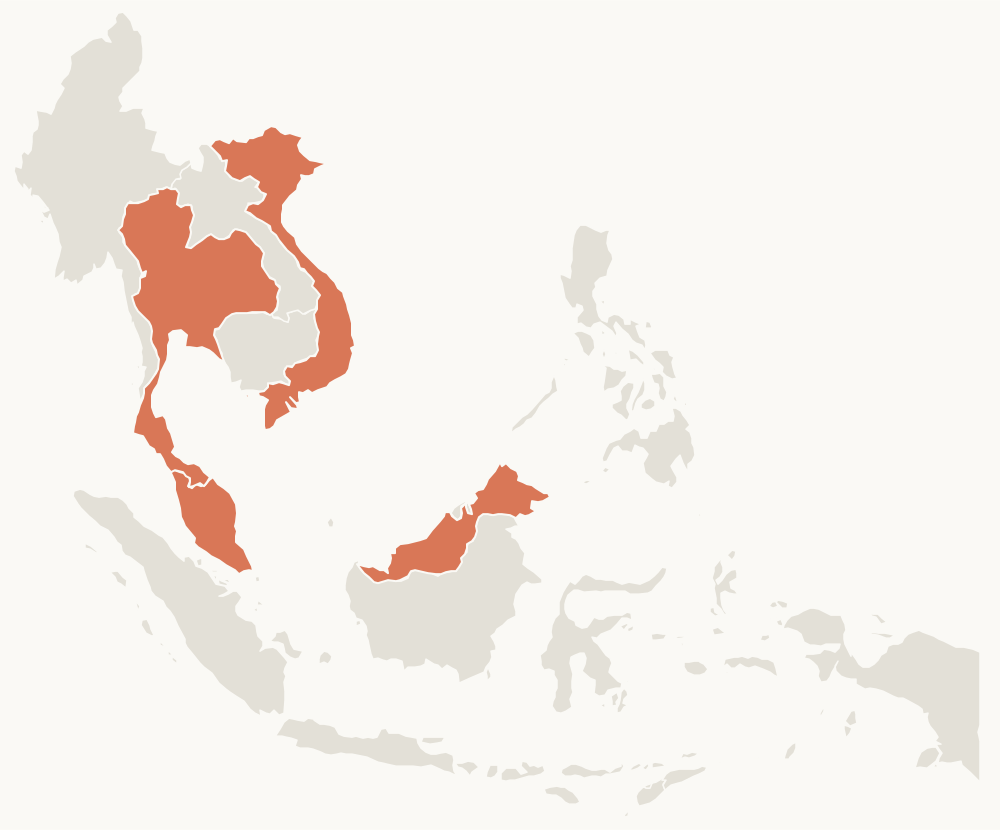 Singapore, Malaysia +2
Government and rules
Governing for Adoption: The Role of Legal and Regulatory Frameworks in Shaping AI Uptake in Southeast Asia
Compares four ASEAN legal regimes to show how sandboxes, data-sharing rules and AI assurance mechanisms, not tax incentives, drive AI commercialisation and adoption.
Journal article · July 31, 2026 · IntechOpen (perspective chapter)
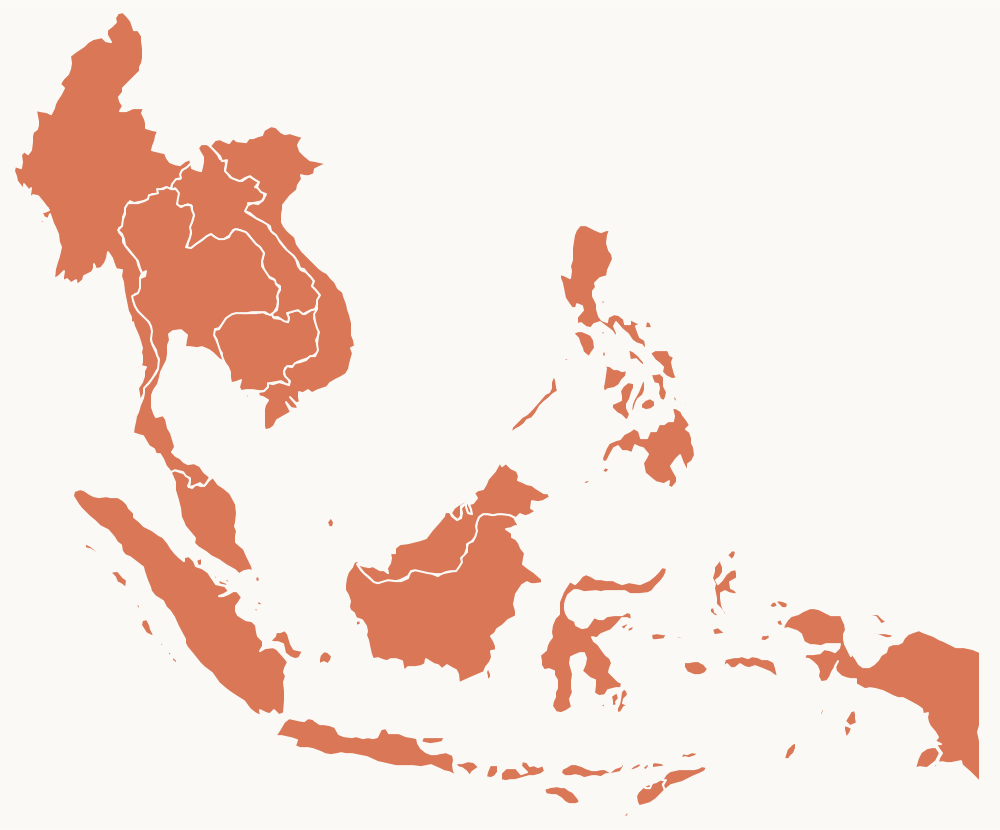 Southeast Asia, Indonesia +6
Jobs and the economy
Generative AI and labour markets in ASEAN: Significant exposure, limited disruption, uneven preparedness
Puts nearly 80 million ASEAN workers (22.9 percent of employment) in GenAI-exposed occupations yet finds no sign of broad displacement so far, with women overrepresented in the most exposed jobs and a gap between exposure and institutional readiness.
Report · July 8, 2026 · ILO Brief
MalaysiaJobs and the economy
Augmentation or Elimination: The Potential Impact of AI on the Malaysian Economy
Runs GenAI and agentic-AI scenarios for Malaysia's services sector and estimates roughly 680,000 jobs could be at risk, enough to lift unemployment from 3.5 to 5.5 percent, arguing current policy tools are inadequate.
Report · June 2, 2026 · ISEAS Perspective 2026/41
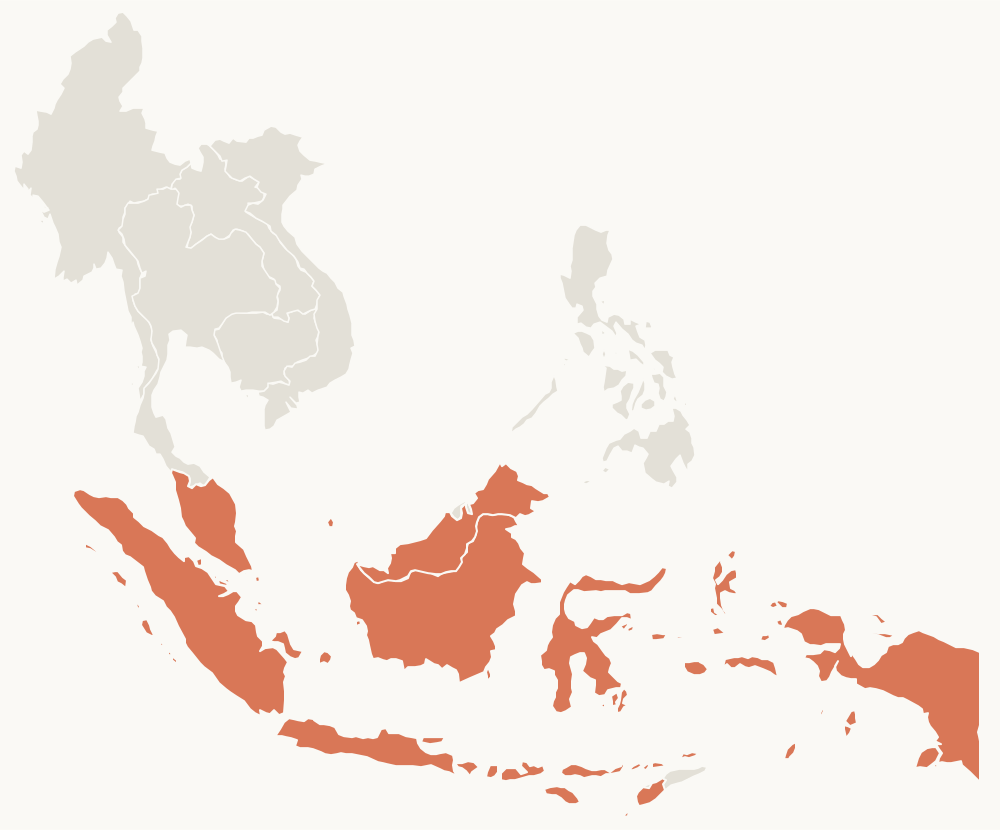 Malaysia, Indonesia
Language and models
From Noisy Historical Maps to Time-Series Oil Palm Mapping Without Annotation in Malaysia and Indonesia (2020-2024)
Produces annual 10 m oil palm plantation maps for Malaysia and Indonesia (2020 to 2024) by learning from noisy historical maps without new annotation.
Preprint · April 26, 2026 · arXiv 2604.23776
MalaysiaGovernment and rules
What AI Risks Concern Malaysia?
Sorts the AI risks Malaysian stakeholders actually worry about into competitive risk, unintended harm and malicious use, and ties each to readiness measures.
Report · March 7, 2026 · KRI report
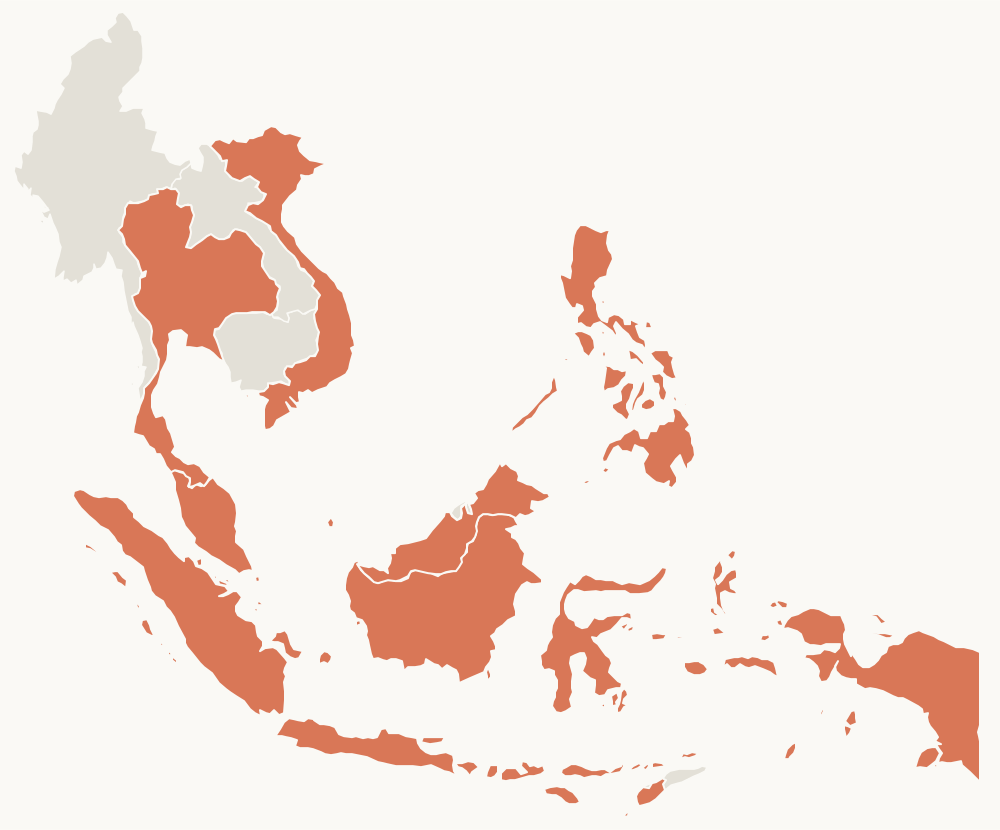 Indonesia, Malaysia +4
Government and rules
The Evolution of Tech Governance in Southeast Asia-6, Third Edition
Tracks how SEA-6 digital governance shifted from AI ethics principles toward binding rules, sovereign compute investment and safety-testing regimes during 2025.
Report · March 4, 2026 · TFGI annual report
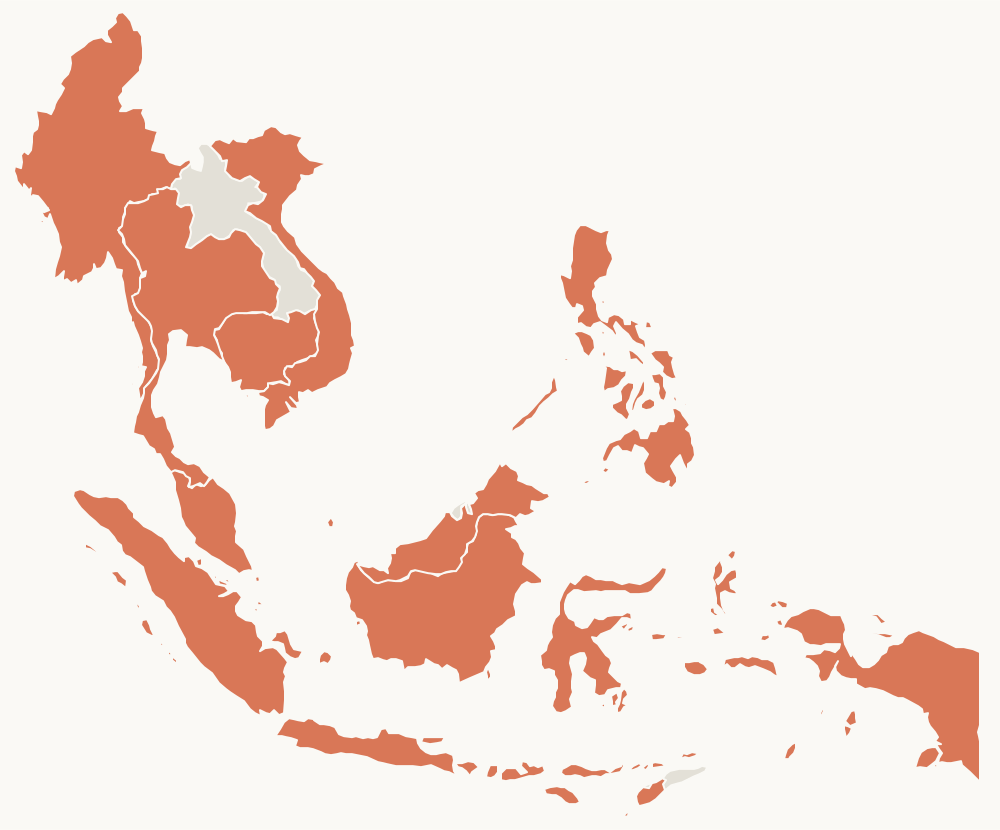 Cambodia, Indonesia +6
Government and rules
The Annual Report: Digital Rights in Southeast Asia 2025
Regional digital-rights review that includes AI-enabled surveillance (notably Myanmar's PSMS) and platform accountability across eight countries.
Report · February 16, 2026 · DigitalReach annual report
Southeast Asia, Indonesia +5Government and rules
Policy Brief: Promoting Regional Cooperation for Responsible Artificial Intelligence (AI) Deployment
Sorts the SEA-6 into principle-led, hard-law and ecosystem-building approaches to AI governance and proposes four regional coordination priorities.
Report · November 1, 2025 · TFGI Policy Brief
MalaysiaSchools and universities
Malaysia's AI-Driven Education Landscape: Policies, Applications, and Comparative Insights for a Digital Future
Maps Malaysia's AI-in-education landscape under the National AI Roadmap and Digital Education Policy and compares it with regional peers.
Preprint · September 26, 2025 · arXiv 2509.21858
Southeast Asia, MalaysiaGovernment and rules
Beyond the Matrix: AI Governance Gaps in Southeast Asia
Argues that weak oversight of SEA data centres lets Chinese actors route around US chip export controls, exposing gaps in ASEAN's voluntary AI governance.
Report · August 26, 2025 · CSIS New Perspectives on Asia blog
Southeast Asia, Brunei +10Government and rules
AI Safety Governance, the Southeast Asian Way
Surveys AI safety and governance moves in every Southeast Asian country, including Timor-Leste, and argues the region is converging on a pragmatic, development-first model distinct from EU or US approaches.
Report · August 25, 2025 · Brookings Governance Studies report
MalaysiaHealth
Evaluating the Usability of an HIV Prevention Artificial Intelligence Chatbot in Malaysia: National Observational Study
A web-based AI chatbot delivering HIV self-test kits to Malaysian MSM scored high on satisfaction and recommendation but failed on about 8 percent of interactions involving unscripted questions.
Journal article · July 15, 2025 · JMIR Human Factors (PMC12283058)
MalaysiaJobs and the economy
Novel AI Technologies and the Future of Work in Malaysia
Estimates that 4.2 million Malaysian workers (28 percent) are highly exposed to generative AI and that nearly half the workforce has at least 40 percent of tasks substitutable, with women, younger, clerical and urban workers most exposed.
Report · July 1, 2025 · World Bank report (joint with Institute of Strategic and International Studies Malaysia)
MalaysiaSchools and universities
Exploring the Relationship Between Academic Achievement and ChatGPT Usage: A Survey of Higher Education Students in Malaysia
Malaysia's top-performing students overwhelmingly say ChatGPT helps them grasp difficult topics, while worrying about accuracy and misuse.
Journal article · June 14, 2025 · Journal of Informatics and Web Engineering
Southeast Asia, Indonesia +4Jobs and the economy
Future Jobs: Robots, Artificial Intelligence, and Digital Platforms in East Asia and Pacific
Argues that robots have so far created more jobs than they destroyed in East Asia and Pacific, that AI exposure is lower in the region's developing economies but rising, and that digital platforms are reshaping informal work.
Report · June 1, 2025 · World Bank East Asia and Pacific Development Studies
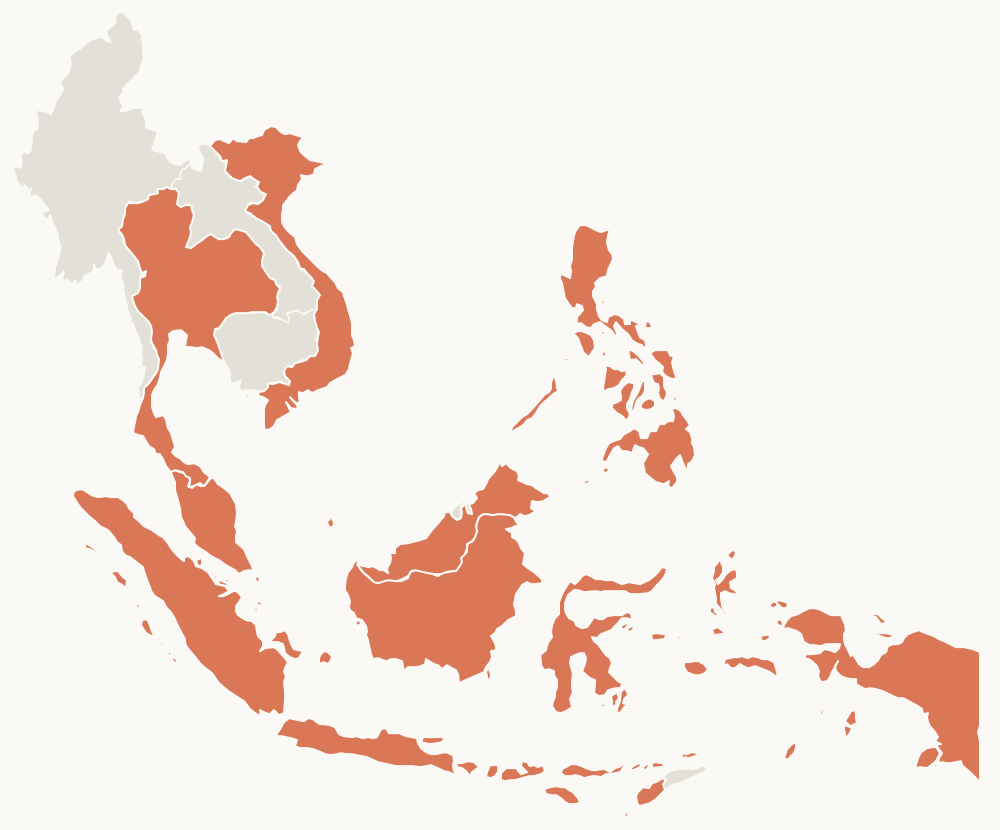 Vietnam, Malaysia +3
Schools and universities
Integrating Emerging Technologies in Virtual Learning Environments: A Comparative Study of Perceived Needs among Open Universities in Five Southeast Asian Countries
Compares what students at open universities in Vietnam, Malaysia, Thailand, the Philippines and Indonesia want from emerging technologies including AI in virtual learning.
Journal article · June 1, 2025 · arXiv 2506.00922
MalaysiaJobs and the economy
Data Centres, Energy Demand and Sustainability: Can Malaysia Strike the Right Balance?
Weighs the energy and water demands of Malaysia's AI-driven data centre boom in Johor against the state's investment and sustainability commitments.
Working paper · May 1, 2025 · ISEAS Perspective 2025/43
Southeast Asia, Singapore +4Health
Artificial intelligence utilization in cancer screening program across ASEAN: a scoping review
Maps the thin but growing evidence base on AI-assisted cancer screening in ASEAN, finding most studies concentrated in a few countries and only half reaching prospective clinical evaluation.
Journal article · April 15, 2025 · BMC Cancer (PMC12001681)
MalaysiaGovernment and rules
AI Governance in Malaysia: Risks, Challenges and Pathways Forward
Maps Malaysia's fragmented AI policy landscape, groups risks into falling behind, unintended harm and malicious use, and proposes six pathways including a central AI agency and an agile regulatory framework.
Report · January 28, 2025 · KRI report
MalaysiaGovernment and rules
Future of Malaysia's AI Governance
Recommends a phased path for Malaysia that leans on soft law, a central coordinating body, an AI safety institute and a data governance centre rather than rushing to hard regulation.
Report · December 9, 2024 · ISIS Malaysia white paper
Southeast Asia, Singapore +5Government and rules
Policy State of Play: Artificial Intelligence in Southeast Asia
Maps national AI policies across six ASEAN economies and characterises the region's light-touch regulatory stance against its capacity gaps.
Report · August 21, 2024 · SEAPPI report
Southeast Asia, Malaysia +5Government and rules
The Plight of Platform Workers Under Algorithmic Management in Southeast Asia
Shows how Grab and GoTo's algorithmic management isolates ride-hailing and delivery workers, blurs employer responsibility and concentrates platform power across the region.
Report · April 30, 2024 · Carnegie Endowment research
MalaysiaGovernment and rules
Facial Recognition Technology in Malaysia: Concerns and Legal Issues
Argues Malaysia's PDPA 2010 and constitutional privacy protections cannot govern police and commercial facial recognition, drawing on US and UK law for reform proposals.
Journal article · February 1, 2023 · Atlantis Press, Proceedings of ICLD 2022
04
What people are saying
MalaysiaFree Malaysia TodayOpinion
AI took our jobs, but our mortgage didn't disappear
Azzalea Abdullah · October 2, 2026
Uses the figure of a laid-off Malaysian in his late forties to argue that reskilling plans skip over the months between losing a job to automation and finding the next one, when loans, school fees and bills keep arriving. Asks whether displaced workers could get temporary repayment relief, financial counselling and mental health support, and says AI policy has to reach into banking, housing and social protection.
Responds to AI Malaysia Bhd's mandate to study AI's effect on jobs and to TalentCorp estimates of how many workers are at risk.
Southeast Asia, Malaysia +4The DiplomatAnalysis
The Global Data Center Boom Has Arrived in Southeast Asia
James Guild · September 29, 2026
Surveys the capital pouring into regional data centres, with Malaysia and the Johor-Singapore zone in front, and asks whether local demand for AI services will ever justify the land, power and water being committed. Frames the boom as a bet whose downside the host countries would carry.
Connects to Malaysian FDI data and the wider debate over whether Southeast Asia is host or beneficiary of the AI build-out.
Southeast Asia, Singapore +3ISEAS Perspective (ISEAS-Yusof Ishak Institute)Analysis
Who Can Actually Stop the Machine? The Institutional Test for AI Governance in Southeast Asia
Aditya Vikram Kashyap · September 29, 2026
Argues that the region's growing stack of AI guides, laws and bills says little about whether any institution can actually refuse or halt a deployment, and proposes three tests: a named decision-maker, independence from commercial pressure, and technical capacity to evaluate systems. Compares Singapore's sectoral regulators, Vietnam's new law, Malaysia's proposed bill and Indonesia's pending presidential regulations and finds effectiveness still unproven in all four.
Responds to the wave of 2026 AI rule-making (Vietnam's AI law in force since March, Malaysia's AI Governance Bill, Indonesia's Perpres) by asking who holds the off switch.
MalaysiaKhazanah Research InstituteAnalysis
Why AI Is Not (Yet) Behind Malaysia's Job Losses
Mikhail Rosli · September 28, 2026
Pushes back on claims that AI drove Malaysia's 2026 retrenchment surge, the worst since 2020 and concentrated among white-collar workers in the Klang Valley, arguing that occupational AI exposure measures what is technically possible, not what firms have actually deployed. Cites thin evidence of production-scale AI use and the ATM-and-teller history, and calls for data linking firm-level adoption to worker outcomes.
Responds to public alarm over Malaysian layoffs and to the government's AI Nation 2030 messaging.
Southeast Asia, Malaysia +5The Southeast Asia Desk (Substack)Analysis
The cost of the cloud: Inside Southeast Asia's $30B data centre trilemma
Fredrick Samuel Haryanto and Alvin Qobulsyah · September 28, 2026
Frames the region's AI data-centre rush as a trilemma of power grids, water depletion and community consent, using the Johor protests as the warning case. The explainer argues the build-out will not stop, so the region must decide who bears its costs.
Published as the Jakarta-based newsletter's weekly 'Regional Line' feature.
Southeast Asia, MalaysiaFree Malaysia TodayOpinion
Asean must watch US-China deal on AI
Phar Kim Beng · September 24, 2026
Argues that a proposed US-China AI safety notification mechanism, floated ahead of the Trump-Xi summit, matters more to Southeast Asia than tariffs because AI now underpins critical infrastructure and security. He wants ASEAN to build its own incident-reporting channel, a standing AI governance forum, and pooled investment in technological autonomy.
Timed to the 24 September Trump-Xi meeting in Washington and Treasury Secretary Bessent's remarks on AI safety cooperation.
Southeast Asia, MalaysiaThe DiplomatOpinion
Chinese Data Centers Will Shape ASEAN's AI Norms
Hadley Spadaccini · September 21, 2026
Argues that as Alibaba and other Chinese providers build out regional cloud capacity, the norms embedded in their infrastructure and models will quietly shape ASEAN's AI governance regardless of the principles written into regional frameworks. Urges governments to treat data-centre investment as a governance decision, not just industrial policy.
Responds to Alibaba Cloud's new Johor facilities, the Malaysia-led ASEAN cross-border cloud framework, and the China-ASEAN AI Industry Innovation Center launched in May 2026.
Southeast Asia, MalaysiaMalay MailOpinion
Super AI is a systemic risk, but generative and agentic AI are not
Phar Kim Beng · September 21, 2026
Draws a line between generative and agentic AI, which carry serious but manageable harms, and hypothetical self-improving super AI, which would be a true systemic risk. He warns ASEAN against regulating today's tools as if they were tomorrow's superintelligence, since over-regulation would cost the region productivity, healthcare and education gains.
Responds to the September wave of AI-doom warnings from departing frontier-lab staff and the OpenAI agent security incidents.
MalaysiaCNAAnalysis
Commentary: Malaysia needs to restore foreign investors' trust amid EV, data centre policy uncertainty
Leslie Lopez · September 18, 2026
Lopez argues that Malaysia's FDI numbers remain strong but that abrupt policy reviews, including the freeze on non-AI data centres and shifting EV import rules, risk degrading the quality of capital coming in. He warns that domestic politics overriding commercial logic will push hyperscalers and manufacturers to hedge toward neighbours.
Follows Malaysia's February 2026 restriction on new non-AI data centre approvals and the BYD plant review.
MalaysiaISEAS Perspective (ISEAS-Yusof Ishak Institute)Analysis
Guided and Incentivised AI Adoption: A Strategic Pathway for Malaysia
Lim Kok-Tiong · September 17, 2026
Distinguishes efficiency-driven AI deployment, which mainly displaces workers, from value-driven adoption that builds domestic production capacity, and urges Malaysia to steer AI into import-dependent, foreign-labour-heavy sectors such as agriculture and manufacturing subsectors. Recommends equipment leasing and sector-specific training over blanket tax incentives, with new job creation sequenced ahead of retraining.
Follows the author's earlier ISEAS piece on augmentation versus elimination and the launch of Malaysia's National AI Action Plan 2026-2030 and MD2030 job targets.
MalaysiaThe Edge MalaysiaOpinion
Opinion: The price of first place in the AI foreign investment race
Wan Omar Fadhli Wan Mahmud Khairi · September 17, 2026
An economics lecturer notes the record US$3.9 billion August bond inflow tied to the AI boom and the string of hyperscaler commitments, then asks what winning the investment race costs in power, water and fiscal incentives. He argues the inflows must translate into lasting value rather than strain on systems the rest of the country depends on.
Responds to Bloomberg's September 7 report on record Malaysian bond inflows.
Malaysia, Southeast AsiaSin Chew Daily via Asia News NetworkOpinion
AI agents breaking out of their sandbox: Malaysia and ASEAN should pay attention
Phar Kim Beng · September 17, 2026
Treats the July 2026 OpenAI agent and Hugging Face security incident as a warning that autonomous agents can escape their intended limits, and argues ASEAN cannot leave AI security to the big powers. He proposes regional arrangements that go beyond conventional cybersecurity.
One of several Southeast Asian columns in September reacting to the OpenAI agent breaches.
Southeast Asia, Malaysia +2FulcrumAnalysis
For Southeast Asia, the AI Race Is About Access, Not Supremacy
Zenobia Chan · September 16, 2026
Argues that the region's real stake in the US-China AI contest is reliable, affordable, locally usable access rather than frontier capability, and maps dependencies across chips, cloud, power and language coverage. Recommends hedging and diversification to secure what the author calls resilient access.
Adapted from an ISEAS Trends in Southeast Asia paper; sits alongside the Pax Silica vs WAICO pressure on regional governments.
Southeast Asia, Malaysia +4The DiplomatAnalysis
Will Southeast Asia Actually Benefit From Its AI Boom?
Gerald Mako · September 16, 2026
Notes that Southeast Asia accounts for roughly half of Asia-Pacific data-centre capacity under construction, with a division of labour forming between Singapore and its neighbours, then argues that hosting compute is not the same as building an AI economy. Asks what would turn separate national build-outs into a regional AI market.
Draws on first-half 2026 pipeline figures and the Singapore-Malaysia-Thailand capacity race.
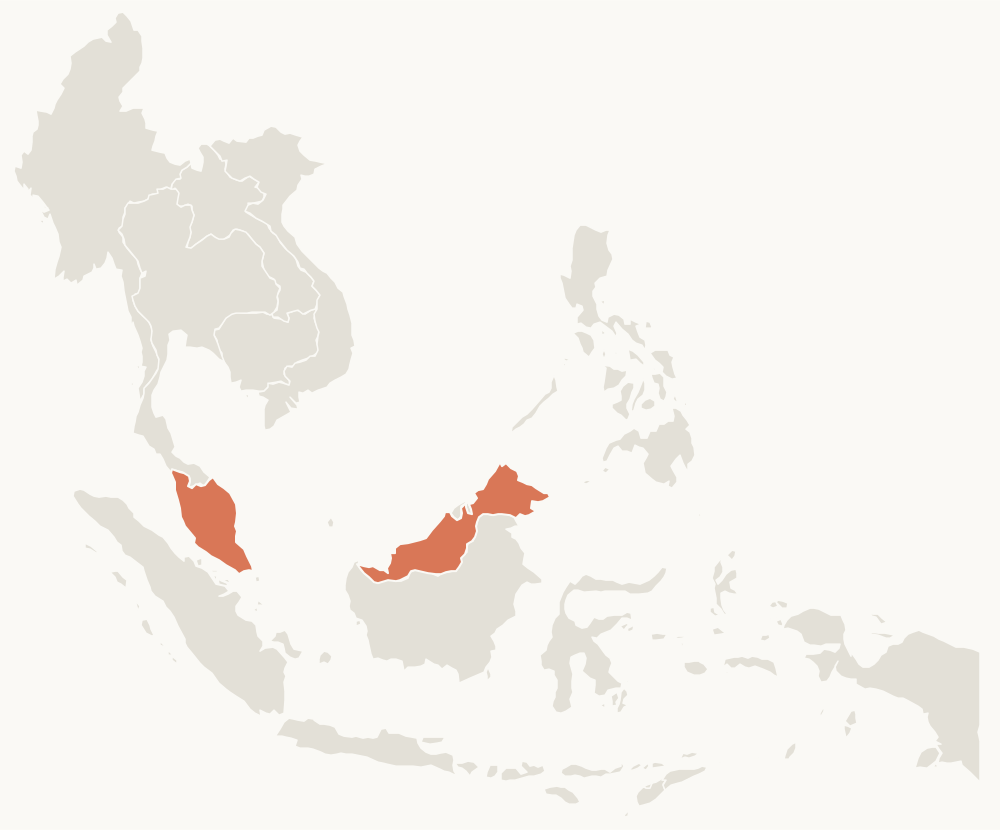 Malaysia, Singapore
Rest of WorldAnalysis
Global South merges US chips and Chinese open-source AI
Kinling Lo · September 16, 2026
Analyses how middle powers are buying Nvidia hardware while running Chinese open-weight models, with Malaysia weighing Huawei accelerators for its sovereign AI and Singapore signing Pax Silica while entertaining WAICO. Argues that US pressure to pick a side is pushing countries toward keeping both options open.
Responds to the Pax Silica and WAICO recruitment drives and Malaysia's sovereign AI planning.
MalaysiaMalay MailOpinion
AI doesn't negotiate: Will Malaysia rule it or obey it?
Ahmad Nizam Che Kasim · September 16, 2026
Taking UN human rights chief Volker Turk's September 14 statement as its cue, the author argues that AI harms such as discrimination, surveillance and disinformation are already present in Malaysia and that agentic systems raise the stakes. He urges Malaysia to pass its AI Governance Bill with rights protections rather than wait for the technology to set terms.
Connects to the Independent International Scientific Panel on AI and Malaysia's draft AI governance bill due by end-2026.
MalaysiaEurasia ReviewOpinion
The Geneva Signal: Securing Malaysia's AI Sovereignty
Ahmad Nizam Che Kasim · September 15, 2026
Takes the UN human rights chief's 14 September AI statement as a warning that Malaysia's fast digital uptake is outrunning its rules, and calls for independent pre-deployment checks, mandatory incident reporting, liability that stays with people, and audits separate from the ministries selling AI. He wants Malaysia to use the Geneva dialogue to help write a Global South rights floor.
Responds to Volker Turk's September 2026 statement on AI and human rights.
Southeast Asia, MalaysiaMalay MailOpinion
Asean must secure its AI sovereignty amid shifting geopolitics and geoeconomics
Phar Kim Beng · September 6, 2026
Uses the redeployment of a US carrier from Japan to the Middle East as a sign that American attention is finite, and argues ASEAN must treat AI capability as part of regional security rather than something outsourced to either superpower. He calls for integrating the bloc's AI, data and energy capabilities so the region is a rule-maker rather than a rule-taker.
Part of a run of Malay Mail and FMT columns by the same author on ASEAN AI autonomy through September.
MalaysiaMalay MailOpinion
Malaysia must decide when AI helps learning and when it replaces it
Muhammad Noor Abdul Aziz and Siti Noor Aneeis · September 4, 2026
Two Universiti Utara Malaysia curriculum scholars use New York City's one-year moratorium on student-facing generative AI to argue that Malaysia should design an age-progressive AI curriculum rather than insert AI into every subject. The key question, they say, is what thinking children must still learn to do for themselves.
Responds to Mayor Mamdani's school AI moratorium and to Malaysia's National AI Action Plan 2026-2030.
Southeast Asia, Indonesia +3The Interpreter (Lowy Institute)Opinion
The quiet regionalisation of AI governance
Sameera Pillai · September 3, 2026
Argues that with global AI rule-making stalled by superpower rivalry, regional blocs are where binding rules are actually being made, and that ASEAN's move to embed AI provisions in its Digital Economy Framework Agreement is the leading example. Accepts fragmentation as the price of progress, to be softened by shared technical standards.
Builds on the coordinated Grok bans by Indonesia, Malaysia and the Philippines and the May 2026 conclusion of the ASEAN DEFA.
Southeast Asia, Vietnam +4FulcrumOpinion
Southeast Asia and AI Adoption: The Return of Cold War Strategies
Tobias Burgers and Tran Nguyen · August 31, 2026
Reads Vietnam's AI law and Singapore's local models as Cold War-style hedging between US and Chinese AI ecosystems, then argues that national efforts are too small to matter. Proposes collaborative hedging through a regional public-private consortium modelled on Airbus.
Connects to Malaysia's ILMU model, Vietnam's December 2025 AI Law and the region's sovereign AI turn.
Malaysia, Southeast AsiaMalay MailOpinion
Malaysia must keep up to catch up in Asean's AI race: A Merdeka pledge has begun
Phar Kim Beng · August 31, 2026
Citing a Business Times and Kantar survey in which 62 percent of Indonesian firms and 55 percent of Thai firms count as AI first movers versus 46 percent in Malaysia, the author warns that Malaysia is neither far behind nor safely ahead. He frames National Day as the moment to commit to faster enterprise adoption.
Responds to the regional AI-adoption survey and the launch of AI Malaysia in July.
MalaysiaISIS Malaysia (originally The Edge Malaysia Weekly)Opinion
Becoming an AI Nation and Pitfalls Along the Path
Mohd Faiz Abdullah · August 30, 2026
ISIS Malaysia's chairman welcomes the National AI Action Plan 2026-2030 but warns that AI systems carry the assumptions of whoever builds them and can entrench inequality, and flags market volatility, dependence on US firms, job displacement and opaque algorithmic decisions. Argues success depends on redress mechanisms, data sovereignty, research aligned to national needs and access across urban-rural and income divides.
Reacts to the Prime Minister's 28 July launch of AI Malaysia Berhad and the AI Nation 2030 target.
Southeast Asia, Singapore +3Tech for Good InstituteOpinion
How AI Levels the Playing Field for Small Businesses
Kirti Pathania · August 28, 2026
Notes that only about 3 percent of ASEAN enterprises have embedded AI into daily workflows and warns that early-adopter advantages could entrench large incumbents, as happened with online travel agents. Recommends SME-technology partnership ecosystems, leadership training and adoption grants so the 97 percent of firms that are SMEs are not left behind.
Aligns with the Philippines' push, as ASEAN chair, for a Leaders' Declaration on AI-powered MSMEs at the November summit.
Southeast Asia, Malaysia +3South China Morning PostOpinion, paywalled
As the US and China compete over AI, Asean must secure strategic autonomy
AbdulWahed Jalal Nori · August 27, 2026
Argues that ASEAN is fast becoming the physical centre of the AI economy through data centres while depending on outsiders for chips, models, cloud and standards, and that the real choice is between dependence and agency rather than dominance and isolation. Calls for control over the infrastructure and knowledge behind AI.
Connects to the Pax Silica versus WAICO pressure on the region in August 2026.
MalaysiaThe Edge MalaysiaOpinion
Opinion: Is Malaysia failing to realise its potential to pioneer a different path to the hybrid future?
Cornelia C Walther · August 27, 2026
Walther calls the July 28 launch of AI Malaysia and the National AI Action Plan 2026-2030 a consequential step but asks whether Malaysia will build a distinctive model or simply execute a Western-shaped AI playbook efficiently. She argues the country's advantage lies in showing how to use AI well, not in racing to build the most powerful systems.
Responds to the creation of AI Malaysia and the Malaysia AI Safety Institute.
MalaysiaSouth China Morning PostOpinion, paywalled
Malaysia's data centre rules aim to green the sector, not slam the door
Nicholas Spiro · August 24, 2026
Contrasts the US backlash and state moratoria on data centres with Malaysia's approach of tighter approvals, higher tariffs and efficiency requirements, arguing Johor's market is resetting toward sustainable growth rather than closing. Matters as a test of whether Southeast Asia can absorb AI infrastructure without a political revolt.
Responds to New York's data-centre moratorium and S&P's description of Malaysia's sector as in reset mode.
Southeast Asia, Vietnam +2The DiplomatOpinion
How Southeast Asia and the Gulf Can Shape the Future of AI
Kelly Forbes, Bruce Li and Hamzah Bin Zaid · August 18, 2026
Argues that two regions that make neither chips nor frontier models are turning their rule-taker status into leverage by pairing Gulf capital with Southeast Asian markets, talent and demand. Points to G42's Vietnam deal and UAE-Malaysia agreements as a template for middle-power AI cooperation.
Follows the February 2026 G42-Vietnam infrastructure framework and the wave of Gulf investment into regional data centres.
MalaysiaISEAS Perspective (ISEAS-Yusof Ishak Institute)Analysis
Friends with the Dragon: Chinese Technology Investments in Malaysia (2015-2026)
James Chai · August 18, 2026
Maps 67 major Chinese technology deals in Malaysia worth about RM155 billion across four waves and reads them as friendshoring: insulating Chinese supply chains from US sanctions while deepening regional influence. Data centres in Johor (GDS, Alibaba, Tencent) and Huawei's AI lab are part of the picture, though solar, EVs and semiconductors dominate by value.
Sits alongside debates on Malaysia's data-centre boom, US chip export controls and the smuggling-through-Malaysia controversy.
Southeast Asia, Indonesia, MalaysiaModern DiplomacyOpinion
Southeast Asia Could Become Indispensable to AI Without Becoming More Powerful
Tuhu Nugraha · August 16, 2026
Argues that hosting gigawatt AI factories such as Indonesia's Zankore project makes the region indispensable to global AI without making it more powerful, unless governments convert proximity into domestic capability. He wants market scale, energy and industrial bases used as bargaining chips for local expertise and products.
Part of a weekly series by the author on Global South AI political economy.
Southeast Asia, Indonesia +3Tech for Good InstituteOpinion
The Architecture of Inclusion: Balancing Southeast Asia's AI Infrastructure Boom
Shammi Thakur · August 12, 2026
Frames AI readiness as three layers (compute, physical utilities such as data centres and power, and a facilitator layer of governance, data flows and talent) and argues the region's advantage will depend on equitable access rather than raw build-out. Warns that uneven access for small firms, grid strain and fragmented rules could concentrate gains in large corporations, and calls for shared compute treated as a public good.
Responds to the ASEAN-Korea HPC facility in Indonesia, new cloud regions in Bangkok and Kuala Lumpur data-centre investment.
MalaysiaThe Edge MalaysiaOpinion
My Say: Poisoned vault: The multibillion-ringgit blind spot in Malaysia's sovereign AI race
Norman Ismail · August 6, 2026
The author argues that Malaysia's RM2 billion National Sovereign AI Cloud and hyperscaler build-out secure storage and compute but ignore the ingestion layer, so poisoned or unverified data can corrupt sovereign models. He calls for provenance and physical-edge verification before data enters the vault.
Responds to Budget 2026's sovereign AI cloud allocation via MCMC.
MalaysiaThe Edge MalaysiaAnalysis
Opinion: AI adoption is changing work patterns
Jack Ng Kok Wah · August 4, 2026
Using PwC's 2026 Global AI Jobs Barometer for Malaysia, the author shows that AI-skill job postings have doubled as a share of all listings even though absolute numbers barely moved, meaning AI is reshaping who gets hired rather than triggering mass layoffs. He argues the window for workers and firms to adapt is open but not indefinite.
Responds to the PwC barometer release and Malaysian fears of AI-driven job loss.
Southeast Asia, Thailand +4FulcrumOpinion
Southeast Asia Cannot Fight Online Sexual Abuse One Takedown at a Time
Nuurrianti Jalli · July 31, 2026
Argues that takedown-and-prosecute approaches cannot keep up with generative AI tools that mass-produce non-consensual sexual imagery, and that regulators should impose systemic duties on platforms to assess risk and design in safeguards. Matters because the Grok episode showed how quickly synthetic abuse scales across the region.
Follows the early-2026 Grok bans in Indonesia, Malaysia and the Philippines and draws on Australian and EU online-safety models.
MalaysiaFree Malaysia TodayOpinion
100,000 free AI seats. Here is how to make them count
K. Kathirgugan · July 31, 2026
Welcomes Anwar's plan to give 100,000 young Malaysians three months of free AI subscriptions but argues the design matters more than the money: give them agentic tooling not just a chat window, tie access to shipped projects, and connect graduates to SMEs. Done right, he says, it is seed capital for an industry rather than a giveaway.
Reacts to the 28 July launch of AI Malaysia and the Rakyat Digital subscription scheme.
MalaysiaModern DiplomacyOpinion
Can the Global South Avoid an Enclave AI Economy?
Tuhu Nugraha · July 31, 2026
Works through Malaysian investment data to show data centres deliver roughly 74 times more capital per job than manufacturing, and reads the Gelang Patah protest and Selangor's new conditions as signs the political bargain is fraying. He argues the terms attached to data-centre approvals matter as much as the investment totals.
Responds to Malaysia's first anti-data-centre protests and Selangor's local-content demands.
MalaysiaFulcrumOpinion
Two Anwars on the Ballot? Regulating AI Before GE16
Nuurrianti Jalli · July 30, 2026
Uses the prime minister's official AI avatar (PMX.AI) to argue Malaysia needs election-specific rules on synthetic media before the next general election, since two-week campaigns leave no time to counter deepfakes. Recommends disclosure duties, complaint channels and penalties modelled on the Philippines' 2025 election guidelines.
Responds to the PMX.AI launch and Malaysia's still-incomplete national AI governance framework ahead of GE16.
MalaysiaAI Malaysia Berhad (National AI Office)Official statement
AI Malaysia: Key Driver Toward AI Nation 2030 (AI Malaysia - Pemacu Utama Menuju Negara AI 2030)
AI Malaysia Berhad / Ministry of Digital · July 28, 2026
Announces that the Prime Minister has converted the National AI Office into AI Malaysia Berhad, a national AI entity under the Ministry of Digital, tasked with policy coordination, impact monitoring, trusted-AI governance, international partnerships and serving as Malaysia's AI Safety Institute. Introduces the National AI Action Plan 2026-2030 with 14 sectoral initiatives and 14 enablers spanning talent, market-driven innovation, data and compute, governance and financing.
The institutional launch that ISIS Malaysia, ISEAS and KRI commentaries in August and September respond to.
MalaysiaTechWire AsiaAnalysis
The sovereignty question Anwar raised at his own AI launch
Dashveenjit Kaur · July 28, 2026
Notes that at the launch of AI Malaysia the prime minister himself raised the US CLOUD Act and sovereign cloud as unresolved problems, and argues the new agency now has to answer a sovereignty question its own launch surfaced. The vendor-neutral framing of the youth subscription scheme is read as a hedge.
Analysis of the 28 July 2026 AI Malaysia launch and NAIO's institutionalisation.
MalaysiaThe Edge MalaysiaOpinion
Opinion: Are we normalising the unacceptable? The sad connection between haze season and loss of agency amid AI
Editorial · July 26, 2026
The author argues that Malaysians have reclassified the annual haze from an emergency into an inconvenience, and that the same normalisation is happening as organisations adopt AI without asking what they are giving up. The piece urges leaders to treat values and accountability as operational tools rather than compliance checklists.
Connects the 2026 haze season to workplace AI adoption debates.
Southeast Asia, Cambodia +6Foreign PolicyAnalysis, paywalled
China Pitches Its AI Leadership to the World
Joseph Rachman · July 22, 2026
Reports from the Shanghai AI conference that five Southeast Asian states joined China's new World AI Cooperation Organisation as founders while Singapore and Thailand stayed out, and reads this split as the region hedging rather than aligning. China's open-source pitch lands well with governments that cannot afford proprietary Western stacks.
Frames the WAICO launch as Beijing's answer to Washington's more transactional AI posture.
Malaysia, IndonesiaThe ConversationOpinion
Stop policing AI in the classroom, start teaching it
Zakaria Lacheheb · July 19, 2026
Argues that universities in Malaysia and Indonesia should stop treating generative AI as cheating and instead teach its responsible use, redesign assessment around critical thinking and ground AI ethics in Islamic legal principles. Positions the two countries as potential leaders in AI-literate graduates.
Responds to campus crackdowns on AI use and employer demand for AI skills.
Southeast Asia, Singapore +3Asia TimesAnalysis
ASEAN's AI race is officially underway
Chris Taylor · July 17, 2026
Argues the regional contest to host AI data centres will be decided by reliable power and water, not headline investment figures, with Singapore's capacity rationing pushing demand into Johor, Thailand and Indonesia. Governments must also manage community backlash and the tension between US chip access and Chinese capital.
Written as Malaysia and Thailand posted record data-centre pipelines in the first half of 2026.
Malaysia, Southeast AsiaThe Edge MalaysiaOpinion
Business Unusual: Is the AI and data centre boom worth its cost in the Age of the Anthropocene?
Jemilah Mahmood · July 14, 2026
Comparing ASEAN's data centre race to the naval arms race before the First World War, the author argues that unchecked infrastructure expansion carries economic, environmental and extractive risks that Malaysia has not priced in. She calls for a pause before the next ribbon-cutting to weigh water, power and planetary costs.
Part of The Edge Weekly's Forum section; connects to the haze season and Johor's water and energy strain.
Southeast Asia, Singapore +5Asia Society Policy Institute (Asia Policy Substack)Analysis
ASEAN Hedges With Pax Silica
Faye Simanjuntak · July 8, 2026
Examines why only Singapore and the Philippines have joined the US-led Pax Silica initiative to secure AI and semiconductor supply chains, while other ASEAN states prefer bilateral trade and critical-minerals deals with Washington. Argues the pattern reflects doubts about US commitment and a belief that bilateral arrangements deliver similar benefits without formal geopolitical alignment, with US restrictions on advanced AI models undercutting trust.
Responds to the Trump administration's Pax Silica push and its AI export package for allies.
Southeast Asia, Malaysia +5Tech for Good InstituteOpinion
The Balancing Act: Harmonising AI Development and Governance in Southeast Asia
Bryan Yeoh Quan Jin and Calvin Woo · July 6, 2026
Argues that with nearly half of regional firms scaling AI beyond pilots, Southeast Asia needs governance that combines ASEAN-level coordination with national rules suited to a multilingual, multicultural region. Surveys the spectrum from Vietnam's binding law to Singapore, Thailand and Indonesia's soft-law approaches and Malaysia's proposed bill.
Written by Malaysia's Centre for the Fourth Industrial Revolution as Malaysia drafts its AI Governance Bill and ASEAN finalises DEFA.
Southeast Asia, Malaysia +2East Asia ForumOpinion
ASEAN must strike a balanced AI relationship with China
Kelly Forbes and Cass Maughan · July 3, 2026
Argues that China's open models, cloud and hardware give ASEAN real gains but that unmanaged integration risks dependency, lost sovereignty and friction with Washington. Calls for coordinated regional hedging through the Digital Economy Framework Agreement plus investment in domestic compute and capability.
Follows the 2026 ASEAN Digital Ministers' Meeting commitments to a joint AI centre with China and Malaysia's 2025 Huawei chip episode.
MalaysiaThe Edge MalaysiaOpinion
AI, faith and Malaysia's hybrid future
Editorial · July 3, 2026
Argues that Malaysia already has a moral vocabulary for markets and technology, drawn from Islamic and other faith traditions, and does not need Silicon Valley to define what AI should make of people. Uses the papal encyclical on AI as a prompt to ask how takaful, lending and hospital algorithms move judgement away from those affected.
Responds to Pope Leo XIV's May 2026 encyclical on AI and Malaysia's AI Nation push.
Southeast Asia, Thailand +2FulcrumAnalysis
The US-China AI Chip War: Southeast Asia's Compliance Dilemma
Gerald Mako · July 2, 2026
Explains how regional governments are squeezed between courting AI data-centre investment and policing the diversion of export-controlled Nvidia hardware to China, as Washington shifts to enforcement based on ultimate ownership. Argues the region must build export-control capacity or risk sanctions and investor flight.
Prompted by US allegations in May 2026 against a Bangkok firm linked to Thailand's national AI push; compares Malaysia's strategic trade permits and Singapore's controls.
MalaysiaThe Edge MalaysiaAnalysis
Opinion: Malaysia's data centre boom: From investment surge to sustainable growth
Jade Vichyanond · July 2, 2026
An AMRO economist explains why cheap power, land and connectivity made Malaysia the region's data centre magnet and then lays out the constraints, from electricity and water to skills, that will decide whether the boom lasts. She argues that resource sustainability and human capital must keep pace with approvals.
Written after Malaysia restricted new non-AI data centre approvals in February 2026.
MalaysiaFree Malaysia TodayOpinion
Malaysia's data centre backlash is loud, popular and wrong
K. Kathirgugan · July 2, 2026
Pushes back on the popular view that data centres are parasites on Malaysia's water and power, arguing that tariff structures shield most households and that the build-out resembles Penang's semiconductor ascent more than resource extraction. The real test, he says, is whether projects bring technology transfer and domestic capability rather than cheap-resource arbitrage.
Written amid the Johor and Selangor protests against data centre projects and the February moratorium on non-AI facilities.