- 28%
- People using generative AIMicrosoft AI Diffusion Report, 2026-Q2
- 0.5
- Claude use per personAnthropic Economic Index, 2026-05
- 88
- ChatGPT messages per person, world rankOpenAI Signals, 2026-Q2
01
Who is using AI
02
What governments are doing
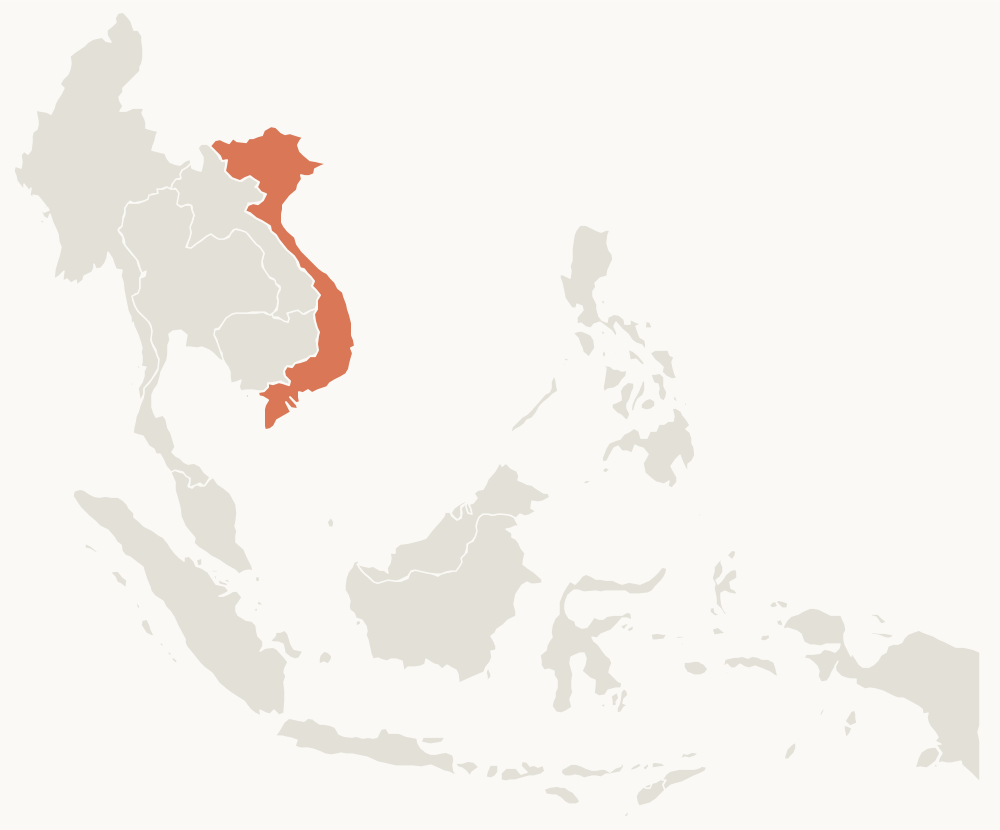
Vietnam
Verified September 29, 2026
- AI law
- Law on Artificial Intelligence, No. 134/2025/QH15 (Luat Tri tue nhan tao)Enacted, December 10, 2025
- Data law
- Law on Personal Data Protection, No. 91/2025/QH15, with implementing Decree 356/2025/ND-CP (replacing Decree 13/2023/ND-CP); Law on Data 60/2024/QH15 sits alongside itEnacted, January 1, 2026
- Sector rules
- Draft Circular on safety, risk management and deployment conditions for AI applications in the banking sectorDraft, 2026Circulated for industry comment via Official Dispatch 1162/NHNN-CNTT of 2026-02-13 (6 chapters, 27 articles in the first draft; a later draft reported as 5 chapters, 26 articles), it would require credit institutions, foreign bank branches and payment intermediaries to classify AI systems by risk, keep human oversight, disclose AI interaction to customers, control bias and report serious incidents within 24 hours, with existing systems to comply by 2027-09-01; it was being finalised after Decision 33/2026 as of August 2026 and had not been located as issued on the SBV portal by 2026-09-29.
- Decision 33/2026/QD-TTg promulgating the List of High-Risk AI SystemsEnacted, 2026Names the specific AI uses in six fields (for example automated credit decisions and transaction controls in banking, surgical robots and diagnostic aids in health, automated student assessment in education, biometric identification in proceedings, autonomous driving and traffic control in transport) that trigger conformity assessment and the other high-risk duties of the AI Law and Decree 142.
Naming: the AI Law's Vietnamese name is Luat Tri tue nhan tao; English sources use 'Law on Artificial Intelligence' or 'AI Law'. Government-portal pages give the law's date as 2025-12-10 (passage and signing), while some English news dated it 2025-12-11. The lead ministry is the Ministry of Science and Technology (MOST, sometimes abbreviated MST on its English site) after absorbing the Ministry of Information and Communications in 2025; the ministry's English site still carries some 'MIC' page paths. A Decree 225/2026/ND-CP (reported in state media as effective 2026-07-01) is said to add AI explicitly to MOST's functions and create a Department of Digital Technology and AI, but this was not confirmed at a primary source. Strategy: the 2021 Decision 127/QD-TTg record on vanban.chinhphu.vn does not yet show a 'replaced' flag, and the government newspaper article on Decision 1671 does not state that it repeals Decision 127, though LuatVietnam reports that it does; treat Decision 1671 as the current strategy and Decision 127 as its predecessor. Political backdrop: Politburo Resolution 57-NQ/TW of 2024-12-22 on breakthroughs in science, technology, innovation and digital transformation (a Party document, not law) drives the whole programme. Law on Digital Technology Industry 71/2025/QH15 (passed 2025-06-14, in force 2026-01-01) originally carried an AI chapter that the AI Law repealed. Pending or unconfirmed: SBV AI banking circular (draft); administrative-sanctions decree for the AI Law and for the PDPL (none located as issued); MOST technical guidance on conformity assessment; the Ministry of Education and Training's AI curriculum framework for grades 1 to 12 from school year 2026-2027 (reported mid-August 2026, no primary document located, so not listed as a sector rule). Penalty amounts under the AI Law are not stated in the sources opened; Vietnam Briefing reports penalties may be set as a share of global revenue but gives no figure. The National AI Ethics Framework is binding only for public-sector AI use and recommended for everyone else; the 2024 Decision 1290 principles were fully voluntary.
03
What researchers are finding
VietnamLanguage and models
Fusing Visual and Textual Representations via Multi-layer Fusing Transformers for Vietnamese Visual Question Answering
Proposes a model that blends image and text features at several levels of detail to answer questions about pictures in Vietnamese, and reports that it beats earlier approaches on a standard Vietnamese test set.
Preprint · October 1, 2026 · arXiv 2610.01637
VietnamLanguage and models
ViLegalExpert: A Large-Scale Benchmark for Vietnamese Legal Retrieval and Question Answering from Real-World Consultations
Builds a large test set from real Vietnamese legal consultations and finds that AI systems answer fluently but still struggle to find the specific legal provisions that back up an answer.
Preprint · September 30, 2026 · arXiv 2609.39189
VietnamSchools and universities
DeepEdu-v1: Efficient and Scalable Agentic LLMs for Vietnamese Education
Describes an AI tutor for Vietnamese schools that runs on local hardware to keep student data in the country, roughly halving response time and improving accuracy on complex tasks compared with standard setups.
Preprint · September 25, 2026 · arXiv 2609.31568
VietnamSchools and universities
Vietnamese EFL Teachers' Perceptions of ChatGPT-Generated Feedback: A Cross-Sectional Survey Study
Finds that Vietnamese English teachers rate ChatGPT's comments on essay content above its grammar corrections, and that their willingness to adopt it hinges on usefulness and on backing from their institution.
Journal article · September 25, 2026 · Electronic Journal of Foreign Language Teaching
VietnamLanguage and models
VietPrism: A large-scale Vietnamese speech and deepfake corpus with diverse dialects and code-switching
Releases nearly a thousand hours of Vietnamese speech across five dialect groups with matched fake voices, and shows existing deepfake detectors fail badly when the fake closely imitates a real speaker.
Preprint · September 24, 2026 · arXiv 2609.30005
VietnamGovernment and rules
Automated Extraction of Records of Processing Activities (RoPA) Using Hybrid RAG and Locally Deployed Large Language Models
Builds a tool that drafts the data-processing records Vietnam's new personal data law requires, and shows a language model run on an organisation's own hardware does about as well as a cloud model, keeping data in the country.
Preprint · September 23, 2026 · arXiv 2609.27359
VietnamLanguage and models
Cross-Lingual Legal QA for Vietnamese Labour Law: Retrieval, Translation, and Verifier-Guided Correction
Finds that AI systems answering English questions about Vietnamese labour law struggle to find the right statutes, and that an added fact-checking step mostly just keeps citations intact rather than making answers better.
Preprint · September 23, 2026 · arXiv 2609.27376
VietnamSchools and universities
Understanding dynamic learning profiles in AI-supported environments in Vietnam: Evidence from a three-wave latent transition analysis
Tracks Vietnamese undergraduates over a semester and finds three learning profiles (optimal, moderate, maladaptive) defined by AI self-efficacy, cognitive offloading and metacognition.
Preprint · September 21, 2026 · Research Square rs-10468699/v1
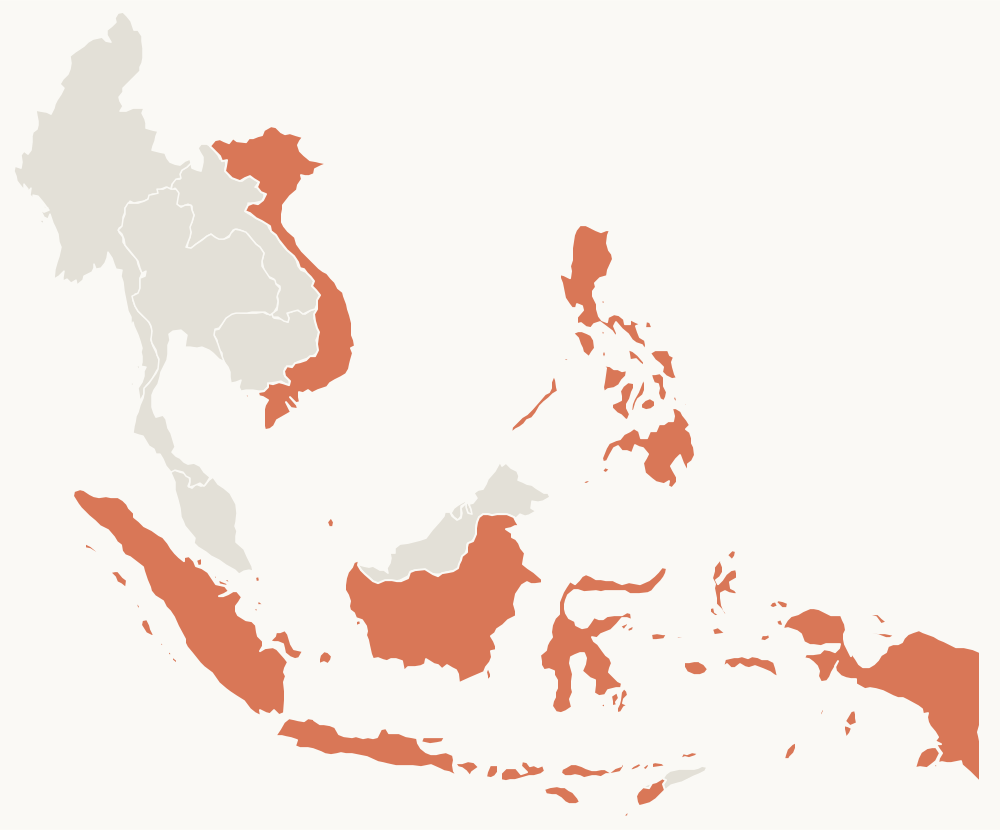 Indonesia, Philippines +2
Schools and universities
Bridging the Divide: An ASEAN Fintech Skills Framework for Indonesia, the Philippines, Singapore, and Viet Nam
Finds roughly 48 percent technical and 46 percent soft-skills gaps in the fintech workforce of four ASEAN economies, with AI and cybersecurity among the scarcest capabilities, and proposes a regional skills framework.
Report · August 1, 2026 · ADB report
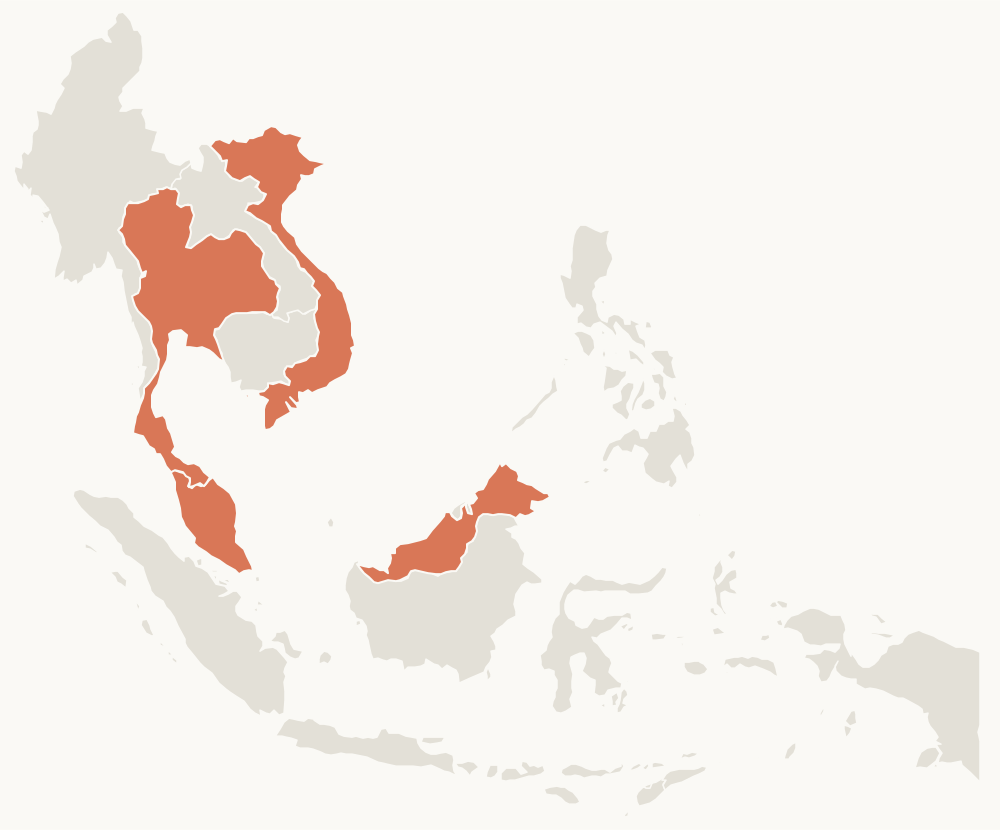 Singapore, Malaysia +2
Government and rules
Governing for Adoption: The Role of Legal and Regulatory Frameworks in Shaping AI Uptake in Southeast Asia
Compares four ASEAN legal regimes to show how sandboxes, data-sharing rules and AI assurance mechanisms, not tax incentives, drive AI commercialisation and adoption.
Journal article · July 31, 2026 · IntechOpen (perspective chapter)
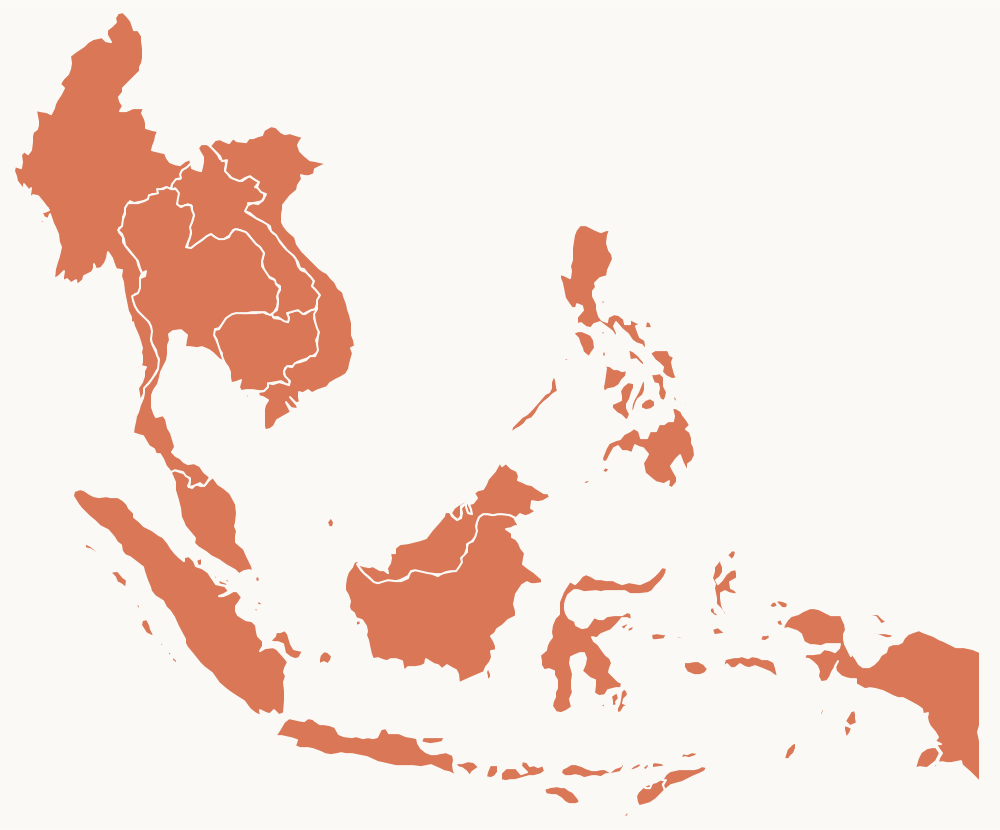 Southeast Asia, Indonesia +6
Jobs and the economy
Generative AI and labour markets in ASEAN: Significant exposure, limited disruption, uneven preparedness
Puts nearly 80 million ASEAN workers (22.9 percent of employment) in GenAI-exposed occupations yet finds no sign of broad displacement so far, with women overrepresented in the most exposed jobs and a gap between exposure and institutional readiness.
Report · July 8, 2026 · ILO Brief
VietnamJobs and the economy
Applications of Artificial Intelligence in the Vietnamese Economy
Surveys the evidence on how AI is reshaping work, digital skill demand and productivity in Vietnam as the country moves off a low-cost labour model, flagging skills gaps, adoption costs and job quality as the main constraints.
Working paper · July 1, 2026 · IZA Discussion Paper No. 18825
VietnamSchools and universities
ConnectED: A Curriculum-Aligned AI System for Vietnamese Instructional Lesson Planning and Student Learning
A Vietnamese-curriculum LLM scores 87 percent on the 2025 national exam and cuts lesson-planning time from hours to under an hour with teacher oversight.
Preprint · June 2, 2026 · arXiv 2607.28647
VietnamJobs and the economy
Generative AI and jobs in Viet Nam: Labour market exposure and policy considerations
Finds 20.8 percent of Vietnamese employment (11.5 million jobs) is potentially exposed to GenAI but only 1.8 percent sits in the highest-exposure tier, with exposure concentrated in Hanoi, Ho Chi Minh City and Da Nang, in clerical work, and among women.
Report · April 1, 2026 · ILO Brief
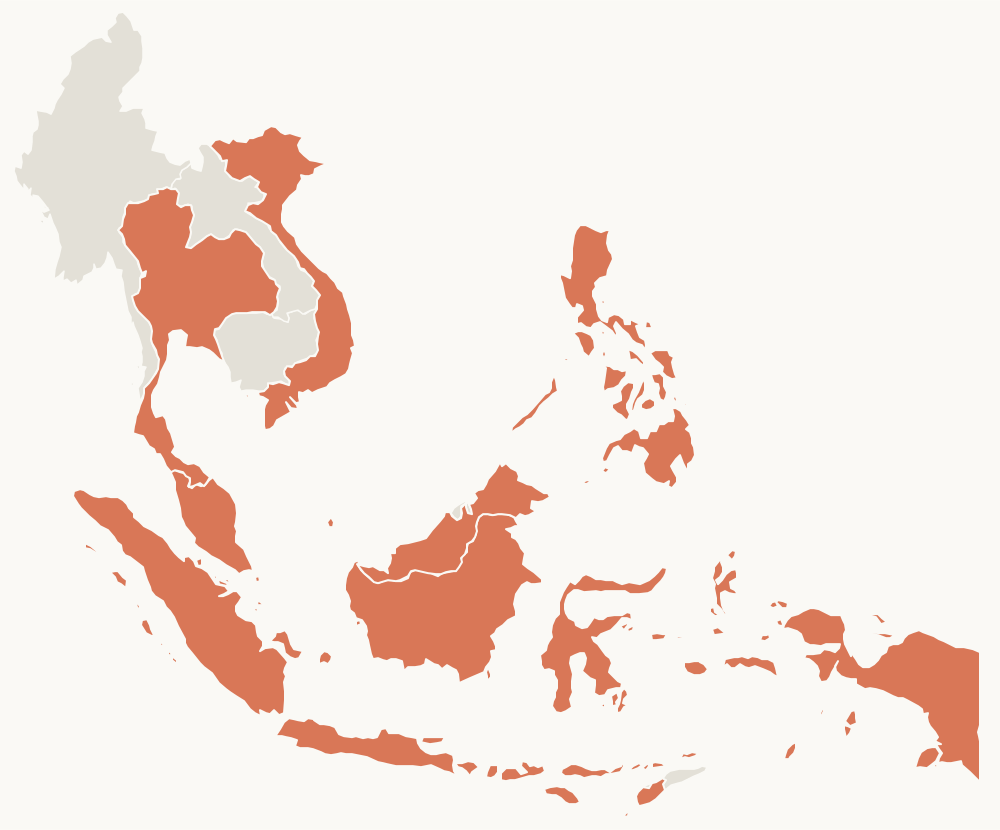 Indonesia, Malaysia +4
Government and rules
The Evolution of Tech Governance in Southeast Asia-6, Third Edition
Tracks how SEA-6 digital governance shifted from AI ethics principles toward binding rules, sovereign compute investment and safety-testing regimes during 2025.
Report · March 4, 2026 · TFGI annual report
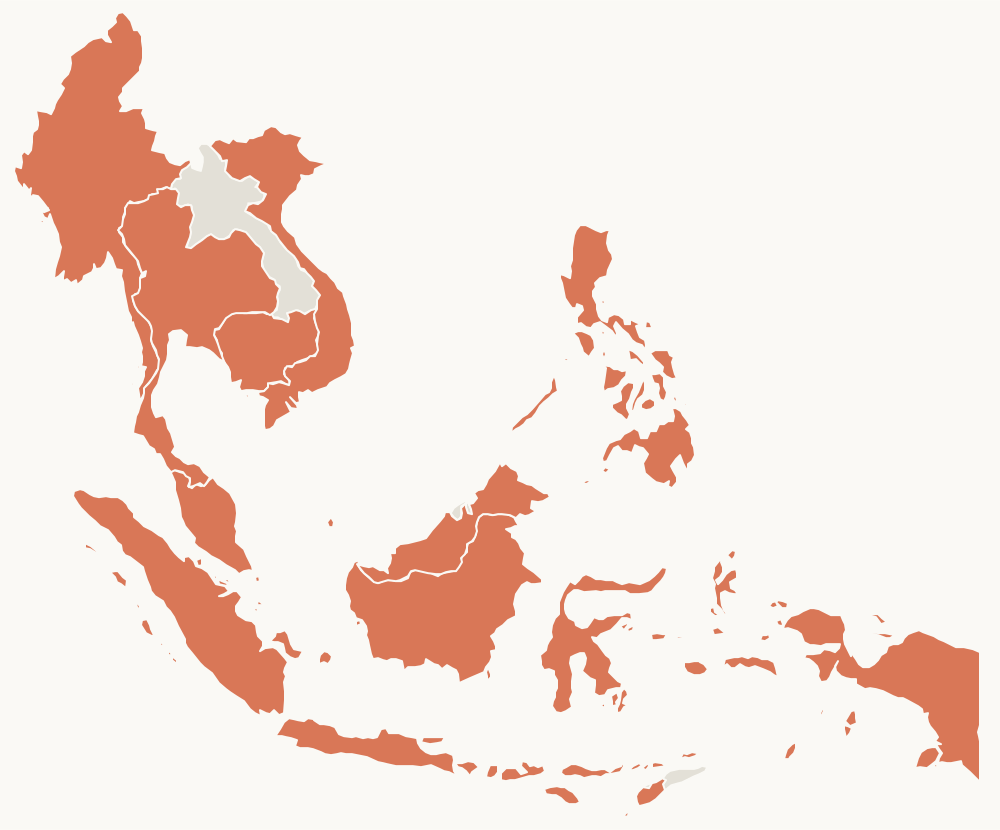 Cambodia, Indonesia +6
Government and rules
The Annual Report: Digital Rights in Southeast Asia 2025
Regional digital-rights review that includes AI-enabled surveillance (notably Myanmar's PSMS) and platform accountability across eight countries.
Report · February 16, 2026 · DigitalReach annual report
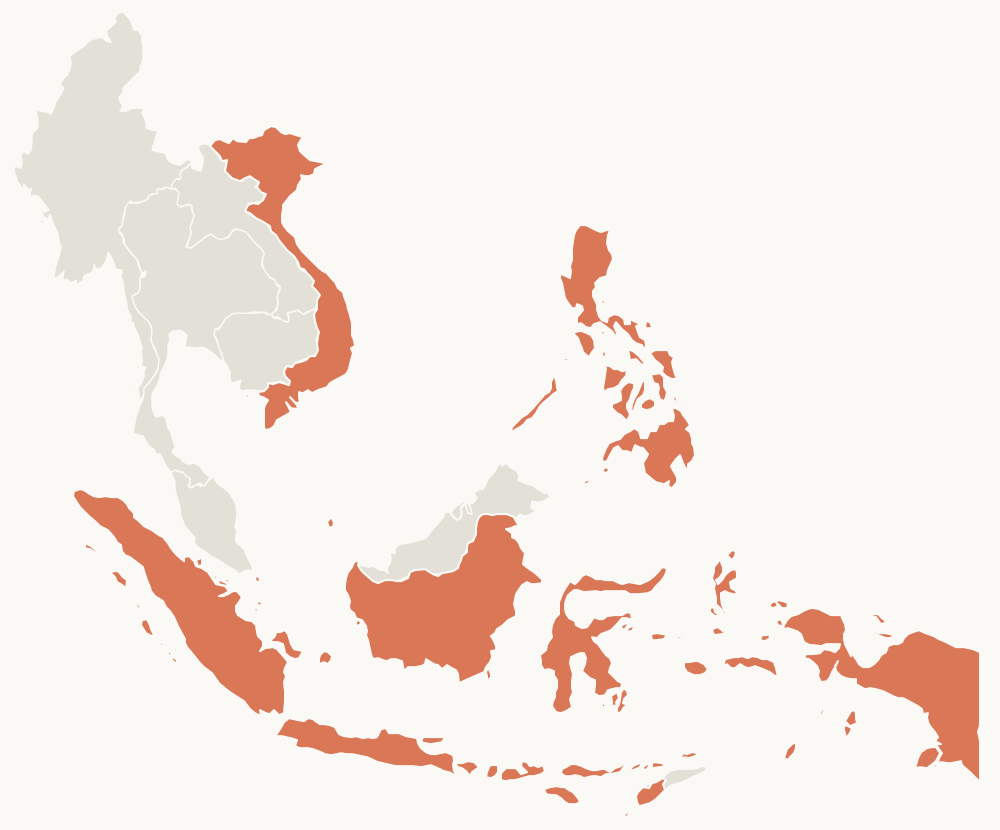 Indonesia, Philippines +2
Jobs and the economy
Workers' Exposure to Artificial Intelligence Across Development Stages
Builds development-stage-adjusted AI exposure measures and shows workers in lower-income Asian economies, including Indonesia and the Philippines, are less exposed than those in rich countries mainly because tasks within the same occupation differ.
Working paper · January 1, 2026 · ADB Economics Working Paper No. 836
VietnamGovernment and rules
VLegal-Bench: Cognitively Grounded Benchmark for Vietnamese Legal Reasoning of Large Language Models
VLegal-Bench tests LLMs on hierarchical, frequently revised Vietnamese legislation using questions organized by cognitive level.
Preprint · December 16, 2025 · arXiv 2512.14554
Southeast Asia, Indonesia +5Government and rules
Policy Brief: Promoting Regional Cooperation for Responsible Artificial Intelligence (AI) Deployment
Sorts the SEA-6 into principle-led, hard-law and ecosystem-building approaches to AI governance and proposes four regional coordination priorities.
Report · November 1, 2025 · TFGI Policy Brief
VietnamGovernment and rules
Viet Nam: Artificial Intelligence Readiness Assessment Report
Assesses Viet Nam's AI ecosystem after the 2025 Digital Technology Industry Law, documenting a 5,000 to 7,000 AI engineer base against a large IT talent shortfall and a fast-growing AI market.
Report · October 1, 2025 · UNESCO AI Readiness Assessment Methodology country report (SHS/BIO/2025/AI-RAM/VN)
Southeast Asia, Brunei +10Government and rules
AI Safety Governance, the Southeast Asian Way
Surveys AI safety and governance moves in every Southeast Asian country, including Timor-Leste, and argues the region is converging on a pragmatic, development-first model distinct from EU or US approaches.
Report · August 25, 2025 · Brookings Governance Studies report
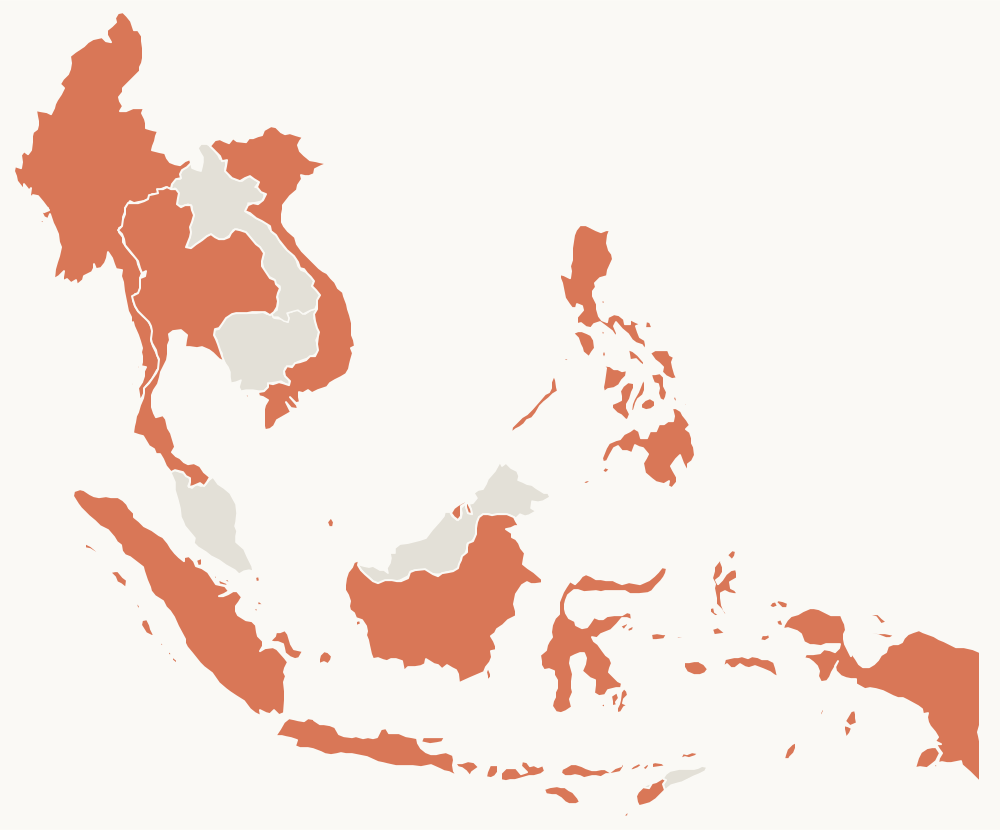 Brunei, Indonesia +5
Health
Insights Into the Current and Future State of AI Adoption Within Health Systems in Southeast Asia: Cross-Sectional Qualitative Study
Stakeholders across seven SEA health systems say AI uptake hinges on basic digital infrastructure and data/technology governance, with a sharp readiness gap between high-income and lower-middle-income members.
Journal article · June 16, 2025 · Journal of Medical Internet Research 27:e71591 (doi 10.2196/71591)
Southeast Asia, Indonesia +4Jobs and the economy
Future Jobs: Robots, Artificial Intelligence, and Digital Platforms in East Asia and Pacific
Argues that robots have so far created more jobs than they destroyed in East Asia and Pacific, that AI exposure is lower in the region's developing economies but rising, and that digital platforms are reshaping informal work.
Report · June 1, 2025 · World Bank East Asia and Pacific Development Studies
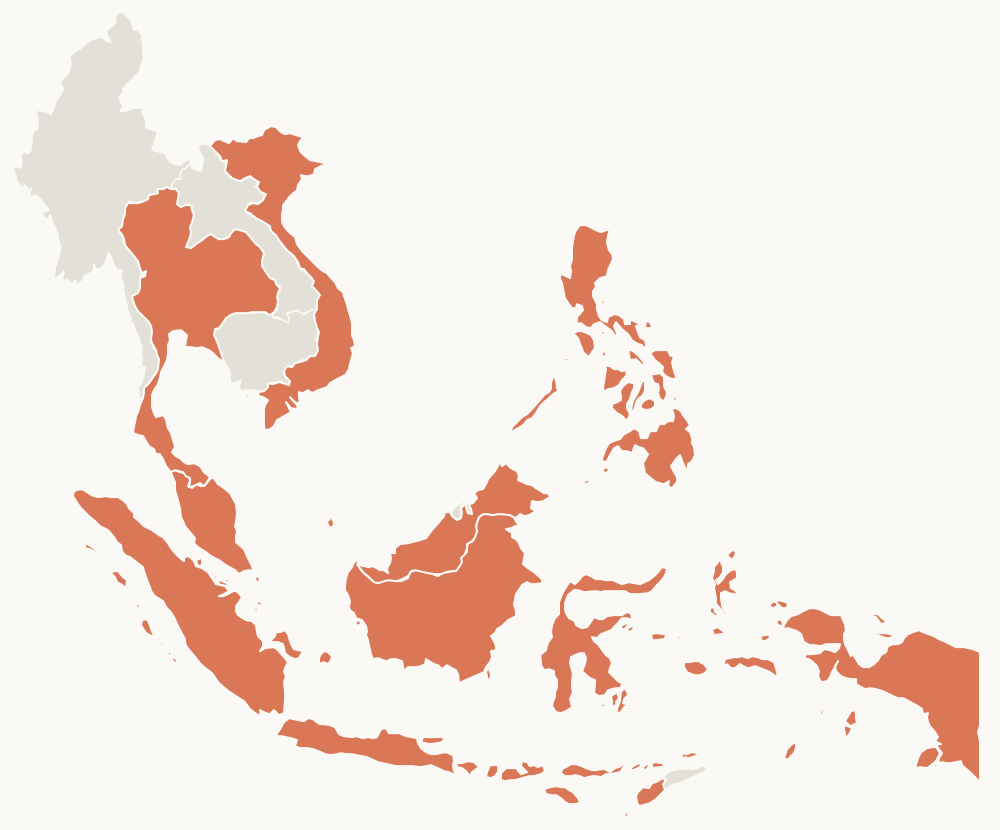 Vietnam, Malaysia +3
Schools and universities
Integrating Emerging Technologies in Virtual Learning Environments: A Comparative Study of Perceived Needs among Open Universities in Five Southeast Asian Countries
Compares what students at open universities in Vietnam, Malaysia, Thailand, the Philippines and Indonesia want from emerging technologies including AI in virtual learning.
Journal article · June 1, 2025 · arXiv 2506.00922
Southeast Asia, Singapore +4Health
Artificial intelligence utilization in cancer screening program across ASEAN: a scoping review
Maps the thin but growing evidence base on AI-assisted cancer screening in ASEAN, finding most studies concentrated in a few countries and only half reaching prospective clinical evaluation.
Journal article · April 15, 2025 · BMC Cancer (PMC12001681)
VietnamGovernment and rules
Artificial Intelligence Landscape Assessment (AILA): Shaping AI to be an Empowering Force for People and Planet, Viet Nam 2025
Scores Vietnam's public-sector AI capacity, finding weak inter-agency data sharing and a shortage of in-house AI expertise, and proposes a roadmap for AI in government.
Report · April 1, 2025 · UNDP AILA country report
VietnamHealth
Leveraging Climate Data for Dengue Forecasting in Ba Ria Vung Tau Province, Vietnam: An Advanced Machine Learning Approach
For a coastal Vietnamese province, a lagged-climate negative binomial model beat XGBoost and LSTM at weekly dengue forecasting, though none captured outbreak peaks well.
Journal article · October 21, 2024 · Tropical Medicine and Infectious Disease (PMC11511084)
Southeast Asia, Singapore +5Government and rules
Policy State of Play: Artificial Intelligence in Southeast Asia
Maps national AI policies across six ASEAN economies and characterises the region's light-touch regulatory stance against its capacity gaps.
Report · August 21, 2024 · SEAPPI report
Southeast Asia, Malaysia +5Government and rules
The Plight of Platform Workers Under Algorithmic Management in Southeast Asia
Shows how Grab and GoTo's algorithmic management isolates ride-hailing and delivery workers, blurs employer responsibility and concentrates platform power across the region.
Report · April 30, 2024 · Carnegie Endowment research
VietnamLanguage and models
Crossing Linguistic Horizons: Finetuning and Comprehensive Evaluation of Vietnamese Large Language Models
Fine-tunes open LLMs for Vietnamese and builds a broad Vietnamese evaluation framework, showing that data quality and instruction tuning matter more than scale for Vietnamese performance.
Journal article · March 5, 2024 · arXiv 2403.02715
VietnamLanguage and models
PhoGPT: Generative Pre-training for Vietnamese
PhoGPT-4B is an open Vietnamese generative model and chat variant pretrained from scratch, reported to outperform much larger multilingual models on Vietnamese instruction following.
Preprint · November 6, 2023 · arXiv 2311.02945
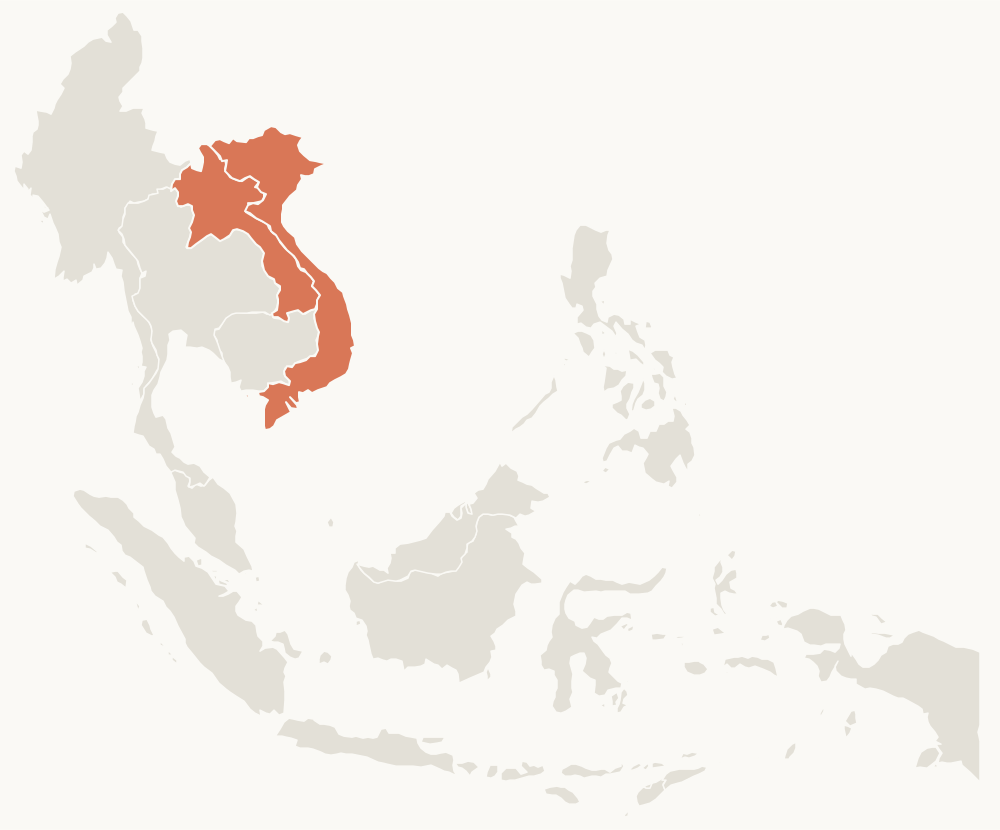 Laos, Vietnam
Jobs and the economy
The impact of artificial intelligence on labor markets in developing countries: a new method with an illustration for Lao PDR and urban Viet Nam
Develops a text-similarity method to port US-based AI exposure measures to developing-country skills surveys and finds urban Vietnamese workers face more displacement-type AI exposure than workers in Lao PDR.
Journal article · July 1, 2023 · Journal of Evolutionary Economics 33(3)
04
What people are saying
Southeast Asia, Singapore +3FulcrumAnalysis
Southeast Asia's Mixed AI Stacks: Pragmatic but Not Risk-Free
Zenobia Chan · September 30, 2026
Shows that regional projects such as SEA-LION, Sahabat-AI, Typhoon and FPT's AI Factory combine American chips, American and Chinese open-weight models and local data rather than picking one bloc. Argues these mixed stacks bring real gains in local relevance and testing capacity, but warns that labels like sovereign can overstate control when every model still runs on the same foreign cloud or chips.
Adapted from her ISEAS Trends in Southeast Asia paper, and written as Washington signals that partners may have to choose between US and Chinese AI coalitions.
Southeast Asia, Malaysia +4The DiplomatAnalysis
The Global Data Center Boom Has Arrived in Southeast Asia
James Guild · September 29, 2026
Surveys the capital pouring into regional data centres, with Malaysia and the Johor-Singapore zone in front, and asks whether local demand for AI services will ever justify the land, power and water being committed. Frames the boom as a bet whose downside the host countries would carry.
Connects to Malaysian FDI data and the wider debate over whether Southeast Asia is host or beneficiary of the AI build-out.
Southeast Asia, Singapore +3ISEAS Perspective (ISEAS-Yusof Ishak Institute)Analysis
Who Can Actually Stop the Machine? The Institutional Test for AI Governance in Southeast Asia
Aditya Vikram Kashyap · September 29, 2026
Argues that the region's growing stack of AI guides, laws and bills says little about whether any institution can actually refuse or halt a deployment, and proposes three tests: a named decision-maker, independence from commercial pressure, and technical capacity to evaluate systems. Compares Singapore's sectoral regulators, Vietnam's new law, Malaysia's proposed bill and Indonesia's pending presidential regulations and finds effectiveness still unproven in all four.
Responds to the wave of 2026 AI rule-making (Vietnam's AI law in force since March, Malaysia's AI Governance Bill, Indonesia's Perpres) by asking who holds the off switch.
Southeast Asia, Malaysia +5The Southeast Asia Desk (Substack)Analysis
The cost of the cloud: Inside Southeast Asia's $30B data centre trilemma
Fredrick Samuel Haryanto and Alvin Qobulsyah · September 28, 2026
Frames the region's AI data-centre rush as a trilemma of power grids, water depletion and community consent, using the Johor protests as the warning case. The explainer argues the build-out will not stop, so the region must decide who bears its costs.
Published as the Jakarta-based newsletter's weekly 'Regional Line' feature.
VietnamVietnam Ministry of Science and TechnologyOfficial statement
Tie Law Implementation to Real AI Needs: Technology Supports People, People Stay Responsible
Tran Trung Tinh · September 18, 2026
At a Ho Chi Minh City training conference on implementing the AI law, the deputy minister insists AI outputs must be checked before use in public service and that officials, not systems, remain accountable. Directs agencies to start from concrete problems rather than fashionable tools, classify systems by risk, keep records, avoid uploading sensitive data to public platforms, and pilot and share models through provincial science offices.
Operationalises Vietnam's AI law (in force since March 2026) and the ban on uploading classified documents to public AI platforms.
Vietnam, Southeast AsiaVietnam Ministry of Science and TechnologyOfficial statement
Vietnam Proposes Three Directions for China-ASEAN AI Cooperation
Hoang Minh · September 17, 2026
At the China-ASEAN AI ministerial roundtable in Nanning, Vietnam's deputy minister proposes policy dialogue on AI governance, joint safety testing and risk research with standards suited to local languages, cultures and data sovereignty, and workforce exchange so SMEs and citizens can access AI. Frames all three around a people-centred stance that pairs progress with rights, privacy and accountability.
Vietnam positioning itself, months after its AI law took effect, within China's regional AI outreach.
Southeast Asia, Malaysia +2FulcrumAnalysis
For Southeast Asia, the AI Race Is About Access, Not Supremacy
Zenobia Chan · September 16, 2026
Argues that the region's real stake in the US-China AI contest is reliable, affordable, locally usable access rather than frontier capability, and maps dependencies across chips, cloud, power and language coverage. Recommends hedging and diversification to secure what the author calls resilient access.
Adapted from an ISEAS Trends in Southeast Asia paper; sits alongside the Pax Silica vs WAICO pressure on regional governments.
Southeast Asia, Malaysia +4The DiplomatAnalysis
Will Southeast Asia Actually Benefit From Its AI Boom?
Gerald Mako · September 16, 2026
Notes that Southeast Asia accounts for roughly half of Asia-Pacific data-centre capacity under construction, with a division of labour forming between Singapore and its neighbours, then argues that hosting compute is not the same as building an AI economy. Asks what would turn separate national build-outs into a regional AI market.
Draws on first-half 2026 pipeline figures and the Singapore-Malaysia-Thailand capacity race.
VietnamVnExpress InternationalOpinion
Humans must become wiser to coexist with AI 'species'
Haley Phan · September 16, 2026
After teaching an AI class to 60 Vietnamese students who could list AI's downsides but not how to avoid them, the author argues that treating AI as a tool lowers our guard and that it should be approached as a fast-evolving species. She calls for habits of verification and critical use instead of a brain-off, ChatGPT-on reflex.
Connects to Vietnam's rapid consumer AI adoption (second in ASEAN by Microsoft's count).
VietnamVnExpress InternationalOpinion
The real challenge for university lecturers isn't whether students use AI but how they do
VnExpress reader (university lecturer) · September 5, 2026
A Vietnamese lecturer writes that asking students whether they used AI has become meaningless and that the real gap is faculty preparedness, citing a 2026 study finding nearly nine in ten Vietnamese students use AI tools while only a quarter have any AI-literacy training. The piece calls on universities to redesign courses around guided AI use.
Part of VnExpress' Readers' Views strand on AI in Vietnamese classrooms.
VietnamVietnam Investment ReviewAnalysis
Vietnam can lead the way in AI regulatory system
Dang The Duc and Le Thi Minh Trang (Indochine Counsel) · September 4, 2026
Two lawyers walk through Decision 33/2026 and Decree 142/2026, which list nearly 50 high-risk AI systems and set self-classification and notification duties under Vietnam's AI Law, the first comprehensive AI statute in Southeast Asia. They argue the framework's risk-based design could make Vietnam a regional reference point if enforcement is proportionate.
Follows the AI Law taking effect in March 2026 and the high-risk list taking effect August 15.
Southeast Asia, Vietnam +4FulcrumOpinion
Southeast Asia and AI Adoption: The Return of Cold War Strategies
Tobias Burgers and Tran Nguyen · August 31, 2026
Reads Vietnam's AI law and Singapore's local models as Cold War-style hedging between US and Chinese AI ecosystems, then argues that national efforts are too small to matter. Proposes collaborative hedging through a regional public-private consortium modelled on Airbus.
Connects to Malaysia's ILMU model, Vietnam's December 2025 AI Law and the region's sovereign AI turn.
Southeast Asia, Vietnam, IndonesiaTech for Good InstituteOpinion
What Does the World Cup Teach Southeast Asia About Its Digital Future
Tran Thi Thuc Huyen · August 28, 2026
Uses FIFA's equal distribution of AI analytics to all 48 World Cup teams to argue that access to tools does not create capability; people, institutions and locally tailored solutions do. Points to Vietnam's football federation training and Indonesia's community-built Appa Sport platform as models for pairing AI with human judgment.
Part of a run of TFGI pieces arguing that regional AI strategy must invest in skills and institutions, not just infrastructure.
Southeast Asia, Vietnam +2The DiplomatOpinion
How Southeast Asia and the Gulf Can Shape the Future of AI
Kelly Forbes, Bruce Li and Hamzah Bin Zaid · August 18, 2026
Argues that two regions that make neither chips nor frontier models are turning their rule-taker status into leverage by pairing Gulf capital with Southeast Asian markets, talent and demand. Points to G42's Vietnam deal and UAE-Malaysia agreements as a template for middle-power AI cooperation.
Follows the February 2026 G42-Vietnam infrastructure framework and the wave of Gulf investment into regional data centres.
Vietnam, Southeast AsiaThe DiplomatAnalysis
Vietnam's New AI Law and Its Strategic Implications
Kevin McGahan · July 28, 2026
Assesses Vietnam's state-led AI law, in force since March 2026, as the region's boldest regulatory move and a benchmark against ASEAN's voluntary approach, while arguing Hanoi has ignored the economic, social and environmental fallout of rapid AI transformation. Warns that sovereignty-first regulation can widen inequality.
Responds to implementation of Law 134/2025/QH15 and Vietnam's bid to become a regional AI hub.
Southeast Asia, Malaysia +5Tech for Good InstituteOpinion
The Balancing Act: Harmonising AI Development and Governance in Southeast Asia
Bryan Yeoh Quan Jin and Calvin Woo · July 6, 2026
Argues that with nearly half of regional firms scaling AI beyond pilots, Southeast Asia needs governance that combines ASEAN-level coordination with national rules suited to a multilingual, multicultural region. Surveys the spectrum from Vietnam's binding law to Singapore, Thailand and Indonesia's soft-law approaches and Malaysia's proposed bill.
Written by Malaysia's Centre for the Fourth Industrial Revolution as Malaysia drafts its AI Governance Bill and ASEAN finalises DEFA.